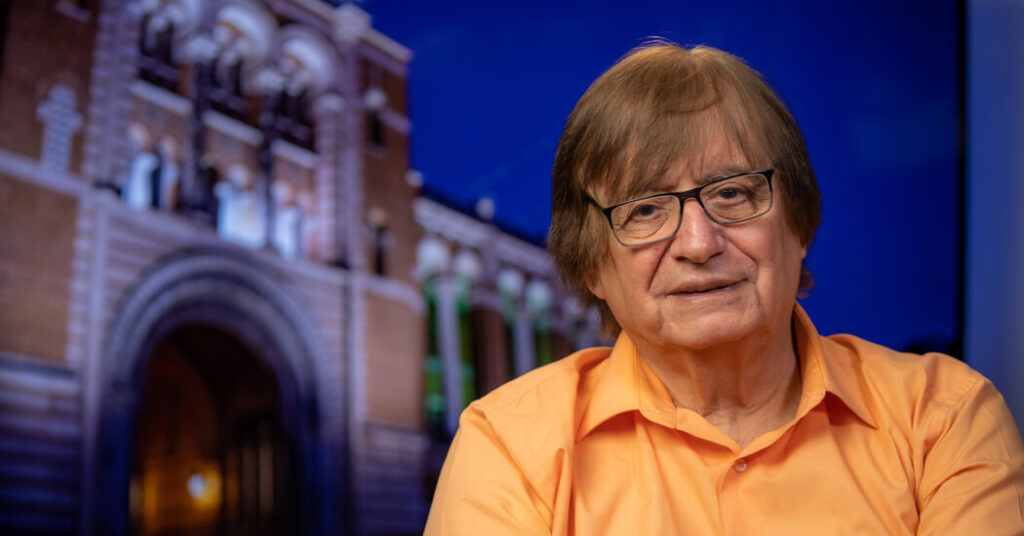
Richard A. Tapia, a Rice University mathematician celebrated within his field for his foundational work in the arcane but vital area of numerical optimization, and celebrated more broadly for his pioneering efforts to create opportunities in math and science for students from underrepresented communities, died on May 22 at his home in Houston. He was 88.
The cause was liver cancer, his brother Steven Tapia said.
“There are a handful of people that have truly shaped the trajectory of Rice University in our nearly 115-year history,” Reginald DesRoches, the school’s president, said in a statement. “Richard Tapia was one of them. Richard’s influence at Rice extends beyond his academic contributions as a world-renowned mathematician, encompassing diversity, advocacy, mentorship and incredible leadership.”
In 2011, President Barack Obama presented Professor Tapia with the National Medal of Science, the government’s highest honor for scientists.
The award recognized his groundbreaking work in numerical optimization, the science of finding the best possible choices out of a wide array of options to solve mathematical problems using numerical algorithms, which led to advances in areas as diverse as designing drug treatments and running chemical plants.
Professor Tapia’s “pioneering work has subsequently influenced modern approaches to transportation, supply chain management, finance and artificial intelligence,” Andrew Schaefer, a fellow professor in the university’s computational applied mathematics and operations research department, said in an interview.
But those technical achievements cannot be “disentangled from his advocacy work,” Professor Schaefer added, “because it was a core part of his scientific contributions. He gave Ph.D. students chances that no other school was willing to give in the 1970s and ’80s. He was able to identify talent that the rest of the world had neglected.”
Cristina Villalobos, a first-generation Mexican American and a math professor at the University of Texas Rio Grande Valley, said Professor Tapia had been a valuable mentor and an inspiration when she attended a summer program for minorities that he ran in the early 1990s.
“I saw so many Mexican American students, African American students and women,” she said in an interview. “I thought, ‘If they can do it, so can I.’”
Over the years, Professor Tapia oversaw the Rice Graduate Education for Minorities and Empowering Leadership Alliance programs. In 1995, he founded the university’s Center for Excellence and Equity in Education, now the Tapia Center, which he considered a career highlight.
The center provides training in science, technology, engineering and mathematics for middle and high school students through its weeklong summer camps for 400 to 500 young people each year, and also offers professional development for teachers.
For Professor Tapia, the effort was personal. He was raised by immigrant parents who were “very proud of being Mexican,” he said in an interview with Latino magazine. “But I grew up in Los Angeles around mostly non-Latinos, and they would tell us that we were inferior. Here’s my mother telling me we’re the best, and there’s the neighbors and people in school saying Mexicans are lazy and stupid. So I had to fight that stereotype.”
He did, becoming the first in his family to attend college and eventually earning a doctorate in mathematics from the University of California, Los Angeles, in 1967.
During his decades in academia, “I saw that underrepresented minorities needed help,” he said. “I know what it takes, and I started helping.”
Richard Alfred Tapia was born on March 25, 1938, in Santa Monica, Calif. He and his twin brother, Robert, were the eldest of five children of Amado Tapia, a horticulturist, and Maria Magdalena (Angulo) Tapia, who ran a nursery and garden supply store.
Richard was the top math student at Nathaniel Narbonne High School, in what is now Lomita, in the South Bay area of Los Angeles County. After graduating in 1956, he briefly worked at an automobile muffler factory.
Cars were a lifelong passion. He was a hot-rod enthusiast in his teens and later helped build dragsters for his twin brother, who set records as a celebrated top fuel racer.
Professor Tapia also loved to customize cars; his tricked-out 1970 Chevrolet Chevelle earned top honors at auto shows in Houston and San Antonio. He married his passion for digits with his love of gears in a lecture he often delivered: “Math at Top Speed: Exploring and Breaking Myths in the Drag Racing Folklore.”
After earning an associate degree at Los Angeles Harbor College, he moved on to U.C.L.A., where he received a bachelor’s degree in mathematics in 1961, a master’s degree in 1966 and his Ph.D.
He taught at U.C.L.A., Stanford University and the University of Wisconsin, and then in 1970 joined the faculty at Rice, where he eventually attained the title of university professor — one of only 11 in the school’s history.
In 1972, Professor Tapia started the Rice Association of Mexican American Students. Two decades later, he became the first American-born Latino to be elected to the National Academy of Engineering.
He wrote or co-wrote more than 100 papers and, with his Rice colleague James R. Thompson, published two important textbooks in his areas of research. He also published a memoir, “Losing the Precious Few: How America Fails to Educate Its Minorities in Science and Engineering,” in 2022.
In addition to his brother Steven, Professor Tapia is survived by a sister, Rebecca Tapia; a son, Richard Tapia; and a daughter, also named Rebecca Tapia. His daughter Circee Lynn Tapia died in 1982; his sister Ana, in 2009; his twin brother, in 2020; and his wife of 63 years, Jean (Rodriguez) Tapia, in 2022.
Founding the Tapia Center, he told Latino, was not merely something he wanted to do — it was something he felt compelled to do: “I had to start it because it was good for the country.”
The point, he added, was “not just to improve representation, but give it credibility.”
His own accomplishments helped boost that credibility. “If you win the National Medal of Science,” he said, “you can’t be a total turkey.”
The post Richard Tapia, Mathematician Who Pushed to Diversify His Field, Dies at 88 appeared first on New York Times.