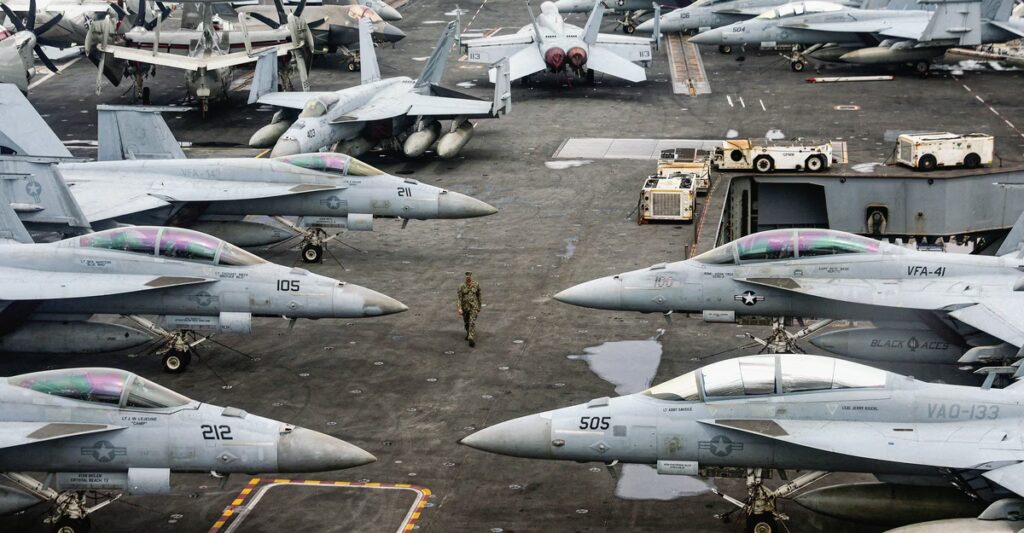
Given the challenges the Pentagon faces with Iran, Russia, China, and the southern border, one might assume that granting it $1.5 trillion—that’s trillion, with a t—in annual funding could only strengthen America’s overstretched military. “President Trump’s historic defense budget guarantees that we keep our competitive edge across every sector,” Defense Secretary Pete Hegseth says in a video posted on his Facebook page. But, much like the lottery winners who haul in mega millions and then see their lives deteriorate, that influx of funding could actually be the worst thing to happen to the Defense Department.
Such overwhelming abundance would allow the president and the Pentagon to postpone the hard strategic choices modern warfare requires. An administration flush with cash can afford the illusion that it can prepare simultaneously for every possible threat—large-scale war with China, attacks by terrorist groups, Russian land grabs in Europe, missile strikes from North Korea, maritime competition in the Arctic, asymmetric warfare with lesser powers—without deciding which missions to prioritize. The windfall would pay for the military to attempt to be everywhere without answering whether the military should be.
The current budget, which has cleared both the House and the Senate Armed Services Committees, calls for more than $1.15 trillion for personnel, weapons, and readiness, up from a $848-billion funding request last year. Separate legislation includes roughly $350 billion in additional funding and a still-unknown amount for the Iran war and to repair damaged U.S. facilities in the Middle East.
The sheer scale of the budget sets up the Pentagon to invest in multiyear contracts that it may struggle to fund in the future should there be less political appetite to spend like there are no limits. And if the budget passes and that elevated base number becomes a permanent fixture, the Pentagon will have to spend more every year than the GDP of 170-plus nations.
The White House argues that the spending surge is needed to modernize the military in a world filled with threats. Democrats have cast the spending, which would dedicate almost 16 percent of federal taxpayer dollars to defense, as a dangerous splurge at the expense of domestic priorities. Even some Republicans—particularly those facing competitive midterm races—have voiced unease over the $73 billion in cuts to nondefense spending that are also part of the package, including to education, energy, and housing.
The administration appears to have calculated that spending on defense instead of domestic programs is a necessary trade-off. During an Easter lunch at the White House shortly after the proposed budget was unveiled, Trump recalled telling the Office of Management and Budget Director Russell Vought, “Don’t send any money for day care because the United States can’t take care of day care. That has to be up to a state. We’re fighting wars, we can’t take care of day care.”
That may not be what American voters want to hear amid skepticism about overseas military missions. An ABC News/Washington Post/Ipsos poll last month found that 61 percent of Americans believe that the decision to use military force in Iran was a mistake. The same poll found that 40 percent of adults feel they are not as well off financially as they were when Trump became president last year, up from 33 percent in February, just before the Iran war started. That war is supposed to end on Friday with the signing of a pact in Geneva that will tee up more comprehensive negotiations over the following 60 days. But at least for now, the U.S. military will remain in the Persian Gulf.
Ukraine and Iran have provided one common lesson about the future of warfare: the importance of asymmetry. In Ukraine, tanks—the backbone of 20th-century armies—have become sitting ducks for drones. Iran may have suffered more than 13,000 missile strikes, but Tehran can claim a victory of sorts from its ability to use cheap drones and fast boats to close the Strait of Hormuz.
Earlier this month, an Iranian drone costing less than $30,000 lodged itself between the two pilots of a $40 million Apache helicopter, leading to the chopper’s crash. (The pilots were then rescued by a naval drone.) The U.S. and Israel often met Iran’s cheap improvisation with multimillion-dollar missiles fired from air-defense systems designed to counter more sophisticated weaponry.
[Read: The glaring oversight in the U.S. war plan]
The proposed budget includes up to $75 billion for drones and autonomous systems that are central to fighting such an asymmetric conflict. But without a clear strategy, a flood of money allows the Pentagon to buy now and decide later what best defends the nation, a potentially wasteful approach. It could also allow the Pentagon to indulge its penchant for bespoke, high-end systems, instead of for the sort of cheap, easily mass-produced drones that have proved so effective in Ukraine.
Defense hawks argue that because the U.S. is facing the greatest period of geopolitical instability since 1945, the imperative is to move boldly and quickly. “Is there a danger of waste? Yes. But does the geostrategic environment require us to sprint because China’s PLA is sprinting? Absolutely,” Bradley Bowman, a senior defense expert at the Foundation for Defense of Democracies, told me, referring to the People’s Liberation Army.
The average U.S. Air Force aircraft is more than 30 years old, making the fleet the oldest in American history and older than many of the airmen at the controls. If Washington wants to deter a conflict over Taiwan or maintain freedom of navigation in the Pacific, the U.S. Navy needs more destroyers, submarines, and other assets—and the means to maintain them. (The budget proposal also calls for more than $65 billion for shipbuilding, a sharp increase from the previous year.) And the Iran war drained U.S. missile stockpiles at a rate that will take years to replenish. In the war’s first few weeks, the U.S. fired roughly 1,000 Tomahawk missiles, but it can produce fewer than 100 annually, Mackenzie Eaglen, a defense-budget expert at the American Enterprise Institute, told me.
Some of the funding would be dedicated to costly traditional systems that already appear out of date before they’ve been built, such as a new Trump-class warship and a new generation of F-47 fighter aircraft (the 47 is a nod to Trump, America’s 47th president). These may be luxuries that only an almost-unlimited budget would countenance.
“We are trying to be the dominant military even though that is no longer an option thanks to technology proliferation and commercialization,” Bryan Clark, a defense expert at Hudson Institute, told me. “And we are also trying to be a more flexible military by fielding a wide array of autonomous systems. You can’t have it both ways.” He added: “The $1.5 trillion creates a false perception that you don’t have to make any choices.”
Clark wrote in a recent paper that the Pentagon itself needs to restructure to be more agile. Nimble is not a word usually used to describe the Pentagon. A 2024 Government Accountability Office report found that the Defense Department needs major digital transformation, including significant changes to processes, policies, the workforce, and technology, among other things.
Over the past year, the Pentagon has started addressing some of those shortcomings, partnering with defense-technology start-ups such as Integrate. In 2025, the Seattle-based company signed a five-year, $25-million contract with the Space Force to improve the management and coordination of space programs. “A lot of investment from the government is going into software to fix a long-running problem around securing real-time, continuous data to inform decision making,” John Conafay, Integrate’s chief executive, told me. But the Pentagon is not there yet. Would it not make sense to have better systems in place before even more money is fed in?
One problem that no amount of money can fix is political inertia. The administration’s request is more than double the official amount the military spent in 2022 and represents a more than 40 percent increase over 2026. But the Pentagon has not always received its funding predictably, making long-term planning and weapons procurement difficult. From 2010 through 2021, the Defense Department started the fiscal year under continuing resolutions—temporary funding measures—for 11 of those 12 years, according to the Government Accountability Office.
The result was a boom-and-bust cycle. Periods of constrained funding were followed by major spending increases, which in turn allowed administrations and Congress to avoid trade-offs and to fund a wide range of programs instead.
At the same time, presidents from both parties have promised to slim down defense spending only to change course once in office. President Biden promised a less militarized foreign policy, one that worked for the middle class. But by the end of his term, he had sent billions of dollars in weapons to Ukraine and Israel and conducted strikes on Iranian-backed groups. Trump promised to focus on threats at the border, to keep U.S. forces out of the Middle East, and to force European allies to take more responsibility for their own defense. But the second Trump administration has so far conducted strikes in Venezuela, Iran, Syria, Nigeria, Iraq, Somalia, and Yemen, with another potential campaign in Cuba. For all the promises to streamline the use of force, “everybody uses the military nonstop,” Eaglen told me.
[Read: So this is what ‘America First’ looks like]
Congress has struggled to pin down the costs of Trump’s most recent use of the military. Only after being asked several times did Jules Hurst, the acting Pentagon comptroller, tell lawmakers at a hearing in May that the price of the Iran war to that point was $29 billion. (By comparison, the entire State Department and other international programs’ annual budget request was $35.6 billion, a roughly 30 percent cut from a year ago.)
The administration has been unwilling to share other key details with lawmakers or the public about the war’s effects, including civilian casualties, the deployment of munitions, and the stress on the thousands of personnel rushed to the region. During last week’s markup of the defense budget, Democrats on the Senate Armed Services Committee pushed for additional transparency. But the upshot is that the White House is asking Congress for unspecified billions for a war Congress wasn’t asked to approve and has largely been kept in the dark about—perhaps not the healthiest environment for the Pentagon to receive record funding.
A 2020 Swedish study of thousands of lottery winners over two decades found that winners were generally happier, because money can buy greater security. But the study also found that huge influxes of money seldom led to a fundamental change in a winner’s mental state. The Pentagon may have drawn a winning ticket, but that’s unlikely to be enough unless it can change the way it thinks, and solve its deeper problems.
The post The Pentagon Might Win the Lottery appeared first on The Atlantic.