Oil prices fell and then rose on Wednesday as investors weighed a preliminary agreement between the United States and Iran amid uncertainty about its provisions.
Traders are hoping the deal, which Iranian and U.S. officials were expected to sign on Friday, would lead to the quick reopening of the Strait of Hormuz. President Trump said he hoped the war with Iran would soon be in the “rearview mirror.” Neither country has publicly released the text of the agreement.
A full recovery of oil flows from the Middle East will take time, the International Energy Agency said on Wednesday, but the eventual surge in crude oil production coupled with weaker global demand could lead to a glut next year.
Oil prices hover below $80 a barrel.
-
The price of Brent crude, the global benchmark for oil, rose less than 1 percent on Wednesday, but stayed under $80 a barrel.
-
West Texas Intermediate crude, the U.S. benchmark, also rose less than 1 percent to around $76 a barrel.
-
Oil prices have slid since the United States and Iran announced the framework of a deal this week, but they are still above prewar levels.
Stocks are listless ahead of Fed.
-
Futures on the S&P 500 pointed to a flat opening when stocks resume trading in the United States on Wednesday ahead of an interest rate announcement by the Federal Reserve, which is expected to hold rates steady.
-
Stocks in Asia were mixed. The Hang Seng in Hong Kong fell less than 1 percent, while the Kospi in South Korea was 1.6 percent higher.
-
In Europe, stocks edged higher. The Stoxx 600, a broad index that tracks the region’s largest companies, was up 0.3 percent.
Gasoline prices fall.
-
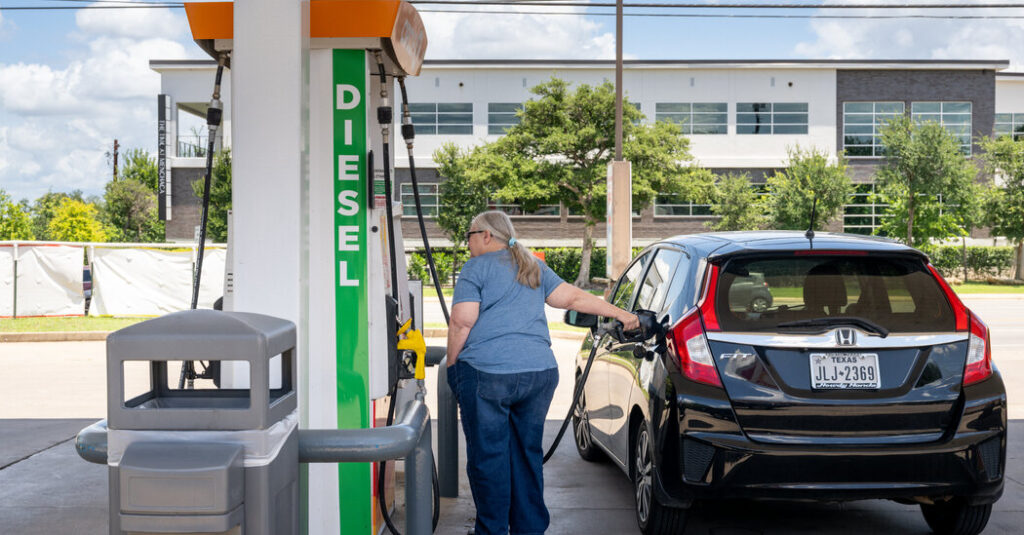
Gas prices dipped on Wednesday, slipping 1 penny to a national average of $4.03 a gallon, according to the AAA motor club. Prices are up 35 percent since the war began.
-
Gas prices don’t move in lock step with crude, usually trailing increases or drops by a few days.
-
The average price of diesel fell to $5.16 on Wednesday, up 37 percent since the start of the war.
What they are saying: “Gradual recovery” for Persian Gulf oil production
-
“If the deal holds, exports and production from the Gulf should see a gradual recovery — not least because Iranian oil exports can fully resume once the US blockade is lifted,” the International Energy Agency said in a report on Wednesday.
-
But a full recovery of Persian Gulf oil shipments will take time, the agency said. “Mines will have to be removed from the main shipping lanes and supply chains will take time to normalize,” it added.
The post Oil Prices Waver as Traders Hope the Strait of Hormuz Will Reopen appeared first on New York Times.