Has there ever been a greater trilogy? The Godfather, monumental as its first two installments are, peters out in Part III. Same with Alien and Terminator. Back to the Future and Indiana Jones more or less land the plane, but the follow-ups never hit the heights of the originals. Richard Linklater’s Before trilogy and Krzysztof Kieślowski’s Three Colors trilogy are masterpieces start to finish, but they lack the operatic scale and mainstream appeal of, say, Star Wars or Lord of the Rings. Those latter two franchises both have a credible claim to the title, but the glut of subpar sequels and spin-offs has diluted their magic. For my money, none of them measures up to Toy Story.
Is this an entirely neutral and clear-eyed assessment? Well, let’s just say that as a child I owned no fewer than nine Buzz Lightyear action figures. This much, though, is beyond dispute: Financially, culturally, artistically—by any metric, really—the original Toy Story trilogy is a triumph. The first movie, released in 1995, practically invented computer animation and became the first animated film to earn a Best Screenplay nomination at the Oscars. The next two installments, out in 1999 and 2010, were just as good. Each ranked among the three highest-grossing films worldwide in the year of its release; Toy Story 3 was the first animated feature to crack $1 billion at the box office. They were successful in part because the films appeal to both children and adults. They are about friendship and existential angst. They combine the prelinguistic appeal of bright colors and physical comedy with a peppering of allusions to Jurassic Park, The Shining, The Wizard of Oz, and innumerable other classics. Taken as a whole, the trilogy captures what it’s like to grow up in all of childhood’s ambivalent complexity.
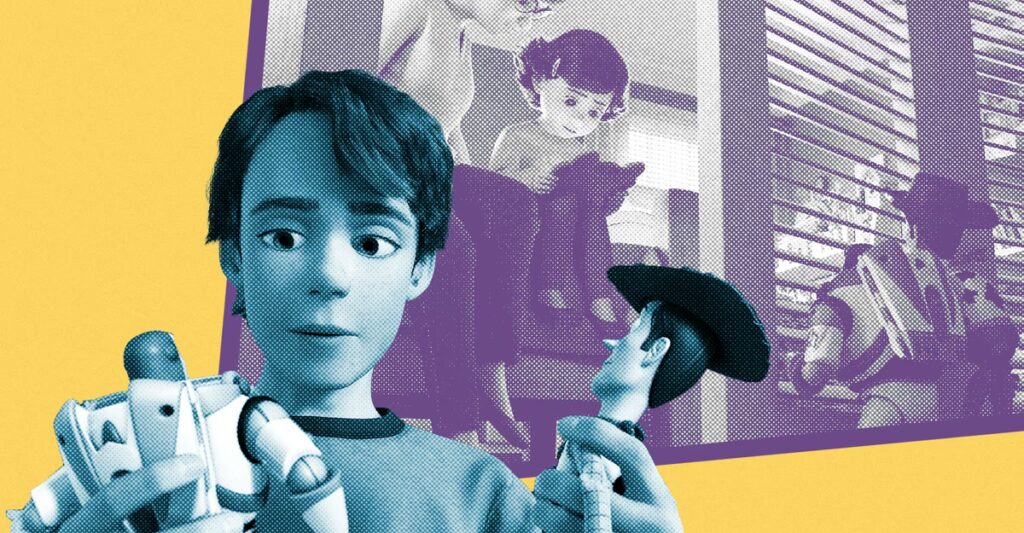
The epic begins with a birthday party. In the opening scene of Toy Story, 6-year-old Andy unwraps a new Buzz Lightyear action figure, and Woody, a mid-century cowboy doll with a sheriff’s badge and a pullstring (“There’s a snake in my boot!”), is forced to reckon with the reality of having been displaced as Andy’s favorite toy. Buzz, meanwhile, with his pop-out wings and red laser gun, must come to terms with the fact that he is not, as he initially believed, a real space ranger. (“You. Are. A. Toy!!!” an exasperated Woody shouts at him.) The characters spend much of the movie’s brief runtime bickering and brawling, but they follow parallel arcs: Both, in their way, must accept that things change and the world does not revolve around them.
Heavy stuff for a kids’ movie—but Toy Story 2 goes even darker. On its face, the second film is a rescue-mission adventure, but it’s also, absurd as this may sound, a meditation on loss, finitude, and mortality. Woody confronts a choice between spending his life behind glass in a toy museum, forever admired by masses of anonymous children, and returning to Andy, who he knows will one day grow up and leave him behind. Whereas, in the original Toy Story, the toys stand for children, here they’re more like parents. “I can’t stop Andy from growing up,” Woody says at the movie’s emotional climax, “but I wouldn’t miss it for the world.”
[Read: The bizarre tragedy of children’s movies]
Saying that when Andy is 8 years old is one thing; facing the reality when he’s 17 is another. “We all knew this day was coming,” Woody reassures his fellow toys at the beginning of Toy Story 3. “Yeah,” Hamm the ever-acerbic piggy bank replies, “but now it’s here!” Andy’s off to college, and the toys have to figure out what that means for them. If Toy Story 2 is about accepting the inevitability of the end, then Toy Story 3 is about experiencing its arrival.
Because the Toy Story franchise is about growing up, it is also, necessarily, about being left behind. In the first movie, Woody has to overcome his fear that Buzz will replace him (a sly metacommentary by a studio that was itself upending the animation industry). The villain of the second, an adult toy-obsessive who steals Woody and nearly ships him to the toy museum, is almost literally stuck in the past: He drives a vintage 1950s car and falls asleep watching old black-and-white newsreels, like nostalgia incarnate. And the third is explicitly about letting go of the things you loved as a child. In the movie’s final scene, Andy gives his toys away to a little girl named Bonnie, then, after playing with them one last time, drives off to college. Buzz and Woody sit side by side on the stoop, watching him go. “So long, partner,” Woody says—to Andy and, it seemed, to us.
No one could have known at the time, but Toy Story 3 marked the end not just of Andy’s childhood but also of Pixar’s golden age. In the 15 years following the release of the original, the studio delivered an unbroken series of classics: Toy Story 2, Finding Nemo, The Incredibles, Ratatouille, WALL-E, Up, and finally Toy Story 3. After that, Pixar still produced some hits—most notably 2015’s Inside Out—but its imprimatur no longer carried the same guarantee. The studio, struggling for the first time to connect with original stories, retuned to the well.
Toy Story 4, which came out in 2019, broke $1 billion at the worldwide box office and also won Best Animated Feature at the Oscars. There’s a lot to love about it. The movie’s animation is so rich that at times it verges on photo-realism; the way it captures the bokeh shimmer of porch lights on wet pavement is genuinely gasp-inducing. And it ventures into new thematic territory, tackling heady metaphysical questions that the original trilogy only gestured at: Where do these toys’ consciousness come from? Where, for that matter, does ours?
In a vacuum, Toy Story 4 is a very good movie. But it exists in a world already graced by its predecessors, and in advancing a new plot and exploring new themes, knocks the original trilogy off its axis.
The Toy Story universe is premised on the idea that toys want more than anything to be played with—that a deep bond with a child is what gives a toy’s existence meaning. “No owners means no heartbreak,” the evil purple teddy bear Lotso assures the other toys as he welcomes them to Sunnyside Daycare at the beginning of Toy Story 3. “We don’t need owners at Sunnyside. We own ourselves! We’re masters of our own fate.” Maybe so, the toys learn, but the love is worth the heartbreak. Toys must throw themselves into the relationship with their child, even though they know that the child will one day leave them behind, and then the toy must do the same thing with another child, and another, and another. Toy Story 4 undermines this core emotional drama of the Toy Story franchise by imagining that toys can simply strike out on their own—that they can be, in Lotso’s words, masters of their own fate. It imagines them less as toys than as people. To me, it will always be non-canon.
[Read: A radical message for a kids’ movie]
The movie’s gravest sin, though, might be its very existence. The arrival of Toy Story 4 signaled that the original trilogy’s success had, in a way, compromised its own message. A story about growing up and leaving your toys behind had shaped a generation that had grown up and now could not leave it behind. Pixar can’t leave its toys behind, either (as the release of the 2022 spin-off, Lightyear—a box-office and critical dud—drove home). Of the four upcoming projects the studio has announced, three are sequels. The first of those, set for release later this week, is Toy Story 5.
I say all of this with the deepest reverence for the Toy Story franchise—and also as a total hypocrite. I’ve seen the first two movies, which came out around the time I was born, dozens of times. As a child in the early aughts, I wore my Buzz Lightyear costume (with wings and all) virtually every day. On a trip to Disney World at age 4, I spotted an animatronic Buzz and shouted, “See, Daddy, I told you Buzz Lightyear was real!” Fourteen years later, as a high-school graduation gift, my parents got me life-size replicas of the main Toy Story toys, and, like Andy, I wrote my name in black marker on the right foot of each one. To this day, “You’ve Got a Friend in Me” moves me at a subcortical level. When it comes to nostalgia, I am not immune.
On Friday, Toy Story 5 hits theaters. The movie, which reunites the gang in a battle against an iPad-like antagonist named Lilypad, has a strong premise, and its dynamic, watercolor-style rendering of playtime is a big step forward animation-wise. But the plot feels overstuffed, the character development rushed, and the themes recycled. The movie works best when it focuses on Jessie, the spunky-but-anxious cowgirl doll introduced in Toy Story 2—this is her story, not Buzz’s or Woody’s. And it delivers one truly great moment near the end that, if you have any investment in the franchise, I challenge you not to cry at. But I wonder whether it will connect for kids. At my screening, parental chuckles far outnumbered kid giggles. On my way out, I heard a mom with two small children tell another parent, “I loved it—it was too spicy for them, though.”
The truth is, no matter how good it was or could have been, a part of me wishes that it weren’t happening. Some things are perfect as they are, and the Toy Story trilogy is one of them.
But I’m not naive. I know that as long as Toy Story movies keep grossing 10 figures, Pixar will keep making them, and I, against my better judgment, will keep watching them. Andrew Stanton, the director of Toy Story 5 and the member of the Pixar braintrust most consistently involved with the franchise, has defended the studio’s decision to continue beyond Toy Story 3. “Nobody’s being robbed of their trilogy. They can have that and never watch another if they don’t want to,” he said in a November interview. “But I’ve always loved how this world allows us to embrace time and change. There’s no promise that it stays in amber.”
We’re not the ones clinging to our toys, Stanton argues. You are! Maybe he has a point. If Toy Story 5 brings joy to a new generation of children, who am I to object because it messes with my beloved trilogy? Much as it offends my principles, I can reconcile myself to the continuation of the franchise—so long as it doesn’t come at the expense of Pixar investing in original stories.
Sometimes, when I’m at my parents’ house, I visit the toys they gave me for graduation, which now live on a bookshelf in my childhood bedroom. As I get them in order—adjusting Woody’s cowboy hat, dusting Buzz’s helmet—I always feel an absurd pang of guilt for keeping them on the shelf, the very place that, in the movies, they most dread.
In these moments, I take some solace imagining that I might one day have a child to share them with. If she wants to play with them, I will let her. And if she wants to make them her own, I will let them go.
The post The Toy Story Franchise Forgot Its Own Message appeared first on The Atlantic.