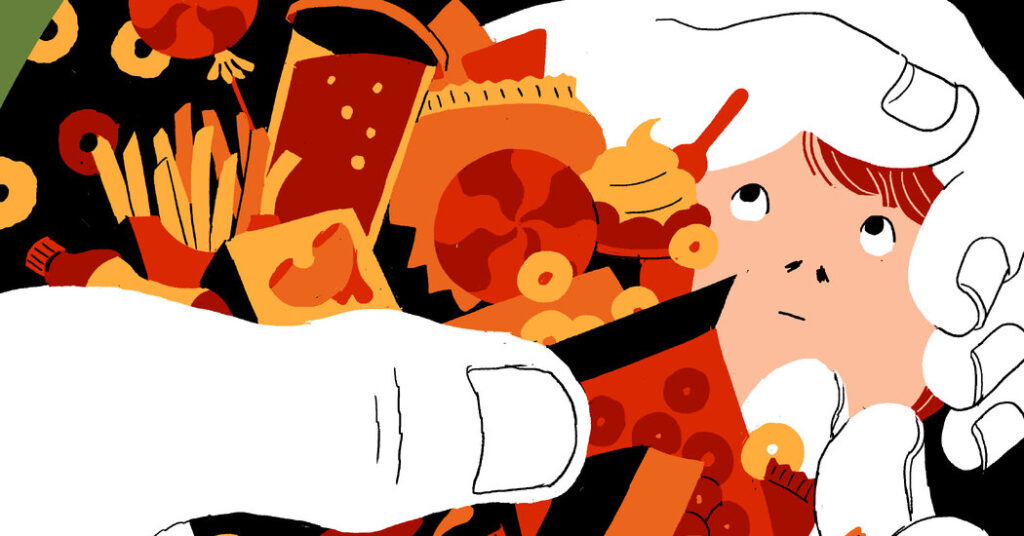
I spent last week close reading a special section of The American Journal of Public Health dedicated to ultraprocessed foods and corporate influence, and talking to some of the researchers behind these articles. While much of this information has been public for decades, seeing it all in one place is sobering, and maddening. As the days wore on and I started looking at the studies, I found myself experiencing the same kind of impotent, disgusted rage that I have felt when reporting on Big Tech.
Big Food and Big Tech know that the products they are marketing to children are not healthy in a variety of ways. Much as Meta, Snapchat and TikTok knew that students were using social media during school hours and did nothing to stop it, the tobacco giant Philip Morris — which owned Kraft Foods from 1988 to 2007 — used the research, development and marketing strategies it honed to sell cigarettes to hook schoolchildren on sodium-and-sugar-laden products.
We know as much as we do about the way the food industry targets kids with unhealthy food because of the trove of documents released by lawsuits against tobacco companies. Some of the papers in The American Journal of Public Health relied on a trove of over 19 million documents released through class action litigation against the tobacco industry and digitized by the University of California San Francisco.
Through her years of work analyzing these documents, Laura A. Schmidt, a professor at the Philip R. Lee Institute for Health Policy Studies at U.C.S.F., discovered that Philip Morris used what the company called “technical synergies” between its tobacco and food products. Her paper in The American Journal of Public Health focuses on the development and marketing of Lunchables.
For those of you who weren’t in elementary school in the late ’80s, Lunchables combine processed meats, cheeses and breads in stackable piles in a plastic tray. These “synergies” included chemical additives and “flavor encapsulation technology,” also used in cigarettes and other packaged foods.
“Philip Morris applied its ‘better for you’ reformulation strategy, first used to create filtered Marlboro cigarettes, to develop Low-Fat Lunchables in efforts to keep consumers worried about childhood obesity loyal to the brand,” in the mid-90s, Schmidt’s paper notes — but these “healthier” Lunchables weren’t much more nutritious than the originals, even if they were lower in fat.
You can see food brands using similar strategies today to appeal to health-conscious, MAHA-adjacent consumers: taking the artificial dyes out of chips and cereals, for instance. But those products often contain other additives that make them “hyper-palatable,” thanks to a combination of sodium, sugar, fat and carbohydrates that also make them easier to overeat.
I had already been frustrated with how difficult it is as a parent to have my daughters consume mostly healthy, nourishing foods, without encouraging restrictive or disordered eating, or making packaged foods some kind of forbidden fruit. I cook at home nearly every night and read food labels before buying anything, and I still feel ill equipped and trapped fighting multiple bad outcomes.
I also know that much of the food outside my home is junk, and I can’t (and don’t want to) control what my kids eat when they’re at friends’ homes or buying their own snacks. A 2023 study published in the journal Nature Communications indicated that “73 percent of the U.S. food supply is ultraprocessed.”
In a Times Opinion guest essay from September, Julia Belluz and Kevin Hall explained that “the root cause of America’s chronic disease crisis” is “our toxic food environment.” The endless array of hyper-palatable and always available foods disrupts our internal signals around satiety. “Our bodies weren’t designed for a calorie onslaught, in the same way a house built for moderate weather isn’t designed for a heat wave,” Belluz and Hall wrote.
Luckily there are a ton of policy ideas that could improve our food environment. George Washington University’s Global Food Institute just released a road map for reducing added sugar in American children’s diets.
These suggestions include asking the U.S. Department of Agriculture to further reduce the cap on added sugar in school and day care food like flavored milk and yogurt, taxing sweetened beverages, restricting the marketing to children of foods with poor nutritional value and encouraging the Food and Drug Administration to finalize a proposed rule that would highlight products that are high in added sugar.
Many people don’t know how much added sugar is in everyday products like breads, cereals and pasta sauces, Priya Fielding-Singh, the director of policy and programs at the Global Food Institute, told me. Without even giving your children dessert, they can exceed the amount of added sugar recommended by the American Heart Association, Fielding-Singh said.
Schmidt, the U.C.S.F. professor, also mentioned improved food labeling as a policy fix that the United States should adopt. First, “we need a regulatory definition of ultraprocessed food,” she said. In the June 12 edition of Helena Bottemiller Evich’s Food Fix newsletter, Evich quotes Robert F. Kennedy Jr., the secretary of health and human services, as saying the definition is imminent and that once it is finalized, “we’re going to go to front-of-package labeling … the model that we’re looking at right now is a red light, green light, yellow light.”
This type of food labeling system, based on the amount of fat, sugar and salt, is in place in some other countries. Green means the food has the lowest levels, yellow is in the middle, and a food labeled red has the highest levels.
However “ultraprocessed” is ultimately defined, the food industry will most likely push back. In West Virginia, a state that was among the first to ban certain artificial food dyes, the International Association of Color Manufacturers sued and successfully blocked the law for the time being.
Though Kennedy has been promising to address ultraprocessed foods for years as a key part of his Make America Healthy Again movement, we have seen him make compromises before when his long-held beliefs conflict with the Trump administration’s business interests.
It is also worth noting that Republican policies are making healthy eating more expensive, and potentially out of reach for the poorest Americans. “The House of Representatives recently passed legislation proposing to cut $141 million from the vegetable and fruit allowance in the Special Supplemental Nutrition Program for Women, Infants and Children,” the Bloomberg columnist Abby McCloskey wrote on Monday, showing that Kennedy’s “eat real food” slogan will “ring hollow” if few can afford it.
Still, awareness of the downsides of ultraprocessed foods is rising. A majority of Americans surveyed, regardless of political party, said they believe that food companies should have to label ultraprocessed foods, be transparent about their harms and reduce the amount of sugar and salt in their products. “People in the United States broadly believe that U.P.F.s are harmful and addictive and are aligned in support of a variety of potential regulations,” the survey’s authors note.
We know the problem. We know the solutions. We just need our federal government to actually work for us.
End Notes
-
In 2021, I interviewed Priya Fielding-Singh about her book “How the Other Half Eats: The Untold Story of Food and Inequality in America.” She followed families from different socioeconomic brackets about their eating habits and how they were affected by their financial situations, their cultural practices and the judgment of other parents. “It becomes so difficult to navigate a world where there is so much advice, so much prescriptive guidance about the right way to feed, sometimes it feels like there are only wrong answers,” Fielding-Singh told me almost five years ago, and that hasn’t changed.
-
I am really enjoying the comedian Rosebud Baker’s new memoir, “Fully Baked.” It’s raw while still being funny, just like her standup. She doesn’t shy away from expressing grief, whether it is about her younger sister’s death or her miscarriages. But she still manages to eke humor out of the darkness, without making it seem that she’s tying it up in a tidy bow (the subtitle of her book, “A Messy Memoir,” is apt).
Feel free to drop me a line about anything here.
The post The Deck Is Stacked Against Healthy Eating appeared first on New York Times.