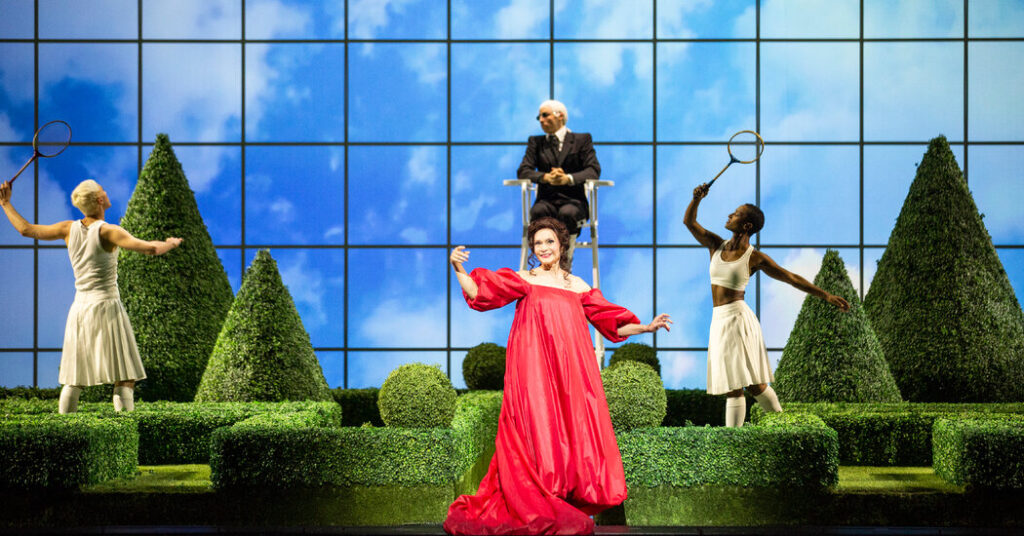
Puffy clouds float serenely across a blue sky on a screen at the front of the huge stage at the Opéra Bastille in Paris. When it rises, we see the flashy boudoir of a large-bellied man, singing of his desire for a young woman. Footmen — Karl Lagerfeld look-alikes with white-haired ponytails and dark glasses — serve him hamburgers from silver domes. A glamorous woman appears and tells him she understands perfectly; why shouldn’t he have what he wants?
A new contemporary opera drawing on events of our time?
Not at all.
This is the beginning of Antonia Bembo’s “Ercole Amante” (“Hercules in Love”), an almost unknown opera from 1707 by an almost unknown composer, written for Louis XIV but given its fully staged premiere more than 300 years later, at the Paris Opera last month. (That was two days later than scheduled after a strike by Opera personnel forced the cancellation of the opening night.)
“Ercole Amante” tells the tale of the aging demigod Hercules, who lusts after his son’s fiancée, Iole, and, aided by the goddess Venus, plans to marry her and abandon his wife. The goddess Juno steps in to protect Iole and appropriately baroque plotlines ensue.
The story of the Venice-born Bembo is just as drama-worthy as Hercules’ affairs of the heart. Schooled in music and voice by Francesco Cavalli, the most important Venetian opera composer of his time, Bembo, an accomplished singer, was married to an abusive nobleman whom she sued for divorce before seeking refuge at the court of Louis XIV in Paris.
Forty-five years before Bembo’s opera, Cavalli had written an “Ercole Amante,” a commission to celebrate Louis XIV’s marriage to Maria Theresa of Spain.
“That is usually performed as a spoofy comedy,” Netia Jones, who directed the Paris production of Bembo’s opera, said in a video interview. “No one seems to have any problem with the idea of this old man wanting to seduce a young woman. But for me that is central, and related to the life Antonia Bembo lived; she did not have a great time with men.”
Why Louis XIV asked Bembo to write a version of the story decades later, using the same libretto, by Francesco Buti, remains a mystery.
“I think the king, who had a great artistic sensibility, wanted something different, something new,” said the Argentine conductor and Baroque specialist Leonardo García-Alarcón, who discovered the score in the Bibliothèque Nationale in 2014. “He was near the end of his reign, perhaps it was a kind of mirror to his life.”
Another mystery is why it was never performed in Bembo’s lifetime. (She died in 1720.) Speaking in French in an interview in his dressing room before the opera, García-Alarcón said that perhaps at that point in Louis’s reign, there weren’t the means to produce the huge spectacle that Bembo had envisioned. “But who knows,” he said.
García-Alarcón said he had been researching a musical program based on Louis XIV’s life, when he found a reference to the king’s commission to Bembo. After some sleuthing, he found the vellum-bound score in the Bibliothèque archives.
“I have found many scores by unknown composers,” he said, “but this is the biggest surprise I have ever had.”
Bembo wasn’t entirely unknown to García-Alarcón, but he had never heard of this opera. “When I examined the score, I realized it was a masterpiece,” he said, “with a singular style that melded both French and Italian genres of the time.”
His enthusiasm about the score reverberated in music circles: “Ercole Amante” was performed in small concert versions by Il Gusto Barocco in Stuttgart in 2023, and by Ars Minerva in San Francisco in 2025.
In a meeting with Alexander Neef, the director of the Paris Opera, about future collaborations, García-Alarcón played him extracts from Bembo’s opera without disclosing the composer. “I could see he was surprised by the bel canto aspect of the music, but really liked it,” García-Alarcón said. “When I told him it was a female composer, commissioned by Louis XIV,” he said, ‘If the former boss of the Opera wanted this, we must do it!’” (Louis founded the Opera in 1669.)
In a telephone interview, Neef said it was immediately clear to him that it was “a special work, merging Italian and French influences in a way I had only heard in Charpentier’s ‘Medée’; it was rich, inventive, and it wasn’t hard to convince me.”
Neef and García-Alarcón approached Jones, an associate director at the Royal Opera in London, known for her use of multimedia and for designing her own sets and costumes.
“It’s not every day you get a call about a forgotten female composer,” Jones said, adding that Bembo is “only the second woman composer to be performed at the Paris Opera” in the modern era.
Jones said she was wary at first of García-Alarcón’s suggestion that the piece be staged at the modern Opéra Bastille, rather than at the ornate Palais Garnier. “Then I realized it was a very good idea,” she said. “The Cavalli version was created in the Salle de Machines, a huge, cavernous space using new theater technology, and Bastille leans to that. I liked that bridge between what is high tech now and then.”
She added: “I was always going to do something contemporary with this. I believe in Diderot’s comment that theater should reflect the world we live in.”
At the same time, she said, “Ercole” comes from the Baroque era with its very particular aesthetic: “It’s a spectacle opera, very much a two-dimensional world. Presentation rather than representation, with a mix of what the Italians call affetto — emotional intensity — and French elegance. It’s the opposite of naturalism, but it’s truthful.”
Her production uses projections and multiple screens as well as stylized décor, first setting the aging, balding Hercules against huge statues of his muscular, youthful self; later, the action and sports-themed dances — badminton, fencing, wrestling — are in a formal French garden; near a tower in the middle of the sea; and in a gloomy underground tomb. (The choreographer is Maud Le Pladec.)
The five-act opera has “eight scenarios, eight scene changes,” Jones said. “Bembo would have been thinking about the Salle de Machines and its capacities; she has put in directions like ‘goddess comes down from the sky.’ It’s very authentic to have this modern version of these dynamic technologies; the moving scenery, things flying, coming up from the floor.”
With the projections, she added, she could refer to the visual language of Baroque art. “Some of the most beautiful paintings and wall paintings of the time are of the sky and the sea,” she said. “That was front and center in imagining the visual world of ‘Ercole.’”
So were the themes of coercion and consent.
Jones acknowledged that this was a contemporary perspective. “We can’t have any idea what Bembo was thinking,” she said. “But the challenges of being a woman in a man’s world have not gone away, and an opera only exists in the live moment. And this one has a central theme that is actually in the news.”
Ana Vieira Leite, who plays Iole, said in a telephone interview that the opera’s feminist themes were constantly discussed in rehearsal. “Iole becomes the object of Hercules’s obsession,” she said; “he is the source of a terrible abuse of power.”
Andreas Wolf, the bass-baritone who plays Hercules, was drawn to the opera’s fascinating history. “The interesting part came later when I met Netia and learned I needed to look like Gérard Depardieu and wear a fat suit,” he said with a laugh. “Let’s say it was a process to get used to.”
The performers interviewed said that the music wasn’t particularly difficult to sing. (At least without the fat suit, Wolf added.) “The biggest challenge,” said Julie Fuchs, who plays Juno, “is to make every word of the Italian libretto, which is quite archaic and poetic, really articulated and understood.”
Wolf added that the volume of recitative — lines sung with the rhythms of ordinary speech — made it harder to show the development of character. “From a singer’s point of view, it’s nice to have time to express yourself in long arias,” he said. “There isn’t so much of that here, although there are beautiful moments.”
Reviews of the Paris production were divided. In Libération, Lucile Commeaux praised both the score — “virtuosic, full of musical ideas and playful elements” — and the production: “This version of ‘Ercole Amante’ really delivers by laughing at the heroes and their useless phalluses, and handing the power to the goddesses, queens and princesses of history.” In Le Figaro, Christian Merlin wrote: “Certainly some of the composition is astonishing. But the recitatives are (very) long and the construction is diluted, without the dramatic tension created by Bembo’s teacher Cavalli, in his unforgettable ‘Ercole.’”
García-Alarcón defended Bembo’s importance in the Baroque pantheon.
“Perhaps because Bembo was a singer, she deploys the coloratura techniques that we associate later with Handel,” he said. “We get the harmonic richness of the French style — the overture, the ballets — merged with the rhythmic complexity and virtuosity of the Italian forms that sometimes recall Bellini.”
He added that after the death in 1687 of Jean-Baptiste Lully, considered the founder of French opera, “everyone kept imitating him, nothing was original until Rameau 30 years later. Between them now is Antonia Bembo.”
The post This Opera Written for Louis XIV Feels Ripped From the Headlines appeared first on New York Times.