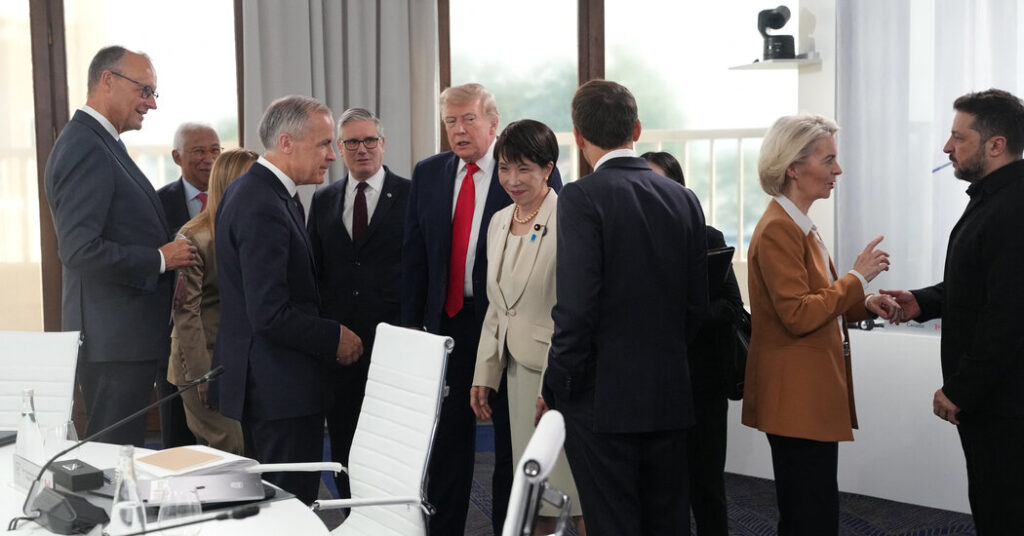
A Group of 7 summit is, by nature, one of the world’s most exclusive clubs. But each of the leaders has come to this week’s summit in France bearing their own burdens and pressing their own agendas.
Here is a look at the leaders who are there representing seven advanced industrial nations, as well as others who were invited:
-
President Trump: Facing bleak poll ratings and a tough midterm election, he wants to turn the page on the Iran war and its economic fallout. His preliminary agreement with Tehran is a start, but he faces questions about the details.
-
President Emmanuel Macron of France: The French president, who is hosting the summit on the south shore of Lake Geneva, is in legacy-building mode. Politically hamstrung at home, he is eager to roam the global stage in his final year in office, calling for Europe to seek “strategic autonomy.”
-
Prime Minister Keir Starmer of Britain: He may be out of a job within weeks. A by-election could turn his Labour Party rival, Andy Burnham, into his replacement. Mr. Starmer hopes to remind Britons watching at home that he is a steady pair of hands.
-
Prime Minister Giorgia Meloni of Italy: She once benefited from her reputation as a Trump whisperer. Now that’s a liability at home, where Mr. Trump is deeply unpopular. She is moving to distance herself from him.
-
Chancellor Friedrich Merz of Germany: He started the day on Tuesday by giving Mr. Trump a German soccer jersey with the number 47, a friendly gesture to win favor. He needs it: Mr. Trump pulled some U.S. troops from Germany after Mr. Merz criticized the Iran war.
-
Prime Minister Mark Carney of Canada: Mr. Carney is on a roll. His speech at the World Economic Forum in Davos in January, in which he talked about “middle powers” hedging their bets in a post-American world, has made him a thought leader among the Group of 7.
-
Prime Minister Sanae Takaichi of Japan: Still basking in her landslide election victory last fall, Ms. Takaichi is also on firm footing. But the closure of the Strait of Hormuz because of the Iran war has sorely tested energy-dependent Japan. She wants to talk about energy security.
Other leaders
Some leaders from outside the Group of 7 are also invited to the annual summits. Among those in France are:
-
President Volodymyr Zelensky of Ukraine has benefited from his country’s resilience on the battlefield with Russia. He came to France hoping to translate that into renewed support from Europe, and perhaps even persuade Mr. Trump to re-engage in talks seeking to end the war.
-
President Abdel Fattah el-Sisi of Egypt is attending his first Group of 7 meeting with the status of a leader from a full partner country. It’s a validation of the role Egypt played in mediating the cease-fire in Gaza last year between Israel and Hamas.
-
Prime Minister Narendra Modi of India, who is expected to meet with Mr. Trump on Wednesday, represents the interests of the “global south” at this gathering. But issues like climate change and global development are on the margins, with Iran and Ukraine consuming most of the oxygen.
-
Sheikh Tamim bin Hamad Al Thani of Qatar welcomed news of an initial U.S. deal with Iran, given that Qatar has been targeted by Iranian missiles. Now it will be one of several Persian Gulf states responsible for rounding up investment to help repair wartime damage in Iran.
-
Sheikh Mohamed bin Zayed Al Nahyan of the United Arab Emirates is likely to be as relieved as his neighbor in Qatar by a possible end to the war with Iran. He will face a changed landscape in the Persian Gulf if a U.S.-Iran peace deal takes hold.
The post Who Are the Leaders at the G7 Summit in France? appeared first on New York Times.