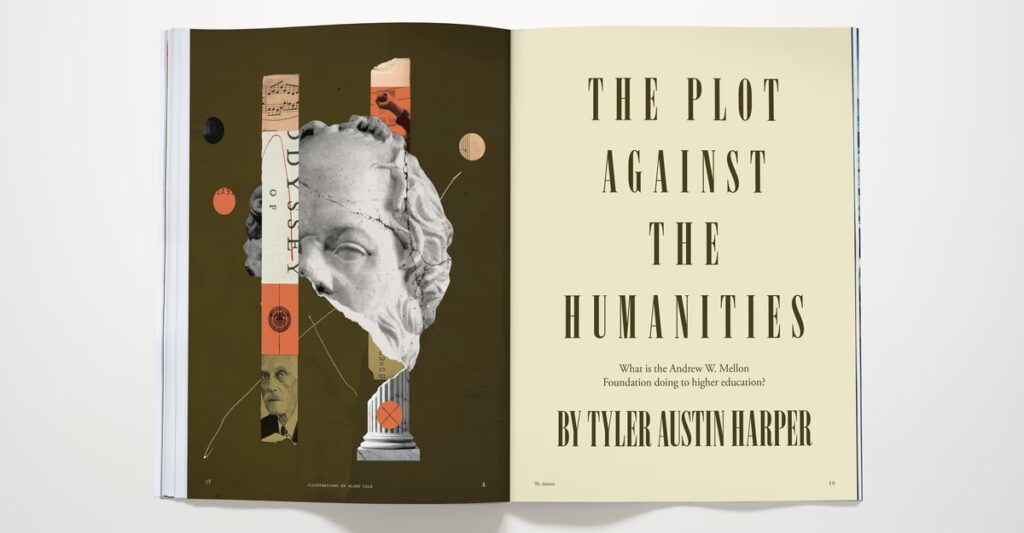
The Plot Against the Humanities
In the March issue, Tyler Austin Harper considered what the Andrew W. Mellon Foundation is doing to higher education.
Thank you to Tyler Austin Harper. Though certainly critical of the Andrew W. Mellon Foundation, his story hit upon a deeper problem facing the humanities: our culture’s insistence on things of immediate “worth,” and the Faustian bargain the humanities made in an attempt to prove that they were one of those things.
Lane Sunwall Mequon, Wis.
Tyler Austin Harper suggests that the Mellon Foundation has yoked arts and letters to the wagon of social justice, subordinating pure inquiry to political fashion. But there never was a “golden age” in which scholarship floated above the turbulence of history. Universities were built alongside empires and on the backs of the working class. Libraries were endowed by industrial fortunes and the robber barons. Canons of literature were curated by gatekeepers who mistook their vantage point for universality. The “neutrality” that Harper mourns was not the absence of politics; it was the comfort of an unexamined center.
To ask who was excluded from that center is not to corrupt the humanities; it is to practice them. Harper treats “social justice” as though it were a contaminant, a solvent dissolving rigor into activism. Yet what is literature if not a sustained inquiry into injustice and freedom? What is philosophy if not a struggle with power and responsibility? What is history if not the patient excavation of conflict, suffering, aspiration, and revolt? Frederick Douglass did not separate moral clarity from intellectual seriousness. Albert Camus did not believe that lucidity required indifference. Both understood that describing the human condition honestly is a first step in confronting injustice. Scholarship that refuses this confrontation is not neutral—it is evasive. The anxiety that expanding representation will displace Lincoln or Washington betrays a curious fragility. Greatness does not diminish when others are acknowledged. Monuments, syllabi, grant priorities—these are not sacred relics but civic choices. They announce whose stories are worthy of endurance. If those choices change, it is not evidence of conspiracy. It is evidence that democracy is still alive enough to argue with itself.
Harper is right about one thing: The humanities are at a precipice. But the danger does not arise when foundations ask scholars to engage with the wounds of the nation. The danger arises when the humanities retreat into a nostalgia for an authority they once possessed and mistake that authority for truth. A field that studies the human condition cannot afford to fear the full humanity of its subjects. The humanities will survive not by defending an imagined past of disinterested purity, but by demonstrating their necessity in a fractured republic. They survive when they clarify rather than obscure, when they widen rather than narrow, when they refuse both dogma and denial. There is no plot against the humanities. There is only the perennial struggle over what it means to be human—and who gets to say so. And that struggle, uncomfortable though it may be, is the humanities themselves.
Rafael C. Castillo San Antonio, Texas
In recent years, more and more students from lower-class families have been able to attend universities. I suggest that this may be part of the reason fewer students are studying the humanities. We don’t have family businesses for our kids to inherit. Our kids need to find a job that pays the bills; they don’t have the luxury of getting an education for education’s sake. Encouraging kids to choose STEM- and business-related majors just makes sense for the changing student body.
Rosie Gaede Oak Hills, Calif.
I read Tyler Austin Harper’s article on the Mellon Foundation with a mixture of recognition and exasperation. I lead a local family foundation. Harper’s argument resonates with all of us who work in private giving. The argument is not really about Mellon—it is about America.
American culture struggles to value anything not immediately and aggressively useful. We live in a society that financializes nearly everything it touches. Art, scholarship, democracy itself—all are subject to the quarterly-earnings logic. That is a genuine cultural sickness. But the cure is not to demand that one private foundation become the counterweight to three centuries of capitalist common sense. That expectation asks the impossible and, more important, asks it of the wrong party.
Private institutions are entitled to set their own missions and follow their own values. If we find that troubling, and perhaps we should, the answer is a more just and equitable public infrastructure for culture and learning, not a set of obligations imposed on private grant-makers. Ironically, building that infrastructure is precisely the kind of work that would likely attract Mellon funding.
Mellon’s president, Elizabeth Alexander, has said that the foundation’s mission is oriented toward a “more fair, more just, more beautiful society.” That that idea is somehow political is troubling. Only within the logic of an authoritarian or deeply reactionary culture can justice and beauty become controversial aims. If we have arrived at a moment when equity is coded as ideology, that is the emergency—not Mellon’s program priorities.
Jennifer Koladycz Beatty Seattle, Wash.
I was a grant administrator at an Ivy League school and am currently the director of a conservation nonprofit. I am always surprised at the amount of progressive orthodoxy and lip service required for successful funding acquisition.
To be clear, I find the pursuit of social justice to be a worthy cause. But does every grant request for research or poetry or land preservation need to include a stated commitment to equity and inclusion?
Riley Schwengel Sloatsburg, N.Y.
Tyler Austin Harper is right to worry about the collapse of support for the humanities. But his critique of the Mellon Foundation’s emphasis on social justice turns a structural crisis into a zero-sum grievance—as though funding historically undersupported fields must come at the expense of “real” humanistic inquiry. That framing is backwards. The deeper emergency is the long retreat of public investment, the market logic governing higher education, and the evaporation of a diverse philanthropic ecosystem. In that landscape, Mellon’s choices do not “control” the humanities so much as reveal how precarious they’ve become.
Ann Jacobs New York, N.Y.
Tyler Austin Harper replies:
For years, progressive academics have defended the naked politicization of their curricula by countering that “everything is political”—that there is no neutral, ideology-free way to run a university or produce knowledge. This is certainly true—and a rather banal truism. When 20th-century English professors taught syllabi with no novelists of color or women, they were driven by ideological biases, and I do not wish to return to a world in which such syllabi are de rigueur. But there is a difference between recognizing that the academy cannot be truly apolitical and deciding—as the Mellon Foundation has done—that the most valuable forms of scholarship are those that instrumentalize knowledge in the service of direct political impacts.
Behind the Cover
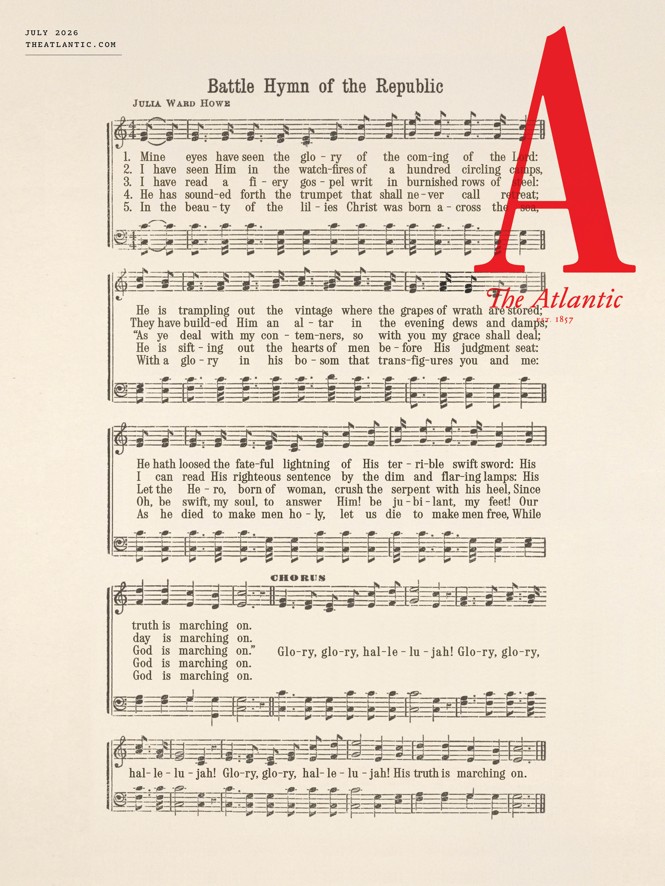
This month’s cover features sheet music for “Battle Hymn of the Republic,” by Julia Ward Howe. The poem was originally published in the February 1862 edition of The Atlantic. As the staff writer Jake Lundberg writes in this issue, Howe composed the poem as new lyrics for the Union marching song “John Brown’s Body.” The “Battle Hymn” itself soon became an unofficial anthem of the Union Army, and its rousing chorus has inspired movements for freedom and liberty ever since.
A Note to Readers
This issue marks the end of the 22-puzzle run for the “Caleb’s Inferno” crossword. We owe a special thanks to Caleb Madison and his editor, Kelsey Dixon, who together provided readers with devilishly difficult puzzles on the magazine’s back page. To keep up with The Atlantic’s crosswords, and to explore other games, visit TheAtlantic.com/Games.
Correction
“I Found It: The Best Free Restaurant Bread in America” (May) included an imprecise allusion to Willy Wonka candies. The article suggested that the Everlasting Gobstopper can convey the sensation of eating an entire meal in every bite. In Roald Dahl’s Charlie and the Chocolate Factory, it is a chewing gum that offers the sensation of eating an entire meal, not the Everlasting Gobstopper, though a real-life candy called the Everlasting Gobstopper does feature multiple distinct flavors.
This article appears in the July 2026 print edition with the headline “The Commons.”
The post The Humanities Were Never Neutral appeared first on The Atlantic.