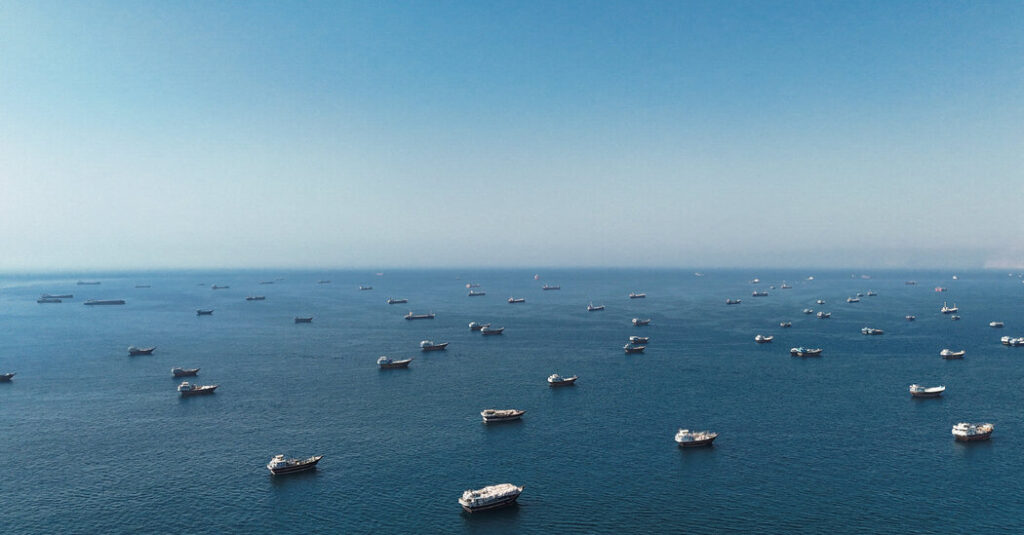
Even as the United States tries to negotiate an end to the war with Iran and open the Strait of Hormuz, President Trump said the U.S. military had been helping ships and oil move through the crucial waterway.
But while the United States appears to be doing more to get ships through the strait, its efforts have not led to a big recovery in shipping traffic.
The number of ships passing through the strait every day is still far lower than it was before the war with Iran began. And the volumes of oil apparently going through are also well below prewar totals, according to independent tanker tracking firms.
The conflict escalated this week before the United States and Iran appeared to move closer to reaching a cease-fire deal that would open the strait and end the U.S. naval blockade on Iran.
Abbas Araghchi, the Iranian foreign minister, said in a live televised address to the country on Friday that the agreement with the United States was in its final stages. Mr. Araghchi said that although all commercial ships would be guaranteed safe passage through the strait, Tehran would maintain its control of the waterway and eventually charge a “service fee” for vessels passing through — an arrangement the Trump administration has opposed.
From the start of the war, Iran has used threats and attacks to deter ship operators from sending their oil and gas tankers through the strait. As ship traffic dwindled, the supply of oil to the world declined, causing gasoline and diesel prices to soar. As long as Iran can suppress tanker traffic, and keep fuel prices uncomfortably high, it has leverage against the United States. And that leverage has increased as global stockpiles continue to decline.
In early May, Mr. Trump announced a military operation, Project Freedom, to assist ships going through the strait, but soon ended it, partly because of objections from Saudi Arabia. Since then, U.S. Central Command has guided ships through but has stopped short of providing a naval escort.
In a social media post on Wednesday, Mr. Trump said more than 200 commercial vessels had traveled safely through the strait.
“This wildly successful effort is because the UNITED STATES of AMERICA CONTROLS the Strait of Hormuz — NOT Iran,” Mr. Trump said.
A senior U.S. military official confirmed that number, and said the passages had taken place over roughly five weeks.
This suggests that some six ships a day went through with coordination by the United States. Before the war, around 130 vessels passed though each day.
It is close to impossible for independent ship tracking firms to check the U.S. totals, because the ships are turning off their tracking devices when going through the strait with American support. (The ship tracking firms have other ways of following vessels, but those methods can take longer to complete.)
Mr. Trump also said the U.S. effort had resulted in more than 100 million barrels of oil going through the strait. He did not say when the shipments took place, and a White House spokeswoman did not provide the dates when asked.
Assuming the oil shipments occurred over five weeks, the period provided by the U.S. official, they would work out to nearly three million barrels a day. Before the war, roughly 18 million barrels were being shipped through the strait per day, according to Dimitris Ampatzidis, a maritime risk and compliance manager at Kpler, a ship tracking company.
A U.S. military helicopter was downed on Monday in the strait. A U.S. official said it had been on patrol, not guiding ships. Still, the episode showed the risks that U.S. forces might face when helping ships get through, and some analysts said the relatively small amount of oil getting through may not justify the dangers involved.
“It’s a risky trickle,” said Rosemary Kelanic, a director at Defense Priorities, a research organization focused on foreign affairs.
Iran has sought to establish itself as the controller of ship traffic in the strait, by requiring that ship operators gain Tehran’s permission to pass. Some vessel operators, eager to get their ships out of the Persian Gulf safely, have complied and taken routes through the strait that run close to Iran’s coast.
This month, Iran said more than 300 non-Iranian ships, mostly tankers, had requested safe passage through the strait since early May. Separately, Kpler estimated that, of the 895 crossings of the strait from March 1 to May 19, just over half were done on the Iran route.
To loosen Iran’s grip on the strait, the United States set up a blockade in mid-April against Iranian and Iranian-linked ships, aiming to prevent the country from exporting oil through the waterway.
From the start of the war until the blockade, Iran was exporting significant amounts of crude through the strait, and far more than any other Gulf state. In that period, around 1.9 million barrels of crude a day were going through the waterway, three-fourths of which were from Iran, according to data from Vortexa, which tracks energy shipments.
From mid-April until June 1, the shipments fell to 1.2 million barrels a day, as Iran’s exports plunged and those of some Gulf states increased, according to Vortexa’s data.
While the blockade seems to be working, the data indicate that it is causing less Gulf oil to get out through the strait, aggravating the global crude shortage.
“Blockading Iran and preventing their oil from coming to the market hurts the whole market,” Ms. Kelanic said.
In enforcing its blockade this week, U.S. forces struck a tanker. India’s shipping minister said three Indian seamen on the tanker had died.
“The crew repeatedly failed to comply with directions from U.S. forces,” said Capt. Tim Hawkins, a Central Command spokesman. “We issued warnings prior to the disabling shots.”
Eric Schmitt and Farnaz Fassihi contributed reporting.
The post Even With U.S. Help, Little Oil Has Gone Through Strait of Hormuz appeared first on New York Times.