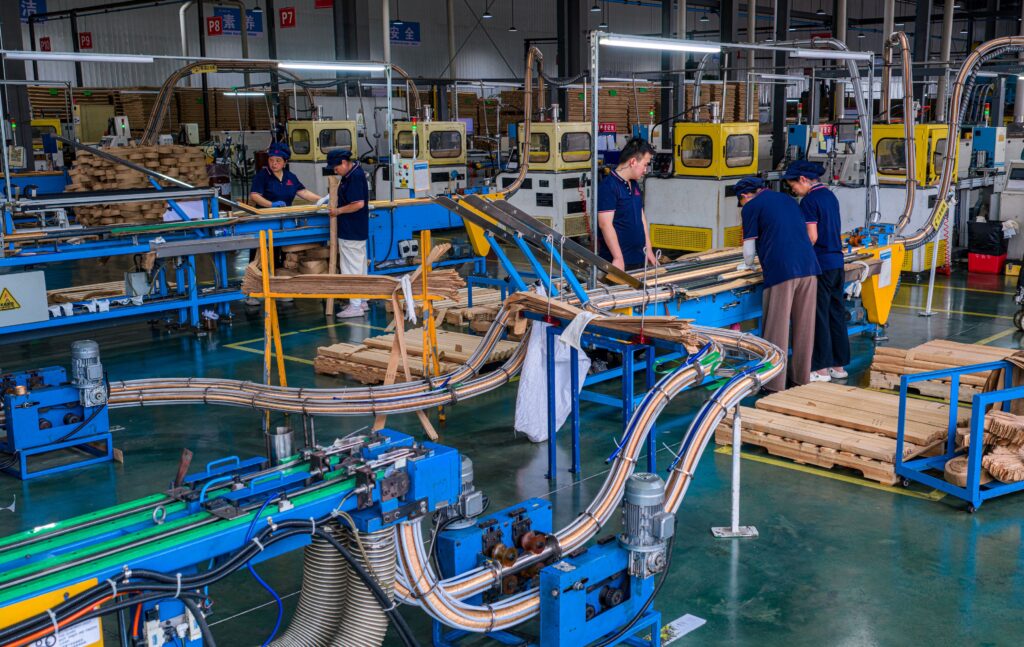
Hundreds of millions of blue-collar workers were the backbone of China’s astounding economic rise through the 1990s and 2000s, enabling the country to post year after year of double-digit economic growth.
Those workers are now being left behind.
Blue-collar laborers, in interviews with The Washington Post, described a shift precipitated by many factors: a top-down decision to automate Chinese manufacturing, the offshoring of many jobs to countries with even cheaper labor and a sharp falloff in demand for construction workers amid a years-long real estate crisis.
The Chinese economy, once powered by low-cost labor, has become highly unbalanced, with aggressive high-tech innovation masking deep domestic pain for the ordinary workers — many drawn from rural, impoverished villages in the countryside — who built the world’s second largest economy.
The hollowing out of the blue-collar class and rise of China’s technological prowess has led to a striking statistic: Under the rule of the Communist Party, according to some measures, income inequality is greater in China than the United States.
The high levels of inequality and unemployment are contributing to the view among some analysts and experts that China will never surpass the United States as the world’s largest economy by nominal GDP.
“You would think, given that the GDP has more than doubled in the past 10 years, that the lives of blue-collar workers and white-collar workers would be substantially better today than 10 years ago,” said Victor Shih, a professor of Chinese politics at the University of California at San Diego. “I just don’t get a sense of that.”
Ran Qiaofeng, 34, entered the Chinese workforce in 2008, when China’s GDP was less than a quarter of what it is today.
His first job, assembling computer components in a Guangdong factory, was often bitterly hard, but “the experience was rich,” he said — far better than the life the high school dropout, then 16, had left behind in his rural village in southwest China.
Like others interviewed for this article, Ran spoke by phone.
Even with a salary of around $120 a month, Ran and his fellow workers didn’t feel poor. They survived on 30-cent bowls of rice noodles and had few material desires beyond the magazines they flipped through after shifts. When work became too monotonous in one factory, they knew another factory job would soon open up.
But after Ran, homesick, moved back to his village in 2016, steady factory work in the region slowed to a trickle. To make ends meet, Ran began taking odd jobs delivering takeout, working in barbecue shops and trying his hand — twice — at opening his own restaurant.
“In the past few years, the pressures of life have been too great,” he said. “No industry has money anymore.”
The Chinese economy is in the middle of a “very complicated transition,” said Mary Lovely, a senior fellow at the nonpartisan Peterson Institute for International Economics think tank.
Even as China develops cutting-edge artificial intelligence and electric vehicles, “parts of the economy … are just as dirty and as low-tech as they ever were,” Lovely said.
After overseeing the transformation of a desperately poor country into the “world’s factory,” the Chinese government bet the country’s future on high-tech innovation — aiming, in effect, to bring China’s trajectory close to those of postindustrial countries like the United States.
Even so, China refused to give up on making the basic goods of the world. To do so required staying ahead of nations with cheaper labor such as India and Vietnam.
Beginning in the mid-2010s, Beijing rolled out a series of policies to heavily subsidize factory automation, Shih said.
The pivot worked: Labor costs stayed low, Chinese products remained cheap for the rest of the world and exports surged. In 2025, China’s trade surplus reached an all-time high of nearly $1.2 trillion.
But the automation of factories also gutted China’s industrial workforce, leaving longtime manufacturing workers with few alternatives.
Many, like Ran, have entered the gig economy, opting to work without permanent contracts for low pay. The number of gig workers in China is projected to reach 320 million this year, up from 280 million last year, according to the China New Employment Forms Research Center, a Chinese think tank.
Ran’s first gig after leaving factory life was delivering takeout in Chongqing, where he joined the ranks of an estimated 2.8 million gig workers in the sprawling metropolis. “Delivering takeout, driving for rideshare apps or being an express courier are basically the only options left now for ordinary people,” he said.
Other blue collar jobs are being lost to the same economic transition of which China was once on the opposite end: jobs moving overseas.
Han Dongshen, 34, who is from a rural village in central China, assembled iPhones for manufacturing giant Foxconn on-and-off for 15 years.
Before the pandemic, Foxconn jobs were plentiful. Eager to take advantage of recruitment bonuses designed to lure workers, Han started “new” jobs at the company’s Zhengzhou plant two or three times over the course of 2019.
But around 2024, as Foxconn began moving production to India, Han became part of a “mass exodus” at the plant, he said.
After turning to the gig economy, Han picked up takeout orders for four years. The most Han was ever paid for a single order was 97 cents, he said. The average order netted closer to 45 cents.
Other workers — especially those in the construction sector — remain at the mercy of China’s years-long real estate crisis, the result of companies taking on debt to build new housing at the government’s behest throughout the 2010s, despite little consumer demand.
After 2021, when real estate giants began to collapse and the bubble burst, China’s construction sector contracted sharply. Between 2021 and 2025, more than 14 million workers left China’s construction industry, according to China’s National Bureau of Statistics.
The shift away from steady blue-collar work to gig work will have far-reaching ramifications for China’s social structure.
At a time when the working-age population is rapidly aging, the gig economy has scrapped the Chinese social contract — work now, pension later — that many laborers counted on when they first joined the workforce.
In the nearly 20 years he spent as a construction worker across “half of China,” Yang Changjun, 37, contributed about $75 each month into China’s mandatory social security program, an amount subsidized by his employers, he said.
But after long-term construction jobs began drying up around three years ago, Yang settled for short-term stints instead. Without an employer to subsidize social security payments, Yang pays around $265 each month — a sum he often struggles to afford, he said.
Gig workers are not required to pay into social security, but they lose a range of benefits, including their future pensions in some cases, if they don’t. In 2024, some 70 million gig workers — out of 240 million — contributed to social security, according to a government report.
The dissolution of the social contract could, in turn, pose political risk for China’s leadership — especially since it was a product of top-down decisions by Beijing to subsidize factory automation instead of social security, Shih said.
“The extent to which [Chinese people] feel these inequities are a consequence of policies that show that the party doesn’t care for them … will translate into more kinds of protest,” said Scott Kennedy, an expert on Chinese business and economy at the Washington-based Center for Strategic and International Studies, a think tank.
The top leadership may be slowly changing course.
Beijing — long reluctant to support welfare, despite China’s communist aspirations — has pledged to institute stronger protections for gig workers.
In July, China’s State Council signaled support for expanding social security protections in gig work, though much of that remains “lip service,” Shih said. “You look at the budgetary allocation, and it’s not happening.”
But it is unclear if such steps will be sufficient. Workers young enough to remember a time when meat was a luxury — followed by a precipitous rise out of extreme poverty — are facing an uncertain, postindustrial future.
“America took 250 years to develop to where it is, whereas it only took China a few decades to cover the same ground,” Yang, the construction worker, said. “But the faster you develop, the harder it is to find jobs and earn money once you get to the end.”
The post Blue-collar workers propelled China’s rise. Their jobs are vanishing. appeared first on Washington Post.