Oil prices slid on Thursday after President Trump backed down from threats of further attacks on Iran and claimed that a peace agreement was close.
Oil prices had already been volatile Thursday morning after the United States and Iran exchanged fire for a second straight day, and Mr. Trump threatened further attacks would come that evening, heightening fears that the two countries could slide back into broader conflict.
But Mr. Trump’s abrupt shift in tone prompted a sharp reaction in financial markets. Stocks lurched higher and government bond yields fell.
Oil prices seesaw.
-
The price of Brent crude, the global benchmark for oil, fell more than 3 percent, to below $90 a barrel.
-
West Texas Intermediate crude, the U.S. benchmark, also fell more than 3 percent, trading around $87 a barrel.
-
Investors and analysts are focused on the continued disruption to shipping in the Strait of Hormuz, the narrow waterway between Iran and Oman that is a vital trading route for oil and natural gas that normally carries as much as one-fifth of the world’s oil supply.
-
Despite the escalating tensions, oil markets had remained relatively subdued in recent days, showing little reaction since the downing of a U.S. Army Apache helicopter near the Strait of Hormuz on Monday.
Stocks rise.
-
The S&P 500 rose over 1 percent in afternoon trading on Thursday. The move comes after two days of losses.
-
Stocks in Asia, where countries import vast quantities of oil and gas, were little changed at the end of the trading day, with shares in Taiwan posting a small decline while stocks in Japan and South Korea recorded modest gains.
-
In Europe, stocks rose. The Stoxx 600, a broad index that tracks the region’s largest companies, ended the day up half a percent.
Gasoline prices pull back.
-
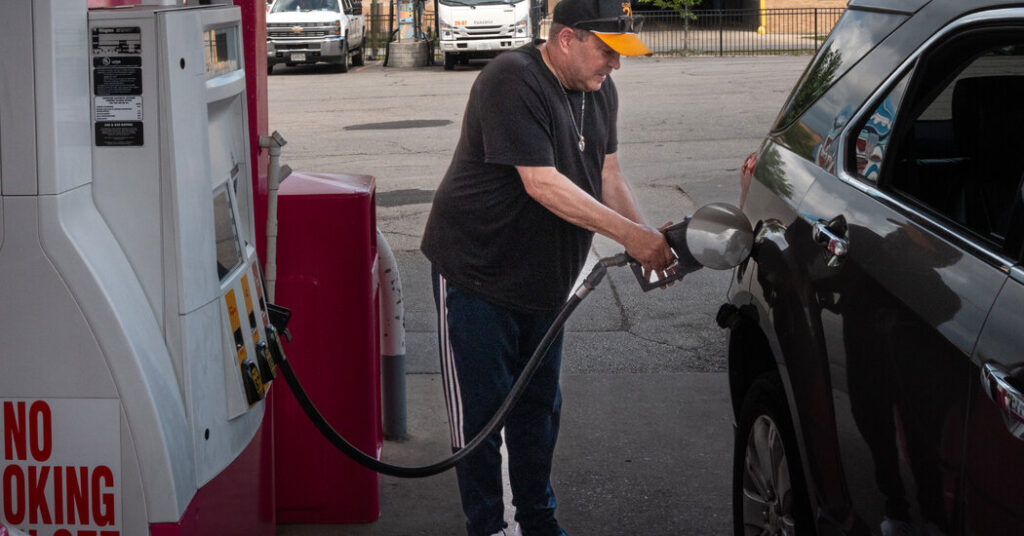
U.S. gasoline prices edged lower on Thursday to a U.S. national average of $4.13 a gallon, according to the AAA motor club. Gas prices have risen 39 percent since the war began.
-
Gas prices don’t move in lock step with crude, usually trailing increases or drops by a few days.
-
The average price of diesel dropped to $5.28 on Thursday but is up 40 percent since the start of the war.
What they are saying: Inflation is ‘taking on a life of its own.’
-
Diane Swonk, the chief economist at KPMG US, warned that accelerating inflation related to the war in Iran had put the Federal Reserve, which is charged with keeping prices in check, in a difficult spot. “Delaying rate hikes is riskier today than it was as the economy emerged from the pandemic,” she wrote. “Inflation has lingered longer and shows signs of taking on a life of its own.”
-
“We are now five years into the post-pandemic bout of inflation,” she noted. “The Federal Reserve did not cause all of it, but it is the institution charged with bringing it down.” Despite the political pressure on Kevin Warsh, who recently took over as Fed chair, to cut interest rates, Ms. Swonk expects officials at the central bank to be convinced to raise rates later this year.
-
The European Central Bank raised interest rates on Thursday, making it the first major central bank to do so since the start of the war with Iran.
-
“There are, of course, other factors that can derail the market independently of what’s happening in the Persian Gulf, with the post-I.P.O. success of the SpaceX’s stock being the most prominent factor to watch, in our opinion,” Thierry Wizman and Gareth Berry, global strategists at Macquarie Asset Management, said in a research note on Thursday.
The post Oil Prices Drop as Trump Reverses Threat to Strike Iran appeared first on New York Times.