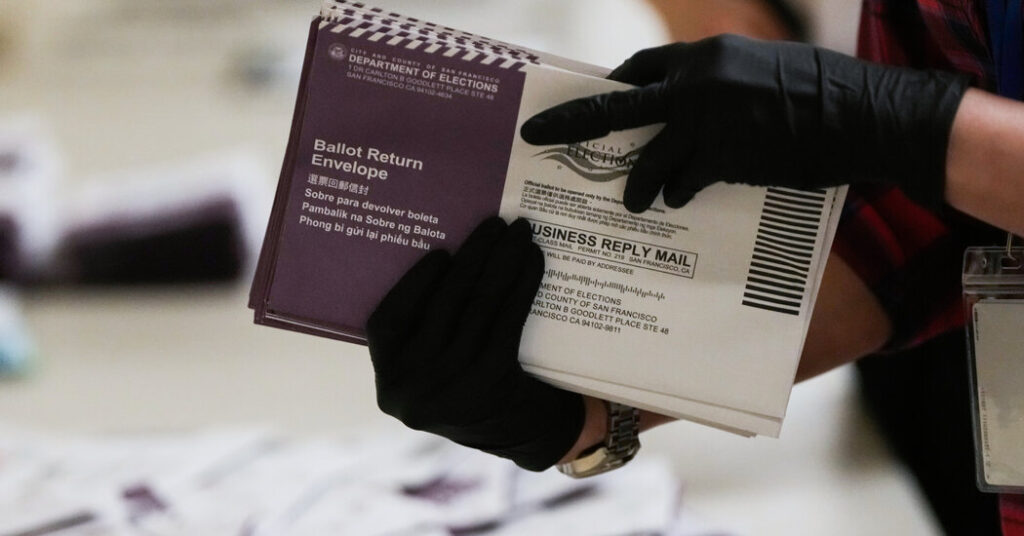
The U.S. Postal Service has proposed a new rule that would allow it to refuse to deliver mail ballots in states that don’t turn over voter rolls to the federal government.
The rule, proposed last week, is vaguely written but appears to establish broad authority for the agency to intervene in the mail voting process. It calls on states to compile lists of mail voters that Postal Service employees would use to screen ballots for eligibility. If states refuse to comply, the agency could refuse to send their mail ballots.
Democrats and voting-rights groups say the proposed rule is clear evidence that the Trump administration is trying to unconstitutionally intrude on state-run elections.
Withholding some mail services in states where voters rely heavily on mail balloting could affect millions of Americans. And most of those affected would likely be Democrats, who disproportionately vote by mail because more Republicans have been convinced by Mr. Trump’s unfounded claims that mail balloting is not reliable and invites fraud. Screening mail ballots for voter eligibility, meanwhile, would amount to an unprecedented, and potentially unconstitutional, involvement of the federal government in the administration of elections. The proposed rule is vague, however, so it is unclear how the screening would work.
In recent oral arguments before a federal judge in Boston, a coalition of Democratic state attorneys general and multiple voting rights groups said the rule amounts to a federal intrusion into the voting process, which the Constitution dictates is the domain of the states. They also argued that it would be expensive, cumbersome and chaotic to comply with the demand to create new lists of voters and, in some cases, to change mail ballot designs, with fewer than 150 days until the 2026 general election.
“It’s just difficult to overstate the disruption that this will cause to election administration,” said Michael Cohen, the deputy attorney general in California, who was speaking on behalf of a broad coalition of states in federal court last week.
The rule is consistent with an executive order Mr. Trump signed in March effectively instructing the Postal Service not to deliver election mail unless states comply with other aspects of the president’s order, including handing over the voter lists.
Postal experts said the order also threatens the service’s independence. Anton Hajjar, a former member of the Postal Service Board of Governors, said his main concern is that Mr. Trump’s order amounts to “political interference with the U.S.P.S., which by law is supposed to be independent.”
The service, whose precursor predates the United States’ independence, was codified by Congress and signed into law in 1792 by President George Washington. The founders considered the service an essential pillar of the young country’s democracy that would protect the uncensored and affordable exchange of ideas. Congress passed another law in 1970 that converted the Postal Service from a cabinet-level arm of the executive branch to an independent federal agency.
The proposed rule is currently open for a 30-day comment period. The executive order calls on the Postal Service to issue a final rule by the end of July.
The proposal is in line with repeated attempts by Mr. Trump and his Republican allies to take over critical parts of the electoral process in the run-up to a challenging midterm election cycle for their party. The president’s first attempted executive order on elections, which he signed last year and included a requirement for documentary proof of citizenship to register to vote, was blocked by courts. His signature voting legislation in Congress, which would have restricted vote by mail and added similar citizenship requirements, stalled in the face of a Democratic filibuster in the Senate.
There are vanishingly few instances of illegal noncitizen voting. Democrats have repeatedly accused the president of trying to give Republicans an electoral advantage in the name of improving election security. Mr. Trump has not denied it. At a gathering of Republican lawmakers in March, he framed support for legislation that would in part crack down on mail voting as a way to hold the G.O.P. majority in Congress.
“It’ll guarantee the midterms,” he told them, warning that failure would bring “big trouble.”
The president has also tried to insulate against Republican losses in the midterms by igniting a nationwide redistricting war to draw new, safely partisan congressional seats before the midterms. And he has repeatedly, falsely castigated the slow voting process in California’s primary earlier this month as fraudulent, a preview of what he might do in the general election if Republicans fared poorly. Without offering any evidence, the Department of Justice has even promised to bring charges of election fraud in the state.
Democrats argued that the executive order signed in March was unconstitutional, and multiple lawsuits were filed within days. But Judge Carl J. Nichols ruled in late May that it was premature for the court to intervene. He cited the fact that the Trump administration had yet to carry out much of the order, meaning that any potential harm caused to states or voters was still theoretical.
“The court recognizes that the Postal Service may ultimately issue a final rule that directly affects plaintiffs or their members, or that the government may develop state citizenship lists that omit specific individuals due to particularized flaws,” he wrote. “Plaintiffs may, of course, renew their motions if and when those future actions occur.”
Although the Postal Service has not yet issued what the judge called a “final” rule, Democrats pointed in court last week to both the agency’s proposed rule and the directive in the executive order to create citizenship lists at the Department of Homeland Security as evidence that the order is being implemented and causing harm.
Both the Postal Service proposal and the executive order show that states will “suffer real harm,” Mr. Cohen said in federal court last week.
Lawyers from the Department of Justice defended both the proposed rule and the executive order, but also reiterated that many details regarding implementation had not yet been developed, making any litigation ill-timed.
“There remain significant uncertainties, even within the federal government, about how and to what extent the executive order will be implemented,” Stephen M. Pezzi, a lawyer for the Department of Justice, said in court.
The rule offers little explanation for how the Postal Service would screen those ballots. One uncertainty is whether there is a plan for merging the citizenship lists that Homeland Security has been ordered to create with the mail-voter lists required of the states. The president’s executive order said the Homeland Security lists would be transmitted to the states, but explained little else.
Earlier this year, Postmaster General David Steiner told The New York Times that the agency would have no part in determining who would be on such a list.
“We’re not going to compile a list. I mean, we can’t compile a list. That’s not what our job is,” Mr. Steiner said. He added: “We can only work off of a list that we are given, and then we deliver mail.”
The Postal Service did not respond to a request for comment.
The 20-page proposed rule was posted on June 2 for public comment. The changes would not apply to primary elections or overseas and military voters.
The proposal also establishes standards for envelope design and tracking, many of which would fall on state and local election officials to carry out.
While the proposed rule says states would retain full control over who can vote by mail, it also makes clear that using the Postal Service to deliver that mail requires states to comply with the rule.
The Postal Service plans to use a “Mail-in and Absentee Participation List” to “facilitate law enforcement efforts,” and plans to verify ballot mail against that list before it enters the Postal Service’s mail stream. If there isn’t a match, or if the envelope does not meet the new standards, the ballot will be rejected.
The proposal does not say how ballots en route to voters would be screened, but it does say they would be verified by Postal Service employees. Mail ballot verification, however, has long been the province of state election officials.
Meanwhile, screening and rejecting such mail for compliance before it enters the mail stream could create bottlenecks. The proposed rule says that if mail ballots are found to be noncompliant, they will be returned and would have to be amended before being resubmitted.
The service rarely returns mail, said William Hensley, a former election mail specialist at the Postal Service, but in this case the rule appears to indicate that the service may say “turn that truck around.”
“And the consequence of that could be incredibly damaging for election officials and for voters,” he said.
Jena Griswold, the Democratic secretary of state in Colorado, said in an interview that the proposed changes, especially requiring states to share voter information for ballots to be delivered, “would put a state like Colorado in a tremendous bind.”
A majority of Coloradans vote by mail, “so it would absolutely have a tremendous effect on our election system,” she said.
The post Postal Service Issues Proposal to Block Mail Ballots in States That Don’t Turn Over Data appeared first on New York Times.