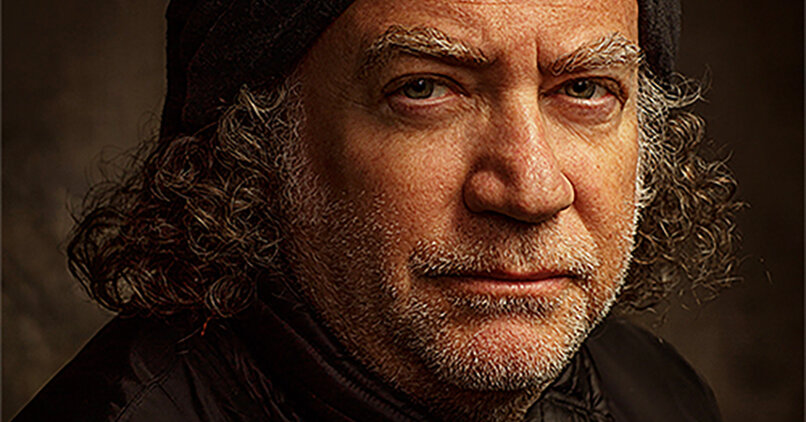
William Coupon, an influential portrait photographer who deployed a painterly style and vast curiosity in his oft-stated quest to “photograph everyone in the world” — shooting punk rockers, artists, politicians and Indigenous people, among others — died at his home in Santa Fe, N.M., on May 29. He was 73.
The cause was complications of non-Hodgkin’s lymphoma, his brother Robert Grossman said.
Mr. Coupon’s first photos were “audiographs,” pictures that emitted sound using looped cassettes concealed behind the frames, and “kinetographs,” images attached to moving motors. (His appeared in the windows at Bloomingdale’s in the late 1970s, as part of a swimwear display.)
Self-taught, he ventured onto the New York cultural scene in 1978, talking his way past the velvet ropes at Studio 54, where he documented the club’s decadent glamour. The “Disco Tribes” series he shot there included photos of a distracted Andy Warhol; the drag queen Divine, decked out in a strapless, sequined gown; and Truman Capote, who agreed to write the text for a book of these photographs.
The project ended abruptly after three weeks, when Mr. Coupon was thrown out of the club and his cameras smashed by bodyguards working for Steve Rubell, who owned the club with Ian Schrager. No one ever explained why.
The next year, he found fresh inspiration in the punk and New Wave scene at the Mudd Club in downtown Manhattan. Instead of dismissing Mr. Coupon’s work, Steve Mass, an owner of the club, exhibited some of his portraits there. “I had always felt like an outsider, but it did kick-start my life as a portrait photographer,” Mr. Coupon wrote in a 2014 essay for Lenscratch, an online photography magazine.
Amid this anarchic aesthetic, Mr. Coupon began to develop what he called his “obsessive pursuit of the face.” His style involved a classic medium shot, the subject set against a backdrop of hand-painted, mottled Belgian linen and illuminated by a light box that created dramatic contrasts of light and dark. Among his inspirations, he cited the chiaroscuro master Rembrandt.
Mr. Coupon’s “Punks of New York” series, shot mostly in the late 1970s and early 1980s, included an enigmatic David Byrne; a slightly terrorized-looking Debbie Harry; a contemplative Jean-Michel Basquiat; and an otherworldly image of Klaus Nomi, the German vocalist.
John Leland wrote in The New York Times in 2015 that Mr. Coupon brought a “different visual vocabulary” to the carnival adventurism of punk, slowing the pace and “taking the circus out of the tent,” while making portraits of “fun-house denizens looking in a mirror that removed distortion rather than adding it.”
Mr. Coupon’s stark, minimalist style was evident in the play of light on the jazz musician Miles Davis’s forehead and fingers in the image on the cover of “William Coupon: Portraits” (2018) and in another photo of Mr. Davis holding Mr. Coupon’s infant daughter.
Anthony Bannon, a culture critic and historian who wrote an essay for the book, said in an interview that Mr. Coupon was confident that “the truth will out” in people’s faces.
Mr. Bannon likened Mr. Coupon’s boundless curiosity to that of a bird. “Look at him, like a crow flying around,” he said. “All of a sudden, the crow sees a red ribbon standing out in contrast to the green foliage. Bang, the crow makes a dive for the ribbon.”
Mr. Coupon, he added, “was out there looking, and ready to dive.”
William Edward Grossman was born on Dec. 3, 1952, in Queens. His mother, Kathryn (Karger) Grossman, was a specialist in poverty statistics for the Census Bureau. His father, Carl Grossman, was an accountant who gave him his first camera.
At Syracuse University, he studied communications, leaving school three credits short of graduating in 1974.
Before turning to photography, he worked in advertising in New York, creating a successful campaign that featured a coupon. Co-workers began calling him Mr. Coupon, his brother said, and eventually he legally changed his surname.
Mr. Coupon’s early photos and his work at the Mudd Club led to jobs with New York magazine and a commission to shoot the cover of Bette Midler’s 1979 disco-inflected album, “Thighs and Whispers.” (Perhaps coincidentally, Mr. Coupon’s trademark hairstyle of golden ringlets came to resemble Ms. Midler’s tresses on the album cover.)
He also began to freelance for The New York Times Magazine. In 1983, he was sent to the Manhattan apartment of Elie Wiesel, the Auschwitz survivor and Nobel Peace Prize winner, to shoot a cover story. While he was there, Mr. Coupon received a call from Rolling Stone magazine, asking if he was available to photograph Mick Jagger that night.
“Who’s Mick Jagger?” Mr. Wiesel asked, according to Mark Bussell, the photo editor for The Times Magazine who had accompanied Mr. Coupon on the shoot.
Mr. Coupon, who accepted the assignment, said that Mr. Jagger later asked, “Who’s Elie Wiesel?”
Mr. Coupon also photographed George Harrison, Jerry Garcia and Neil Young for Rolling Stone covers, and shot 15 covers for Time magazine, including portraits of two presidents, Bill Clinton and George W. Bush, for Person of the Year issues.
They weren’t the only presidents he photographed. He also shot Richard Nixon, who was chatty about baseball. Ronald Reagan offered a pensive smile, which Mr. Coupon preferred to a full smile. “A lot of a person’s personality can get lost in the smile,” he told the Professional Photographers of America in 2020. “An ethereal gaze is more transcendent.”
Mr. Coupon photographed Donald Trump in 1985, long before he became president, for the cover of Manhattan, inc. magazine. Mr. Trump posed with a white dove to signify his desire for world peace, and the bird relieved itself on his hand, said Nancy Butkus, the magazine’s art director at the time. Undaunted, she added, Mr. Trump wiped his hand and continued with the shoot.
Ross Perot, the Dallas businessman and independent presidential candidate in 1992 and 1996, was apparently less understanding when Mr. Coupon arrived for a Fortune magazine photo shoot in 1989 wearing an unconventional outfit that included black tights and ballet-like shoes. Mr. Perot refused to be photographed, Mr. Coupon said, until he changed clothes, borrowing some from a security guard.
Mr. Coupon’s marriage to Karen Seeley ended in divorce. In addition to his brother Mr. Grossman, he is survived by another brother, Martin; a sister, Karen Cohen; and a daughter, Hayley.
Mr. Coupon, a devoted reader of National Geographic magazine as a boy, had long been fascinated by the lives of Indigenous people. Throughout his career, he took his linen backdrop on multiple trips to photograph Native Americans, Aboriginal Australians, the Sami in Scandinavia, the Berbers in Morocco and the Pygmies in central Africa. These projects, which he referred to collectively as “Social Studies,” also included photographs of death row inmates and immigrants in Times Square wearing costumes of American cartoon characters.
“Even if he had only a two-minute session with somebody, William could always create that space where people’s essential underlying humanity came through,” Adam Stoltman, a former photo editor at The Times and Sports Illustrated, said. “It didn’t matter what station in life they were.”
The post William Coupon, Who Wanted to ‘Photograph Everyone in the World,’ Dies at 73 appeared first on New York Times.