1 p]:text-cms-story-body-color-text clearfix”>
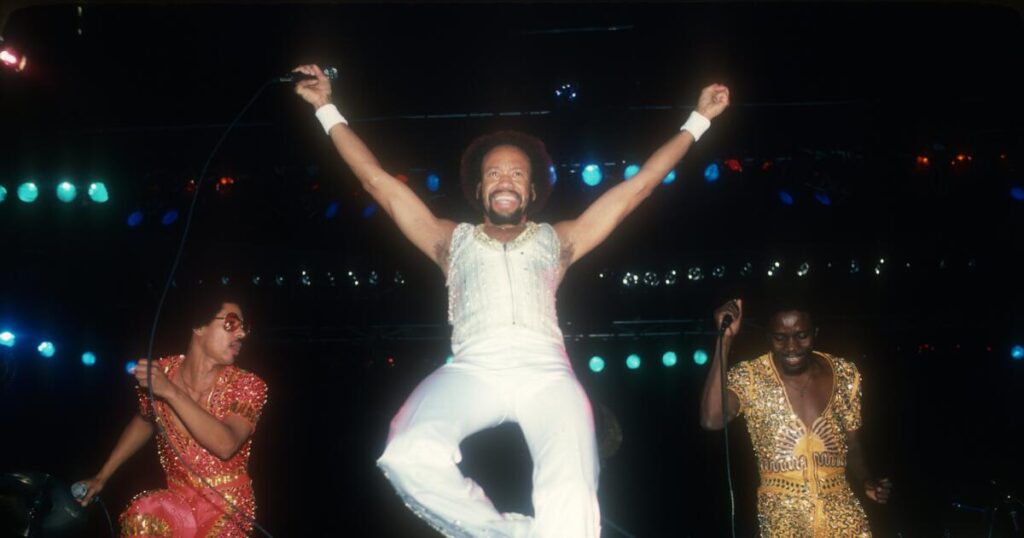
Earth Wind & Fire’s “September,” with its nonsensical phrase “ba-dee-ya,” has been streamed more than 2.3 billion times on Spotify, more than the band’s next five songs combined (including “Let’s Groove,” “Boogie Wonderland” and “Shining Star”).
In his visually and sonically vibrant film “Earth, Wind & Fire (To Be Celestial vs. That’s the Weight of the World),” drummer, DJ and director Ahmir “Questlove” Thompson (“Summer of Soul”) shows how the funky but aspirational band was much more than its biggest hit musically.
But he also explores, in depth, the complexities of the band’s central figure, Maurice White. A self-affirming visionary who wanted to bring hope to people, White mixed journaling with talk of spaceships and metaphysics. However, he was also traumatized by a childhood in which his mother moved to Chicago for more opportunities, leaving White in Memphis, where he was once brutally beaten by white policemen. Those scars created a man who was a distant father and equally remote with his band members at the peak, mistreating them with casual disdain until everything fell apart.
Questlove recently spoke by video call about the film, now streaming on HBO Max, which features interviews with family, surviving band members, childhood friend Booker T. Jones and a couple of fans named Barack and Michelle Obama. This interview has been edited for length and clarity.
What drew you to this story?
In 2020, I was DJing on the internet, live streaming and I was DJing to calm people down from thinking they’re going to die in the apocalypse. One day I did an Earth, Wind & Fire set and when I got to the fourth hour, I thought, “Yo, is this one of the most relentlessly positive groups of all time?”
I started researching the lyrics and realized this band tricked us into positivity, like getting us to eat our vegetables. I started wondering how a band like that got past the velvet rope and realized that none of it was by accident, it was all by design. Their music was so good and you start singing the lyrics and there’s an osmosis effect of positivity that gets you.
When I started this in 2023, I had a spooky feeling that the turmoil of 2020 was going to visit us again, so I thought people would want something to watch that will help them plant seeds of what to do.
You save “September” to the end. Was it so people would see the band was more than their biggest hit or to send audiences off humming and happy?
It’s an unlikely legacy song. They have so many meaningful songs like “Shining Star,” while “September” is a leftover that was a filler song from a greatest hits album that became a career-defining song.
Initially, I was coming out the gate with “September,” just, “Let’s get this out the way.”
It took a while. Early on the Obamas weren’t part of the project. I interviewed them the morning after the 2024 elections; they were so professional and so in the moment and also helped us process the day.
We’d never gotten to see them sit next to each other and be playful and dance. And I didn’t say, “OK, let’s see how you move, dance for 12 seconds,” I was just playing something and they started dancing and the camera happened to be running.
But they put the song in context. In 2009, they said, “What’s the statement we want to make to America to show this is a new era at the White House?” And Earth, Wind & Fire was chosen to be one of the bands at the inauguration and it was that song. So my producer said, “Now we can treat ‘September’ like an encore.” We used that story to show how that song grew on its own organically.
White is a complicated guy. Was it challenging to balance everything in your narrative?
Oftentimes Black artists are seen as caricatures or one-dimensional. It’s easy to do the gotcha of “You’re so positive and metaphysical, what about this or that?” My goal is always to find a human element that you see yourself in. In Maurice’s case with his career, he did drink the Kool-Aid. But his personal life stemmed from not ever forgiving his mother for leaving him behind when he was little. When we hold anger and other emotions in, when we refuse to talk to our partners or friends — and you want people to read your minds — that’s when it becomes a problem. But I wanted to show that in a way where I don’t spell it all out. Hopefully people will make the connection of the importance of dreaming and planning and affirmations but also the importance of letting things go, like forgiving people.
2
‘Devotion: Obedience or Betrayal’ (Paramount+), ‘Bring Me the Beauties’ (HBO Max)
p]:text-cms-story-body-color-text clearfix”>
If you’re endlessly fascinated by cults and crave another documentary dose, this month brings two very different offerings.
“Devotion” is well-made but fairly predictable: the Gloriavale group, based in rural New Zealand, are like many Christian cults, mixing Jesus, back-to-nature and communal living ideals with a harsh patriarchy and ultimately numerous trials on pedophilia- and forced-labor-related cases. The filmmakers got current members to talk, though mostly they try to explain away everything unsavory.
“Beauties” is more arresting on a number of levels. Founder Frederick Von Mierers was a distinctive charlatan — a guy from Brooklyn who found success as a model and refashioned himself as an aristocratic orphan before pivoting to becoming leader of Eternal Values after saying an alien being had “walked in” to his body and shown him the light.
His recruiting focused on the beautiful people of the 1980s, so the screen fills with jet-setting supermodels and nights at Studio 54. Four decades on, Von Mierers appears laughably obvious in his public-access TV pronouncements; he even uses several “Star Wars” quotes, like “Do or do not, there is no try,” unironically.
Still, followers bought overpriced gems, handed over earnings and had casual sex with people he chose. (An enemy of romantic love, he frequently slept with street hustlers before dying from AIDS complications in 1990.)
Beyond the juicy and sordid details, there’s the redemption tale of Hoyt Richards, a Princeton grad who became the first male supermodel in the 1980s. Richards, who now helps people exit cults, is open about what his former beloved leader did but also takes responsibility for his own behavior. He’s deeply remorseful about how he wronged family, friends and colleagues. Articulate and sincere, he makes this journey worth taking even for those not devoted to cult documentaries.
3
‘The Welcome Table’ (HBO and HBO Max, June 23)
p]:text-cms-story-body-color-text clearfix”>
The opening scenes of this climate displacement documentary assaults the senses with horrifying footage of wildfires, storms, floods and other catastrophes, but Oscar-nominated director Josh Fox (“Gasland”) simultaneously makes these events feel intimate by zeroing in on one or two people from each tragedy, bringing personal stakes to the foreground.
The film moves beyond the climate crisis to the increase in climate refugees, which Fox underscores by starting with Americans, including victims of the Paradise blaze, before journeying around the globe.
Fox memorably recites a tone poem of despair for six minutes about the escalating climate crisis, the disinterest of governments and big business, and the increasingly deadly toll it is all taking. “Scientists told us of their nightmares… Every fraction of a degree is a tipping point somewhere…. a rumble becomes a cataclysm a tipping point where a roof flies off instead of staying put… a land grab, a war a genocide.” Eventually, his reading gets faster and faster and subsumed by dizzying text cataloging catastrophes; as he cites droughts and failed states and the weaponization of water, we can’t process all that’s going wrong … and that’s the point.
He weaves the stories together with musicians from perennially imperiled New Orleans performing for his interviewees at a “welcome table” on a levee. It’s meant to contrast with the walls designed to repel refugees. (Many, however, couldn’t come because they were denied visas.)
Amid the social inequity and climate apartheid, Fox tries offering hope, preaching about empathy with lines like “sharing is stronger than hoarding.” But he shows European governments letting Africans drown to maintain their idea of purity and an American president pushing toward fascism by dehumanizing anyone he deems “other” while reminding us that soon enough there’ll be a billion people across the planet seeking safety and shelter.
The post Questlove’s Earth, Wind & Fire doc shows how trauma lingered behind a band’s relentless positivity appeared first on Los Angeles Times.