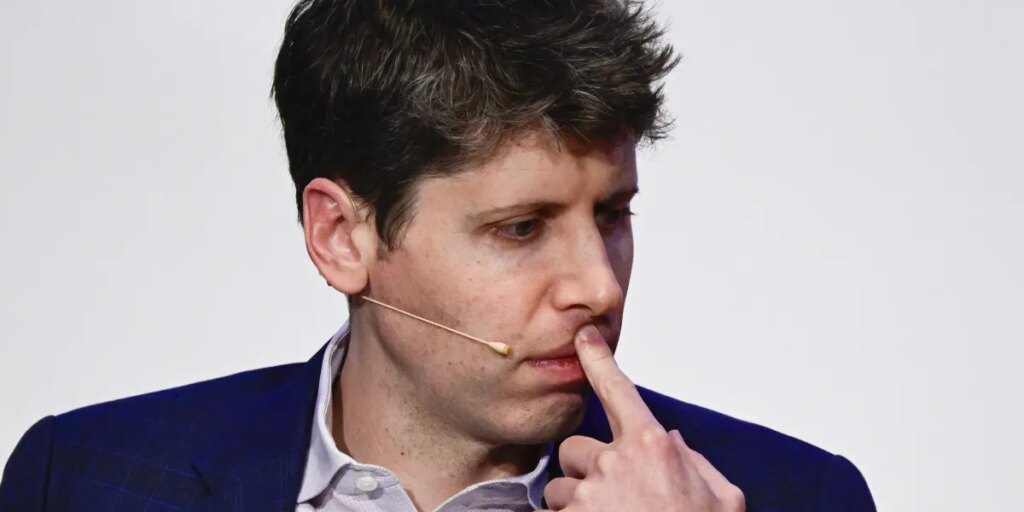
When Sam Altman was president of Y Combinator, he advised founders: stay close enough to profitability that you could get there before your next funding round if you had to. As he told the Wall Street Journal in 2014, keeping “profitability in grasp” was a key lesson.
My late Harvard colleague Clayton Christensen would have recognized immediately some of the hallmarks of good money thinking: keep costs low, test whether real customers will pay real prices, don’t let your cost structure outrun your revenue model.
OpenAI’s S-1 reportedly projects $14 billion in losses for 2026 alone. Profitability is not expected until 2030 at the earliest. A few years ago, Altman told investors that once OpenAI built artificial general intelligence, they would ask it to figure out how to generate a return. He was at least partly joking. The framework suggests he shouldn’t have been.
OpenAI is not even first to the door. Anthropic, the lab founded by its own defectors, confidentially filed this week at a near $1 trillion valuation.
The question none of these roadshows will answer is the one that actually matters: does this company have a viable path to profitability it could activate if it needed to?
Good Money, Bad Money
Christensen and his collaborator Michael Raynor developed the “Good Money/Bad Money” theory for exactly this scenario.
The framework’s insight is simple: it’s not whose money you take that shapes a company’s strategy — it’s the expectations attached to it. For a new-growth venture, the best kind of money is “patient for growth but impatient for profit.” Such capital forces founders to test quickly whether actual customers will pay good prices for a real product. It keeps costs low enough to preserve strategic flexibility. And it shields the venture from unexpected shifts in the funding environment.
So-called bad money is the opposite. Capital that is impatient for growth but patient for profit sounds generous because it ostensibly gives you runway. But there is an insidious quality. When investors demand rapid growth, a venture gets channeled toward the largest, most obvious markets — precisely those where deep-pocketed incumbents also want to invest. As costs ramp up in anticipation of revenues, the cost structure begins to dictate strategy, making the small, unglamorous opportunities that might actually work seem unattractive. Scaling a losing formula doesn’t fix it. It magnifies the losses.
Going public at a $1 trillion valuation is, almost by definition, accepting money that must be impatient for growth. Enormous expectations are already priced in. The pressure to grow faster, enter newer and bigger markets, and justify the number never lets up.
When I teach the framework in my MBA class, reactions are weird. Sometimes, students think it’s the course’s most compelling idea; other times they despise it. I puzzled over their reactions for years until I realized that they seemed to track the capital-market environment almost perfectly. When money was abundant and cheap, students hated the theory. But when money was scarce and expensive, they loved it. The theory didn’t change — the world around it did. That’s kind of the point of the theory.
The Ponzi Scheme of Ambition
Watch how the total addressable market narrative expands. SpaceX started as a rocket company in 2002. Then it added Starlink satellite internet in 2019. Then, after merging with xAI earlier this year, it became a rocket-internet-and-AI company. Now the S-1 describes orbital AI compute satellites by 2028. Each new layer of ambition justifies a higher valuation, but the economics have not yet caught up with the narrative. The analyst Anand Sanwal memorably described this pattern as a “Ponzi scheme of ambition”: a growth company that hasn’t yet dominated its first market keeps painting ever grander pictures of new ones to keep the capital flowing and the valuation rising. Every S-1 has a risk factors section. Almost nobody reads it until it’s too late.
The theory acknowledges that a “get big fast” strategy can make sense — for example, when real network effects and switching costs create true winner-take-all dynamics. But those conditions arise far less often than founders and their backers claim.
The Altman Problem
Amazon is the counterexample everyone reaches for — the growth-prioritizing company that famously refused to turn a profit and still won. But Amazon, maybe not on day one but certainly early on, had a viable profit formula inside the business. It simply chose to prioritize growth. Not every company burning cash has profitability in grasp. The question is whether it could get there if it had to.
Altman once cared about the difference. The S-1 can’t answer whether OpenAI has a
viable path to profitability it could activate under pressure. Neither can the roadshow.
My students are a constant lesson to me that the theory doesn’t change. The world around it does. Right now, money feels abundant. It won’t forever.
“The Good Money/Bad Money framework was developed by Clayton Christensen and Michael Raynor in The Innovator’s Solution.”
The opinions expressed in Fortune.com commentary pieces are solely the views of their authors and do not necessarily reflect the opinions and beliefs of Fortune.
The post When good money goes bad: the question SpaceX and OpenAI investors aren’t asking appeared first on Fortune.