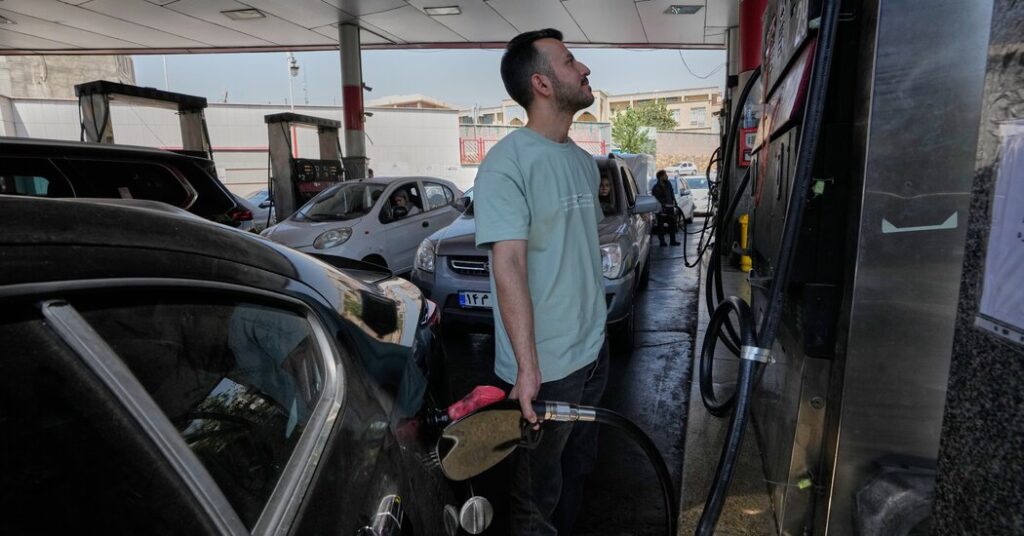
Lines of cars waiting to fill up at Iran’s gas stations, even in the middle of the night, have become a common sight in recent weeks, Iranians said in interviews, as war and a U.S. blockade have strained fuel supplies.
The Iranian government is struggling with how to respond and is wary of reducing expensive subsidies, a move that would raise fuel prices and that has prompted large-scale protests in the past.
Though Iran is rich in crude oil, its refining capacity has long been insufficient to meet the country’s gasoline demand, officials and experts say. The shortfall — just over a tenth of the gasoline consumed per day, according to government figures — is usually made up by imports. Now those have been all but cut off by the continuing U.S. naval blockade of Iran’s southern ports.
Domestic production of gasoline has also decreased since the U.S.-Israeli war, officials say, as strikes have damaged Iranian refineries and limited their capacity.
Iranians reached in several cities, including Tehran, Isfahan and Bandar Abbas, said they had seen long lines at gas stations in recent days.
“Even when you pass through the streets around midnight, like 2 or 3 in the morning, you will see that there is a huge line of cars standing and waiting in line,” said Reyhaneh, 30, an unemployed teacher in the city of Mashhad. Like others reached in Iran, she asked that her last name not be used for fear of retribution.
The prospect of increased fuel prices is compounding difficulties for Iranians, as the war enters its seventh month with no clear resolution in sight. Iranians are already facing 80 percent inflation over this time last year, the central bank has said, as well as widespread job losses caused, in part, by the war and a government-imposed internet shutdown.
The U.S. blockade has been aimed in part at pressuring Tehran to loosen its grip on the Strait of Hormuz, a vital shipping waterway in the Persian Gulf that Iranian forces effectively closed early in the war. The bottleneck has caused an increase in the price of fuel globally, including in the United States.
On Monday, the U.S. government announced additional sanctions on Iran and Iran-linked entities, hoping the measures would force the Islamic republic to make concessions.
The situation has left the Iranian government with few options. In 2019, a sharp increase in gasoline prices set off mass protests that the authorities put down with violence.
Economic discontent also caused nationwide demonstrations early this year. Officials are keenly aware that raising gas prices now could set off a new round of protests.
Iran’s Parliament speaker and lead negotiator with Washington, Mohammad Bagher Ghalibaf, said this month that though gasoline consumption had to be reduced, raising prices was a mistake. Iran’s “enemy” plans to exploit the issue to create unrest, he claimed, while not specifying what the government should do instead.
Amirhossein Khaleghi, an economist in Iran, said, “When the government lacks sufficient legitimacy and resources, and especially in the middle of a war, the question is how we can continue with the current situation when we no longer have the resources to sustain it.”
Iranian officials have acknowledged some of the scale of the crisis and the effects of U.S. pressure but have still sought to project defiance.
“We are facing war,” President Masoud Pezeshkian said in an interview with Iranian state television on Friday. “The enemy has targeted our oil and gas resources, and our production has fallen. We are standing firm in the war, but we have to help increase the country’s resilience.”
Ayatollah Mojtaba Khamenei, Iran’s supreme leader, issued a statement on Friday acknowledging “economic and livelihood challenges” while warning officials not to publicize or highlight government weaknesses, so as to avoid benefiting Iran’s enemies.
On Sunday, he released a longer statement warning that those enemies — implicitly, the United States — were seeking to turn “cultural, social, economic, political and geographic differences into pretexts for creating division” that could later be used to impose foreign domination on Iran. “This servant advises all members of the nation not to allow any discord to arise among themselves in any way whatsoever,” he said.
The gasoline issue is just one of several arenas in which the government has struggled to provide basic infrastructure and align supply with demand. Iran’s electricity usage also exceeds what its infrastructure can deliver.
In his interview, Mr. Pezeshkian urged Iranians to reduce their consumption and said he leaves his office lights off and uses a fan instead of air-conditioning.
In Iran, the government has long provided cheap energy to help make life somewhat manageable even as prices for other goods skyrocket.
The government subsidizes gasoline at different tiers based on consumption, with some gas offered at less than one cent per liter at current exchange rates. There are quotas on how much can be bought at each price, and those quotas have been curtailed in recent weeks.
So far the government has appeared resistant to raising fuel prices. But while Mr. Pezeshkian has pledged that the price of gas at the cheapest tier of quotas will not increase, he said those consuming beyond a set amount could pay as much as double.
“If we raise the gasoline price recklessly, we will create problems for people,” Mr. Pezeshkian said, while lamenting that the government had been subsidizing fuel so deeply.
The looming crisis, though exacerbated by recent events, is the culmination of many longstanding problems.
Because fuel prices in Iran are so much lower than in neighboring countries, some of the subsidized gasoline is smuggled abroad for profit, officials and experts have said. The government has appeared unwilling or unable to stop the trade.
And even in large cities, public transit is inadequate to meet people’s needs, forcing them to rely on their own cars and taxis to get around.
Until that confluence of problems is addressed, said Reza Gheibi, an economic analyst in London, changes like restructuring the quotas “would, at best, change the way the shortage is distributed — not the shortage itself.”
The recent cuts to quotas for fuel have forced many Iranians to buy unsubsidized fuel, and they often must line up for hours as gas stations offer fewer of those pumps.
Soheil, an engineer in Isfahan, said that his city had relatively ample gasoline availability. And yet, he added, “even here, the queues at gas stations are getting longer and longer.”
The post Long Lines for Gas in Iran Show War and U.S. Blockade Squeezing Supply appeared first on New York Times.