Theatrical play is having a moment in Silicon Valley.
Artificial intelligence companies regularly hire improv artists to help train their models — and give motivational sessions to their employees. Sam Altman, the chief executive of OpenAI, joined tech notables like Palmer Luckey and Bryan Johnson for an evening of Mafia, a role-playing game, on YouTube. And earlier this summer, while reporting an article about Vibecamp — a Maryland festival popular with several tech-world subcultures — I came across clowning workshops, a “contact improv” session and an immersive theater production by a group billing themselves as the Oracles, who channeled bespoke prophecies for those who entered their tent.
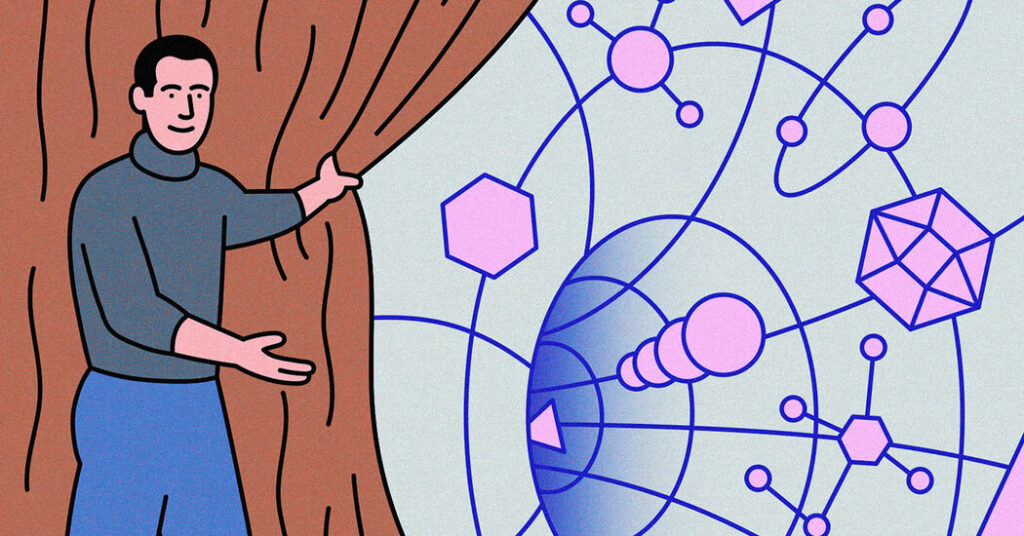
Role-playing has long been part of the nerd stereotype — just think of the popularity of games like Dungeons & Dragons in pop culture depictions of computer geeks. But Silicon Valley’s embrace of improvisation and theater is also part of its much bigger and more longstanding philosophical tendency to treat reality, play, perception and performance as essentially interchangeable. In that worldview, reality isn’t a set of fixed facts, but something malleable, existing as much in people’s perceptions as in the material world. For those who see themselves as cosmic innovators, learning to understand and disrupt the arbitrary conventions of ordinary life is part of the job requirement.
Consider the popularity of Keith Johnstone’s 1979 acting guide, “Impro,” which has taken on a cult status in tech circles. At Palantir, the data analysis and software company co-founded by Peter Thiel, the book has been recommended reading for new hires. It’s also been cited by tech founders like Anduril’s Trae Stephens, the productivity guru Tiago Forte and influential tech-world bloggers like Venkatesh Rao and Scott Alexander.
“Impro” is both a guide to theatrical play and a guide to social relations. Central to Mr. Johnstone’s argument is that human beings are unconsciously playing status games at all times, playing “low” and “high” to each other depending on their context. The book includes exercises for aspiring actors, many of which involve challenging actors to pay attention to one another’s social cues in order to play higher or lower status. (“He who looks away first is the more dominant,” the author warns.)
Other exercises focus on challenging actors to rethink norms we take for granted: One particularly dizzying game requires actors to walk around the room, pointing at objects and intentionally calling them by the wrong name. A guiding idea behind the book it is that actors should see reality as something they can shape if they accept spontaneity and creativity, rather than succumbing to a safe set of norms. “There are people who prefer to say ‘Yes,’ and there are people who prefer to say ‘No.’ Those who say ‘Yes’ are rewarded by the adventures they have, and those who say ‘No’ are rewarded by the safety they attain,” Mr. Johnstone writes.
According to Qiaochu Yuan, a coach and X personality whose work is widely read in Silicon Valley circles, tech workers are often drawn to books like “Impro” because they help readers think about and codify social relationships as measurable status transactions, instead of thinking about them as organic — and therefore mysterious — phenomena. Mr. Yuan thinks he first encountered the book around 2016 through friends at the Bay Area’s Center for Applied Rationality, a nexus for the wider rationalist movement focused on logical thinking and overcoming cognitive biases.
The skills cultivated through theatrical play may also be useful for leadership. Lydia Laurenson, a writer on Silicon Valley culture who spent a year as a member of an immersive-theater-slash-secret society in San Francisco, has heard many prominent founders and people in tech described as possessing a “reality distortion field.” They not only master logistics and motivate employees, but create a worldview compelling enough to sustain the creative and technical challenges a new idea required. (The term was famously used in 1981 to describe Steve Jobs).
“Taking a start-up from nothing to one of these massive companies, is this insane act of culture building and creation,” Ms. Laurenson says. Even the most anodyne-seeming start-up can feel “culty.” Creating a convincing reality for employees and investors — using some of the same techniques found in theatrical play — is simply part of the founder job description.
It may be true that transforming people’s perceptions of what is possible can help them think more imaginatively. But the tech world’s fascination with improv and theater also reveals a darker philosophy. If all of life is a performance, there are few limits on those willing to take charge of the scene. If nothing is truly real but people’s perceptions — perceptions that a canny actor or founder has the capacity to alter — then misleading investors as to the viability of a start-up, or spreading viral conspiracy theories through social media to affect an election outcome can be reimagined not as lying but as alternate reality-formation, the canny creation of truth by consensus.
Distort reality intensely enough, and there’s no such thing as reality at all. And in an era where artificial intelligence can easily conflate collective thought with objective truth, tech founders and those who buy their products are less tethered to the real world.
Erik Davis, author of the book “TechGnosis,” told me that he worries about the potential for both nihilism and elitism encoded in such a worldview. Once you assume that “the world is malleable like a gaming system,” he says, then it is all too easy to assume a clear-cut social hierarchy between “those in the know and those not in the know.” Once you start assuming that you alone can access a secret higher reality — to say nothing of the money, political connections and control over social media that mark many of Silicon Valley’s elite — it can become all too tempting to assume that the “sheeple” aren’t, well, fully real in the way that you are. There’s a reason one of the most cutting ways to insult someone online is to call them an “NPC” or nonplayable-character — a term, rooted in video game parlance, that is now used to suggest a person lacks agency or original thought.
Mr. Davis brought up the popularity of the “simulation theory” hypothesis proposed by many in Silicon Valley, most prominently Elon Musk: That reality isn’t real at all, but rather that human beings are living in a simulation run by higher-intelligence beings. Listening to some tech titans, Mr. Davis said, “you get the sense that they, at least some of the time, really are in that mind frame. Like, this is a game, and the whole point is to play it so big that, you know, something genuinely novel or unexpected happens.” If reality is only a simulation, even the most extreme Silicon Valley doomsday scenarios — an intelligent A.I. that kills us all, say — are not much more existentially troubling than dying in a video game.
Yet at its best, theatrical play brings us into a sense of creative possibility, rather than nihilistic remove. In my own time playing improvisational theater games — both at Vibecamp and with Dzieci, the New York theater company I train with — the ability to “yes and” with strangers through various theatrical games allowed me to meet people not by learning their job title, or their political affiliation, but by helping to create fantastical spaces and scenes, and, yes, be a little silly. During a recent 36-hour largely wordless “marathon” workshop, I developed friendships with people whose names I’d never learned, but whose propensity for rhythmic drumming, or snowball fights, I’d come to know intimately.
Ironically, in an era of artificial intelligence and sky-high screen time, theatrical play demands that we pay full attention to the world around us: a world much richer, and more complex, and full of unfamiliar consciousnesses, than the world of our Twitter feed.
Theater games may help us see reality as malleable. But at their best, they remind us to look at reality in the first place.
Tara Isabella Burton is the author of “Self-Made: Creating Our Identities From da Vinci to the Kardashians” and a director of the Can Beauty Save the World project.
The Times is committed to publishing a diversity of letters to the editor. We’d like to hear what you think about this or any of our articles. Here are some tips. And here’s our email: [email protected].
Follow the New York Times Opinion section on Facebook, Instagram, TikTok, Bluesky, WhatsApp and Threads.
The post How a ’70s Improv Book Became Silicon Valley’s Required Reading appeared first on New York Times.