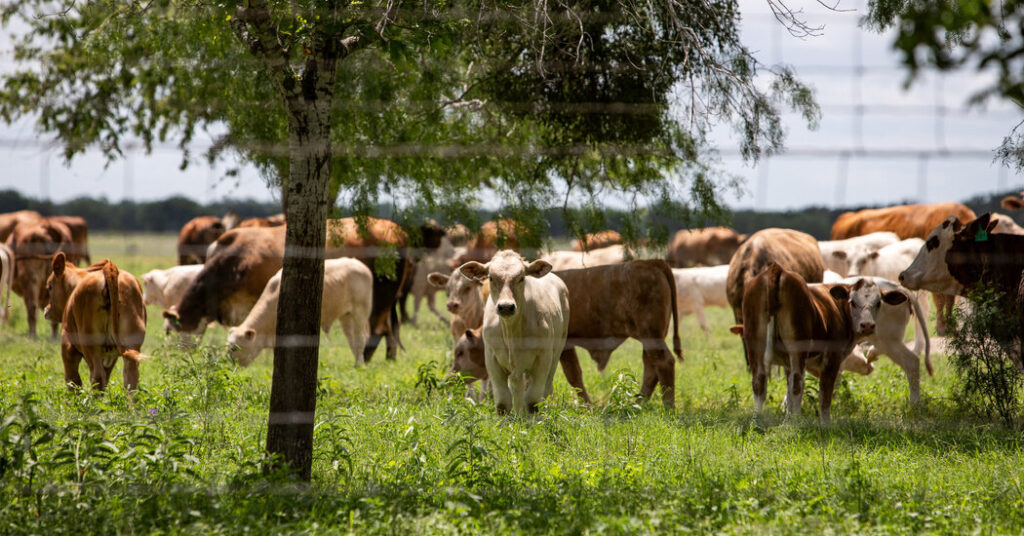
The discovery of the New World screwworm fly in the United States this week is threatening to further disrupt an already strained cattle business at a moment when many ranchers also contending with a severe drought.
The United States herd is at its smallest level in 75 years, even as consumer demand for beef continues to grow. That has driven live cattle prices — and beef prices — higher, which normally would encourage ranchers to begin rebuilding their herds or prompt new ranchers to enter the business. Drought conditions across several states have led to a shortage of grass for grazing, forcing ranchers to sell some of their animals sooner.
“We have a lot of things happening all at once,” said David Anderson, a livestock market economist at Texas A&M University.
The average price for a pound of ground beef is $6.90, according to the Bureau of Labor Statistics, a 32 percent increase from two years ago. Last month, the Agriculture Department forecast beef prices would rise 12.1 percent in 2026.
But successive crises and volatility over the last year have largely prevented ranchers from rebuilding their herds, meaning low cattle supplies and high beef prices are likely to stick around.
That cycle is “taking longer than we all wish for,” said Wesley Batista Filho, the chief executive for the U.S. business of JBS, the world’s largest meatpacker, on a call with analysts last month.
The latest blow is the discovery of the larvae from the New World screwworm fly in a 3-week-old calf in La Pryor, Texas, about 50 miles from the Mexican border. The fly can lay its eggs in open wounds as small as a tick bite, and the infection can kill animals if left untreated.
The New World screwworm was eradicated from the United States in the 1960s, and the rest of North and Central America by the early 2000s. This was done by breeding hundreds of millions of sterile flies each week and dropping them from aircraft into areas where wild flies were found. But eradication efforts have weakened, and since 2022 the fly has been making its way north from Panama and closer to the United States.
Before the flies were eradicated, ranchers used steel forceps to remove the larvae and maggots from their animals, but were largely powerless to stop its spread. Older ranchers who dealt with the fly often speak about it in graphic terms.
“I was just a teen in the mid-50s when I faced this rascal, and when I heard about it again, the nightmares and the horrors it brought back was just unbelievable,” said Lee Weathersbee, a rancher and former city councilman in Del Rio, Texas, said at an emergency meeting about the screwworm in Del Rio last week.
The Agriculture Department set up a 12-mile quarantine around the infected calf, installed fly traps and is dispersing sterile flies from trucks in the area.
“Our responders are already in the area conducting site visits and evaluating the situation to ensure we have the correct information we need to mitigate the spread,” Lewis Dinges, the executive director of the Texas Animal Health Commission, said at a news conference Thursday.
Texas ranchers are stocking up on screwworm treatments and increasing how frequently they interact with the herds. “It’s a small cost that we pay in order to protect a valuable resource,” said Stephen Diebel, the president of the Texas & Southwestern Cattle Raisers Association.
If officials cannot mitigate the spread, the economic effect could be enormous. A 2025 Agriculture Department report estimated that a widespread outbreak could lead to a loss of $732 million for Texas ranchers and $1.8 billion for the state’s economy.
“The real key is how long this goes on for,” Mr. Anderson, the economist, said. “If this is a long-term sustained outbreak, it’s going to be very tough for some ranchers to survive financially.”
The screwworm has been found in tens of thousands of animals in Mexico and Central America over the last 18 months, and has even killed 10 people, according to the Agriculture Department. In May last year, the department banned live cattle imports from Mexico, which has already raised the cost of beef.
Normally around 15 percent of Texas’ feeder cattle — young weaned cattle that are ready to begin fattening for slaughter — come from Mexico. But with the border closed to Mexican cattle, a large feedlot in Lubbock, Texas, went out of business this year because it could not get enough of the animals.
Brooke Rollins, the agriculture secretary, said Thursday that there was “no doubt” that closing the border to Mexican cattle had caused higher beef prices. “We’re obviously very focused on affordability,” she said. “But the president agreed when we briefed him that we had to keep our livestock producers as safe as possible.”
With just two confirmed cases in the United States, the screwworm is more of a potential problem for ranchers, but the fallout from a severe drought is a more pressing one.
A snow-free winter across the West has led to a shortage of grass for cattle to eat and not enough easily accessible water for them to drink. The Agriculture Department says 57 percent of the country’s cattle inventory is in areas experiencing drought, a problem compounded by spring wildfires that burned over a million acres.
At Wyoming’s largest cattle market, more than 9,000 cattle were sold in one week last month. Normally at that time of year, the market would sell fewer than 1,000.
Additional selling could temporarily lower beef prices, but in the long term will raise them by reducing the supply of cattle.
“Everybody is just in survival mode,” said Jay Nordhausen, the owner of Ogallala Livestock Auction Market in Nebraska. He has sold 15,000 more cattle than he did by this time last year, and anticipates a busy summer selling animals that in a typical year wouldn’t go to market until the fall. “It’s pretty bleak around here, just trying to get by,” he said.
Many ranchers simply do not have enough grass for their cattle to graze on, or are worried overgrazing will degrade soil health and lead to long-term damage. While ranchers can supplement grass by giving their cattle feed, like hay, that has its challenges, too. Some areas do not have enough hay, and many ranching operations are not set up to receive and distribute large quantities of hay. It has also gone up in price, making it less economical.
Calves are usually born in the spring, and weaned from their mothers in the fall. That is when ranchers make decisions about how many heifers and cows to retain, and how many to sell at market. But some ranchers are now weaning calves earlier, to reduce the mother cow’s need for nutrients, or considering selling cow-calf pairs early.
“Nobody wants to expand the herd more than our producers,” said Brian Winter, whose family runs cattle markets across four states. “But you are physically limited by forage conditions.”
Kevin Draper is a business correspondent covering the agriculture industry. He can be reached at [email protected] or [email protected].
The post Screwworm Flies and Drought Spell Tougher Times for Cattle Ranchers appeared first on New York Times.