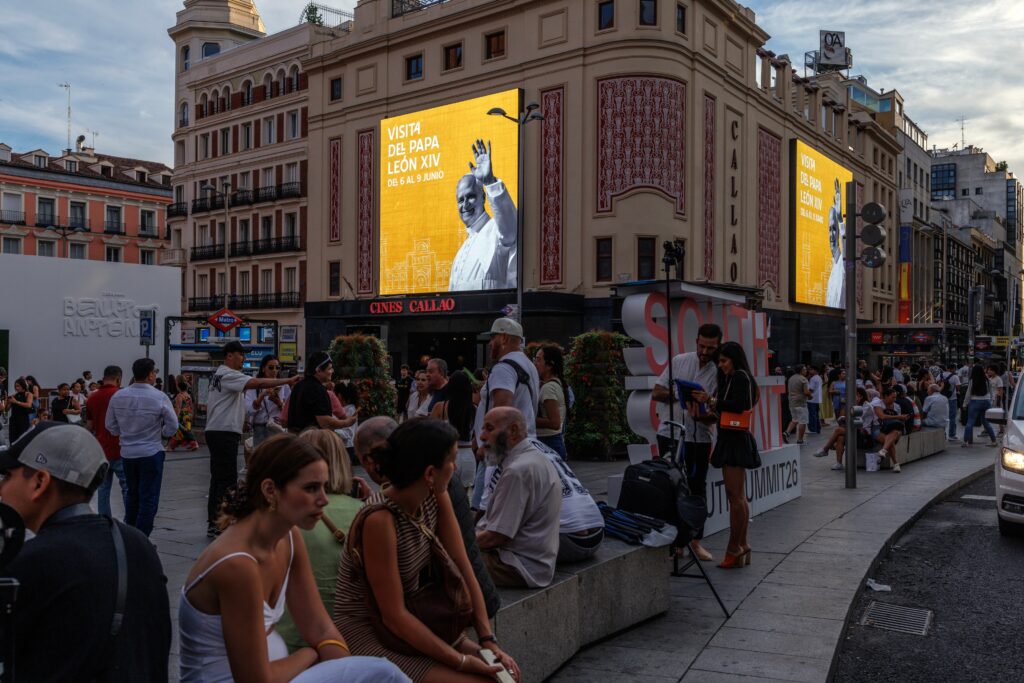
MADRID — As Pope Leo XIV lands in Spain on Saturday for the first papal visit here in 15 years, a realignment between Catholicism and politics is underway on both sides of the Atlantic.
During the era of Franco, the fascist dictator known as El Generalísimo, the Spanish Catholic Church backed National Catholicism — a fusion of faith and right-wing politics that became a trend in Europe and the United States.
When the left returned to power in 1982, Spanish bishops marched in anti-government protests, railing against the lifting of a ban on abortion and the legalization of same-sex marriage.
More recently, the shift by Pope Francis — away from judgment in the bedroom, toward tolerance, including sympathy for migrants — created a new universe in which conservatives are the ones criticizing a church that leftists appear more willing to embrace than ever.
As President Donald Trump feuds with Leo, the first U.S.-born pope, and leading American cardinals clash with the MAGA movement, Spanish arch-conservatives are warring with a Catholic Church they once saw as a powerful ally, especially over the church’s advocacy for migrants.
This poses a challenge for Leo, who has made unity and easing political polarization goals of his papacy.
“The far right in Spain wants to copy the far right in the United States,” said Bishop José Mazuelos Pérez, who heads a Canary Islands diocese providing shelter, food, blankets and medical care for a host of arriving migrants. “To go to war with the bishops over the issue of migration.”
Leo’s goals may be increasingly difficult to achieve as hard-line critics accuse the church of embracing causes of the political left, and Spain is a now microcosm of the seething division over migration and other hot-button topics.
The pope is expected to address polarization in a highly anticipated speech to the gridlocked Spanish parliament Monday in what some are portraying as a keynote papal message to the Western world. He is set to nod to different quarters of the church, holding a prayer vigil with youths on Saturday before marching Sunday in the kind of street procession long embraced by Spanish traditionalists.
The centerpiece issue of his seven-day visit is the church’s role as a lifeline and political advocate for undocumented migrants and asylum seekers — an explosive topic as European governments adopt tougher migration rules in response to public exhaustion.
On Thursday, Leo will visit Spain’s Canary Islands, a hub for Latin American migrants and major landing point for those arriving by sea from the African coast. The waters around the islands have become a graveyard for those who lost their for a chances to resettle in Europe.
The visit there will come a few weeks before Leo’s landmark July 4 trip to the Italian island of Lampedusa, another symbol in Europe’s migration debate, solidifying the plight of migrants as a hallmark of his papacy, as it was for Francis.
The left, by contrast, is hailing a faith it once charged with complicity during the abuses by the fascist Franco regime.
Spanish Prime Minister Pedro Sánchez, from the center-left Socialist Party, flew to Rome ahead of the papal trip to meet with Leo and has taken to quoting the new pontiff, including the pope’s recent warnings on artificial intelligence.
“The [left’s] alignment with Pope Francis was immediate: He defended Spain’s labor reform, and the Episcopal Conference also supported it, something that would have seemed unthinkable 20 years ago,” Spain’s deputy prime minister, Yolanda Díaz, told The Washington Post. “With Leo XIV, that alignment deepens.”
Conservative criticism mounted after the Spanish Catholic Church emerged as the most powerful backer of Sanchez’s ambitious plan unveiled in January to legalize hundreds of thousands of undocumented migrants. Bishops vocally supported the plan, Catholic volunteers were deployed, and sign-up lists were posted in churches to gather names in support of legalization.
Forces on the right have also smarted from the church’s opposition to efforts to prioritize Spanish citizens for access to government benefits as well as to a measure last year aimed at restricting Muslim worship.
Santiago Abascal, president of the far-right Vox party, has blasted the church in recent months for remaining “silent” on the Socialist-led government’s liberal policies, including one of the most inclusive transgender rights laws in the world.
More than anything else, Abascal has zoomed in on migrant advocacy by Catholic bishops, echoing the criticism of Vice President JD Vance against American bishops by suggesting the church’s stance is motivated by financial gain given the grants, donations and payments it receives for its migrant work.
“Some of those who profit from illegal immigration should leave their palace and go down to see the consequences it has for the Spanish people. For health care, security, wages and taxes,” Abascal posted on X in April, in a missive directed at Mazuelos Pérez, the bishop in the Canary Islands.
Conservative anger is partly linked to efforts to transform the Valley of Cuelgamuros, a memorial on the grounds of one of the leading papal basilicas in Europe, 30 miles northwest of Madrid.
A deal last year between the church and the center-left government would change the nature of the spot that commemorates the dead in the Spanish Civil War, where Franco had been buried until his remains were exhumed and moved in 2019. The plan is to turn it into a memorial more respectful to the victims of his regime.
Conservative critics say the agreement shows a church too willing to bend to the will of a Socialist-led government beset by an increasing number of political scandals.
Marcos de Quinto, a former center-right lawmaker, in April called on Spaniards to cease contributions to a church he described as increasingly political.
“It is a shame that our ecclesiastical leaders cowardly dedicate themselves to supporting this corrupt government that steals from us and forces them to accept … the desecration of the Valley of the Fallen and support of a [migrant] regularization that would never have been done in Vatican City,” de Quinto wrote on X, using the memorial’s previous name.
The Catholic Church eschews political labels. But in practice, the church in Spain is led by an across-the-spectrum mix of senior clerics, including conservatives, liberals and others.
As a whole, though, the Catholic Church in Spain is not as outwardly liberal as its counterpart in Germany, for example, where senior clerics have been reprimanded by the Vatican for backing same-sex blessing ceremonies more akin to marriage.
In Spain, several senior positions in recent years have been filled by bishops elevated by Francis and who share many of the late Argentine pope’s priorities.
In a nation that gave birth to some of the most conservative Catholic movements and religious media outlets in the world — including Opus Dei and the InfoVaticana website — the church’s full-hearted embrace of migrant rights, as well as what critics describe as other liberal causes, has generated unease in some conservative quarters.
Spanish bishops denied a report this year that Leo had described the far right’s “instrumentalization” of the church as the faith’s biggest threat in Spain. Leo did, however, cite concern more broadly over the leveraging of faith for “ideology,” they said.
Madrid-based InfoVaticana, one of the most aggressive and conservative outlets writing about the Catholic Church, has brought a right-wing hue to its criticism, decrying a recent meeting between Sanchez and Leo as “obscene” and calling out the Spanish church’s support for “massive regularization” of migrants.
“We are covering Leo XIV’s pontificate very closely because it could determine whether the Church corrects certain ideological excesses of recent years or deepens them,” InfoVaticana’s editorial board said in written replies to questions from The Post.
The board expressed “nervousness” about Leo’s early pontificate. But it fretted more broadly about what it described as an “ideological” shift to the left by the Spanish church “due to fear of social irrelevance, economic dependence on the State, and cultural adaptation to the dominant consensus.”
Archbishop Luis Argüello, head of the Spanish bishops conference, said that while the church may seem closer to the left-wing government on migration, “in other areas, we [disagree], such as the individual’s understanding of the right to life, the regulation of abortion and euthanasia.”
A close reading of Leo’s statements on migration shows that he is often more nuanced than Francis.
Leo, for instance, frequently prefaces his defense of migrants by noting that countries have the right to control their borders, calling for investment in impoverished countries to discourage migration. At the same time, he has stressed the Christian philosophy of welcoming the stranger, as well as safeguarding migrant rights. He has described the Trump administration’s crackdown in the United States as “inhuman.”
In the Canary Islands, Leo will host 700 migrants; a floral offering will be made to the sea in honor of migrants who drowned as they sought to reach Europe from the African coast.
A host of outspoken Spanish bishops have challenged far-right politicians who have framed migrant arrivals as “an invasion.”
“We cannot continue to treat migrants [by saying we] think that they are invading us,” Mazuelos Pérez said.
Referring to migrants arriving by sea to Spain via the Canary Islands, he said: “After four or five days crowded in the Atlantic, without eating, you have to welcome them, you’ll have to help them. We can’t tell them to go back. We can’t kill them. We have to take them in.”
The church’s advocacy on the Canary Islands has generated pushback and accusations that it is encouraging risky, illegal trips by economic migrants who are not in need of international protection.
“The Catholic Church has decided to participate in a vision on immigration policy that I do not share,” said Alberto Rodríguez Almeida, a Vox politician representing the Canary Islands who said he especially opposes welcoming those who do not share Spain’s “language and religion.”
Rodríguez Almeida insisted Vox was not out to confront the church, but he said: “When a Spanish bishop has insulted and discounted Vox voters or Vox’s political leaders, there has been some response to defend them.”
José Bautista contributed to this report.
The post Pope Leo visits a polarized Spain where conservatives are turning on the church appeared first on Washington Post.