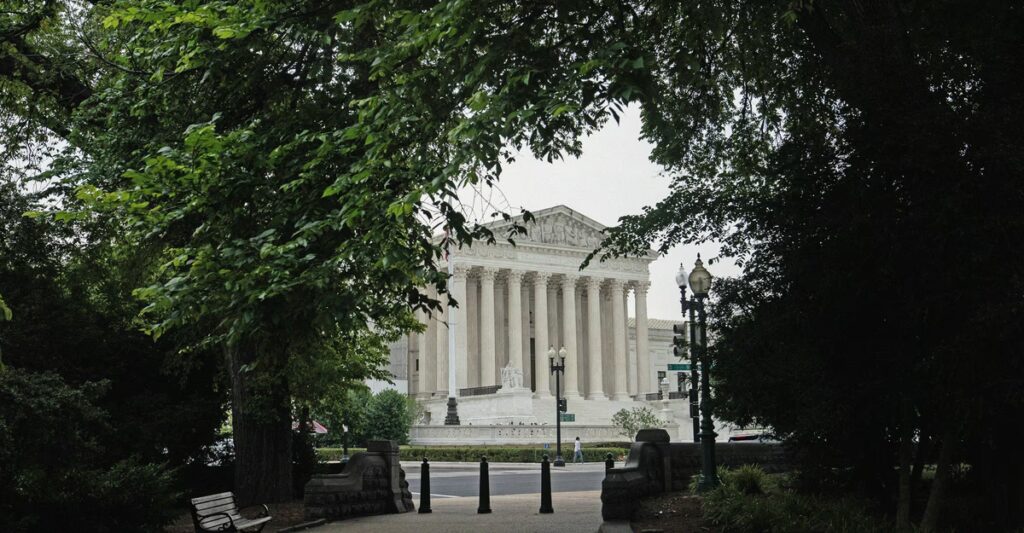
This week, the Roberts Court made clear that when it comes to drawing congressional districts, Black voters have no rights that anyone is bound to respect.
For years, Alabama, where a quarter of the population is Black, had defied federal court orders, including one reaffirmed by the Supreme Court itself in 2023, to create a second majority- or plurality-Black congressional district. Alabama’s reasoning for not doing so was simple: Its Republican legislators didn’t want to, and they didn’t believe the Roberts Court would make them. “The Supreme Court ruling was 5–4,” the state House Speaker Nathaniel Ledbetter said about the 2023 decision. “So there’s just one judge that needed to see something different.”
The state was making a gamble that the Roberts Court was more partisan than sincere. And it paid off: On Tuesday, the Court allowed Alabama to proceed with a map that diminishes Black voting power to the advantage of Republicans. For all the Court’s pretenses—all its insistence on the rule of law, precedent, and good faith—many critics and supporters of the Roberts Court see the institution as an appendage of the Republican Party. The only thing that distinguishes the critics from the supporters is whether they think that is a good thing.
“Alabama willfully drew a map that flouted the District Court’s preliminary injunction and hoped that this Court would eventually see things its way,” Justice Sonia Sotomayor wrote in her dissent, which was joined by Justices Elena Kagan and Ketanji Brown Jackson. “After today, it is hard to call Alabama’s cynical gambit anything other than a success, and the Court’s rewarding of Alabama’s behavior anything other than a blow to the rule of law.”
The majority opinion was unsigned. In it, the judges argued that the lower court had “failed to follow our instruction” in ordering the creation of the new district. This was a reference to the April decision in Louisiana v Callais, in which Justice Samuel Alito announced that “race and politics are so intertwined” that there are almost no circumstances under which the Fifteenth Amendment’s prohibition on racial discrimination in voting actually applies.
Now here was an example of exactly what Alito was talking about. “States are free to decide for themselves whether last-minute changes to an election are in their best interests,” the justices wrote this week. If a Republican legislature decides that a redistricting plan to suppress the power of Black voters is “in their best interests,” they may proceed.
The implications of this case go far beyond one congressional district in one state. In Callais, Alito issued a classic Alito disclaimer: insisting he was not doing the thing he was about to do. The Court, he wrote, was not effectively nullifying Section 2 of the Voting Rights Act when it determined that Louisiana drawing a second black-majority district (out of six total, in a state that is a third Black) was an “unconstitutional racial gerrymander.” This week’s ruling on Alabama makes explicit what was merely implied in Callais. The Court’s logic may apply only to districting for now—but there is no obvious reason to limit its application to that. The Roberts Court has replaced the Fifteenth Amendment’s ban on racial discrimination in voting with a right to engage in racial discrimination in voting.
Theoretically, Callais was a statutory case about the Voting Rights Act’s ban on voting provisions that have the purpose or effect of discriminating against Black voters. That test, adopted by Congress in the 1980s (and opposed by Chief Justice John Roberts when he was an attorney for the Reagan Justice Department), was meant to prevent discrimination by actors careful enough to hide their intent. In Callais, the Court ruled that discrimination was fine because Louisiana argued that its purpose was partisan and not racist.
But in the Alabama case, the federal-district-court panel, which included two Trump appointees, had already determined that lawmakers had intentionally discriminated against Black voters. The district court “bent over backwards, taking every possible explanation for why the state did what they did,” Kareem Crayton, a voting-rights expert with the left-leaning Brennan Center told me. “And they still concluded, Oh no, there’s no other way to understand this except for a racial intent.” Alabama’s plan was “tainted by intentional race-based discrimination,” the district ccourt found, and the legislature was attempting to “rob Black Alabamians of an equal opportunity under the law to elect candidates of their choice.”
Fortunately for those legislators, the justices were waiting to drive the getaway car. Crayton said that the decision to allow Alabama to ignore the lower court’s ruling was shocking. “Out of all the cases you can talk about during the civil-rights movement, where the state of Alabama, state of Texas, all these states were committed to Jim Crow, none of them that I know of had been at the Supreme Court where the Supreme Court says, It’s okay if you just choose to defy a federal order.”
This week’s decision is important because intentional discrimination is not just banned by the Voting Rights Act, but by the Fourteenth and Fifteenth Amendments. When the Roberts Court says that the lower court’s ruling “failed to follow our instruction,” it is referencing Alito’s argument that partisanship cannot be separated from race. Even if a court finds evidence of intentional discrimination, therefore, the Supreme Court may simply ignore it on the grounds that the discrimination in question is merely partisan and therefore acceptable. This turns Callais into something much broader than it purported to be: a finding that the Constitution permits not only unintentional racial discrimination, but intentional racial discrimination, as long as there is also a partisan pretext for engaging in that discrimination.
The Court’s ruling amounts to a total inversion of the Civil War amendments, which make no such exceptions for racial discrimination in the name of partisanship. Indeed, as I have written before, that would have made absolutely no sense at the time the amendments were adopted, when white-supremacist Democrats were disenfranchising Black Republicans. Race and partisanship were even more intertwined then than they are today, given that the Democrats were then the party of the defeated Confederates. If the Fifteenth Amendment did not bar partisan-motivated disenfranchisement, the amendment would not have changed anything at all. . Indeed, the entire purpose of the amendments was to ensure that Black people could use the ballot as a means of self-defense against politicians who would deny them their basic, fundamental constitutional rights if they did not have to answer to them as a political constituency. The Roberts Court has thus rewritten the Civil War amendments to include a constitutional right to discriminate against Black people.
This is a racist absurdity in addition to being an impossible read of the Constitution, which is perhaps why the Roberts Court has buried it under so many layers of obfuscation. The Court has invented a right to discriminate—as long as you provide a political pretext—that not only does not exist in the Constitution, but is explicitly prohibited by the Constitution.
The absurdities continue. According to the majority, anyoneanyone alleging that a map is discriminatory must provide an alternative map that provides the same outcome: The plaintiff’s map “must meet all the State’s legitimate districting objectives’ ‘just as well’ as the State’s own map,” the opinion reads. In this case, that “legitimate” objective is the creation of safe Republican districts. So the burden is on the victims of intentional discrimination to make sure that the people discriminating against them get what they want anyway.
This logic would not have barred any of the Jim Crow voting devices that the Roberts Court frequently congratulates itself and the nation for overcoming. In the aftermath of Reconstruction, white-supremacist Democrats imposed superficially race-neutral requirements such as poll taxes, literacy tests, and grandfather clauses. The approach taken by Alito and the Roberts Court would have found all of these measures constitutional.
Frederick Douglass wrote that “the elective franchise” was “the one great power by which all civil rights are obtained, enjoyed, and maintained under our form of government, and the one without which freedom to any class is delusive if not impossible.” The purpose of the Fifteenth Amendment was to ensure that Black voters could not again be denied their freedoms so that politicians did not have to heed their objections, to provide what Douglass called a “wall of fire for his protection.” But the Constitution has few defenses against a majority of justices willing to ignore it or twist it to its exact opposite purpose.
The post The Supreme Court Has Invented a Right to Discriminate appeared first on The Atlantic.