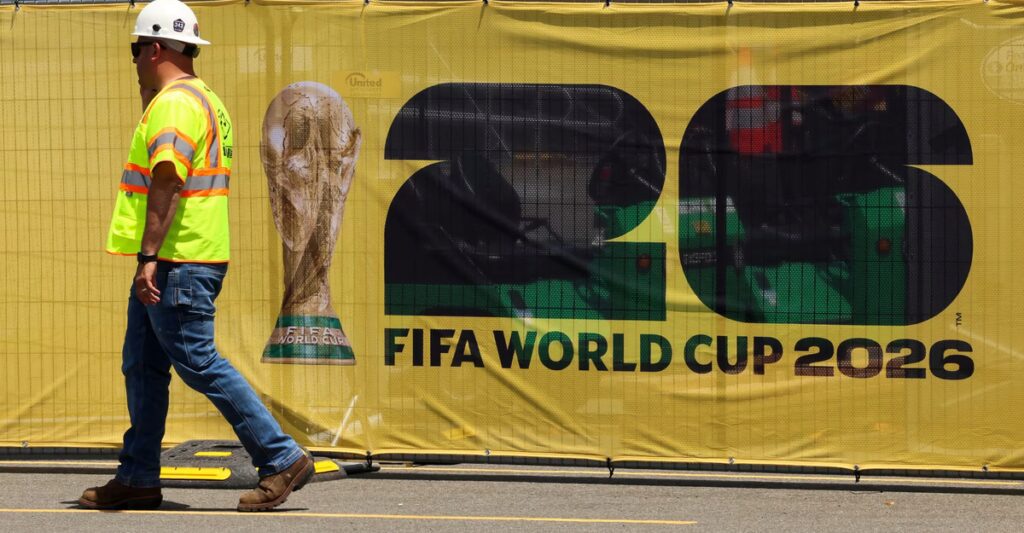
The World Cup is nearly here! But so far, at least, no one seems all that excited.
It wasn’t supposed to be this way. The biggest sporting event in the world is on the verge of returning to the United States for the first time in more than 30 years. Starting next week, teams from 48 nations will play 104 matches in 16 cities across the U.S., Canada, and Mexico. Some of the most famous people on Earth will be playing, each recognizable by a single name: Messi, Mbappé, Ronaldo, Salah. After years of buildup, soccer lovers were convinced that Americans were finally—finally!—ready to fully embrace the sport played and watched by far more people than any other around the globe.
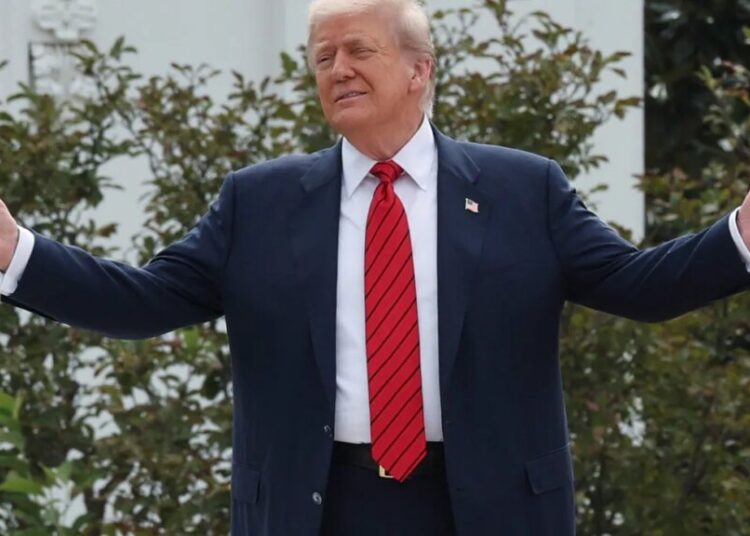
Yet a tournament that should be hotly anticipated—providing a joyful backdrop to America’s 250th-birthday celebrations—is instead surrounded by angst and even dread. Ticket prices are astronomical, demand for them has slumped, and hotels are half-booked. There is little buzz. The New York City area, which will be home to the World Cup Final next month, is far more focused on the Knicks. There is anxiety about fans traveling from the Democratic Republic of the Congo in light of the Ebola outbreak there. Some international visitors are barred by travel bans, and others are nervous about making the trip. Fans are anxious about the potential for ICE raids outside stadiums or terror attacks targeting gatherings of supporters. Hopes for a strong showing for the U.S. team have mostly faded. President Trump has, to the shock of no one, inserted himself into the proceedings. Hanging over it all is the war in Iran, particularly because it was started by the guy to whom the tournament’s organizers recently awarded a peace prize. The United States’ relations with its co-host countries have grown strained—as have its relations with just about every country that is slated to participate.
Perhaps the situation can still be salvaged. Ahead of the previous World Cup, four years ago, there was extraordinary consternation about that tournament’s host, Qatar. Migrant laborers had died in building the nation’s stadiums and infrastructure. Accusations of corruption were rampant. The host country seemed to be an unlikely choice, and its summers were so hot that the tournament had to move to the fall. Plus, the Qataris didn’t even serve beer. All of those concerns were largely forgotten after the transcendent final, when Lionel Messi, of Argentina, triumphed over Kylian Mbappé, of France, in a match considered one of the greatest ever. Can that happen again?
The only other time the World Cup was held in the United States, in 1994, it was treated as a bit of a novelty. Back then, the sport was viewed by Americans as something that the rest of the world loved but that we mostly ignored. We wouldn’t even use their name for it, insisting on soccer rather than football. Sure, little kids play it, but then they move on to American sports such as baseball, basketball, and the other football (the one with helmets). During World War II, my grandfather’s skill at baseball got him designated as the grenade thrower for his unit as he and his comrades fought their way across Europe. Years later, he used to joke that only “a communist sport” wouldn’t let you use your hands.
[Read: When soccer was an American afterthought]
The 1994 World Cup ended when Italy’s Roberto Baggio sent his penalty kick sailing high over the net and doomed his side’s chances. Since then, there has been no question that soccer (we’ll stick to calling it that) has grown far more popular in the United States. Youth participation continues to grow. Major League Soccer, launched after the 1994 tournament, has finally come into its own. No, it can’t compete with the English Premier League or Spain’s La Liga or Germany’s Bundesliga, and it is not on the same footing as the NFL, MLB, NHL, or NBA. But it is healthy, being played in new soccer-only stadiums and having a slick Apple TV contract, and it’s become a popular spot for aging international players to make a final run. (Pink-and-black Messi Miami FC jerseys have become a must-have for many kids.) The U.S. men’s team has made surprisingly strong showings in a few World Cups, the most notable a run to the quarterfinals in 2002 and to the final 16 in 2010, 2014, and 2022. The National Women’s Soccer League is rapidly expanding, and the U.S. team has been the most dominant in the Women’s World Cup, winning in 1991, 1999, 2015, and 2019. Both of my sons play soccer, and we’ve become ardent Liverpool supporters—though we live nowhere near the west of England. For the soccer enthusiasts among us, 2026 was primed to be “The Year.”
But that’s not how it’s shaping up. MetLife Stadium is a personality-less concrete behemoth in the swamps of New Jersey, about eight traffic-clogged miles from Midtown Manhattan. So naturally enough, it was picked to host the World Cup final. Last summer, it hosted the finals of the FIFA Club World Cup, a new tournament of elite clubs meant to stir interest in the real World Cup a year later. But several top teams were absent, and attendance was generally light. A fairly healthy crowd assembled for the last match, though, to see Chelsea capture the title—but lose the trophy. Trump celebrated as though he, too, had just defeated Paris Saint-Germain 3–0, and then he snagged the trophy for himself, later displaying it in the Oval Office. (The team subsequently received its own trophy.)
FIFA President Gianni Infantino indulged Trump’s trophy-grab as part of his ongoing effort to keep the mercurial U.S. president happy through a tournament that is expected to generate about $9 billion. Infantino then unleashed a hat trick of over-the-top flattery. First, the FIFA World Cup draw was held at the Kennedy Center, to which Trump was about to attach his name. Second, he had the president help draw teams to select the tournament’s groups. And third, Infantino created the FIFA Peace Prize and presented it to Trump, who had been grousing for months that he had not received a Nobel Peace Prize. Why, you might sensibly ask, is a soccer organization giving out such awards? Trump didn’t seem to care, and beamed as he wore the medal around his neck—and further celebrated peace by commissioning a military operation in Venezuela, and then launching a war on Iran.
That war will be a storyline at the tournament; there was some debate as to whether the Iranian team would participate at all. (It will, but it has moved its tournament training from Arizona to Mexico.) Other countries touched by the conflict (Iraq, Qatar, and Saudi Arabia, among others) will also be playing. Security officials have warned about possible terror attacks, and Homeland Security Secretary Markwayne Mullin likened the challenges of safeguarding the tournament to protecting “78 Super Bowls.” Some experts are worried that fan gatherings are potential targets that are even more difficult to protect.
[Read: Here’s another way America will choke at the World Cup]
FIFA, of course, is no stranger to awarding hosting of its prized tournament to nations with complicated relationships with the rest of the world. Four years before Qatar, the tournament was in Russia, giving Vladimir Putin a turn on the global stage despite his incursions into Ukraine and Georgia. (No peace prize for him, at least.) And there is precedent for a World Cup being split among rival nations; the 2002 tournament was shared between Japan and South Korea and was marked by some mild diplomatic spats. But the leader of Japan didn’t take to social media less than two weeks before the tournament began to muse about annexing South Korea, as Trump did with Canada on Monday, writing: “51st State!”
Against this backdrop, it’s perhaps not surprising that 54 percent of Americans surveyed in a poll released last week said that they were not at all interested in the World Cup. Even those who are interested likely can’t afford to attend a game. Outside of a limited number of affordable tickets, the face-value price for even nosebleed seats currently stands at $400 to $600. Ticket lotteries seemed impossible to win, and then some fans accused FIFA of assigning them worse seats than they’d purchased. The secondary-ticket market right now is so outrageous that the cheapest option on StubHub for the World Cup final is $8,000 (and continuing to climb), and the most expensive is more than $84,000. (To be fair, the top price to a potential NBA Finals–clinching Game 6 at Madison Square Garden is currently listed for more than that.) New York City Mayor Zohran Mamdani was able to secure a limited number of $50 tickets to earlier games for city residents, but only after he complained that World Cup prices were so high that “you’d have to mortgage your house to be able to afford that.”
[Read: The unhappy hosts of the World Cup]
Yet the games will go on. And for significant swaths of the country—and, of course, much of the world—that’s all that matters. The kickoff pits Mexico versus South Africa in Mexico City next Thursday afternoon, and the U.S. team opens up the next day playing against Paraguay in Los Angeles. TV ratings are expected to be huge. (An estimated 1.4 billion people worldwide watched at least a portion of the 2022 final.) And even though the U.S. team enters the tournament with modest expectations, host teams sometimes make unexpected runs. South Korea, hardly a soccer powerhouse, went all the way to the semifinals when the World Cup was on its turf. Roger Bennett, one of the great soccer evangelists, told me that he agrees that the tournament will be massive, irrespective of how far the U.S. men’s team goes.
“Americans will reconnect with their generational roots, as they did in 1994 at the Meadowlands when Italy played Ireland, and the whole of New Jersey was there, half the stadium like The Sopranos, the other half Angela’s Ashes,” Bennett, the author of We Are the World (Cup), said. “That is this tournament’s magic.”
He spoke of the tournament’s potential with bright-eyed optimism, promising me that it could provide “pure moments which can drive out darkness and let in light.” I hope he’s correct that the game itself will indeed be beautiful, the stars transcendent. Perhaps England will collapse again in heartbreaking fashion, and we will witness matches that we’ll all remember for a lifetime. The hope is that all of the ugliness and worry will be forgotten during next month’s final, when the winning team hoists the World Cup trophy. Unless, of course, Trump takes that one too.
The post The World Cup of Ugh appeared first on The Atlantic.