If we traveled in time to America at its founding, we would be as thrown by how people sounded as by the absence of electricity, highways and bottled water. And realizing how the way we speak has changed since then gives us a clue to how Americans might speak in the future.
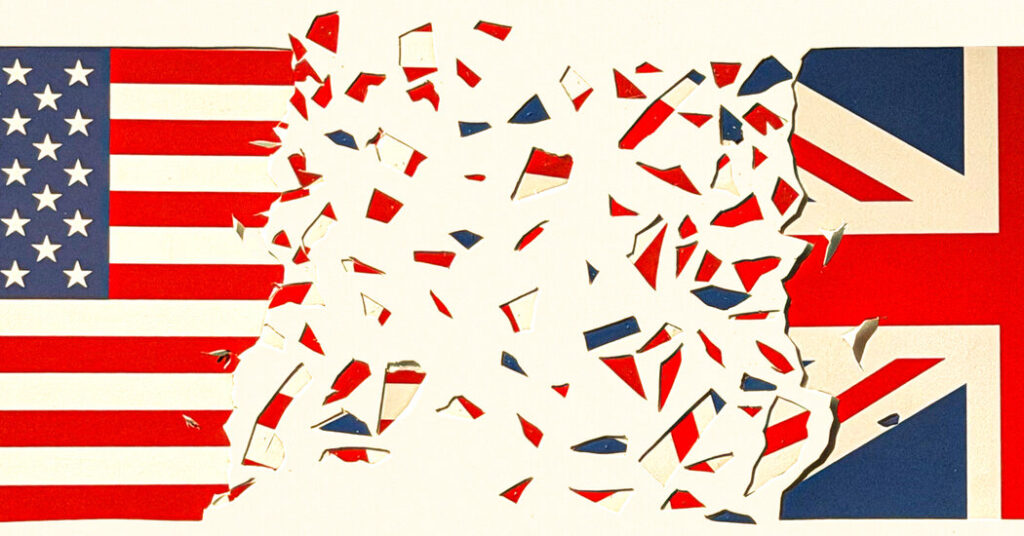
You might think that early Americans sounded like Anthony Hopkins and Helen Mirren, and that the American accent developed after independence. It was probably the other way around. Up until the early 1800s, you couldn’t tell whether a person was British or American from their accents. When naval officers tried to free sailors who had been shanghaied into service in the War of 1812, they said they couldn’t tell for sure who was American or British by the way they spoke.
The hallmark of the British accent — pronouncing words like “path” and “fast” as “pahth” and “fahst” or “fah” for “far.” — developed only at the end of the 18th century. English in the United States and Canada sound so much alike because their language started as British English in the 1700s. Australian English sounds much like today’s British English because by the time British people were sent there after the 1820s, what we know as a British accent had emerged.
Other things in early America would throw us as well. From writings in the early 19th century, we know that Southerners said “gyardin” for “garden” and “year” for “ear,” as Meriwether Lewis, of Lewis and Clark fame, rendered it in his journal. But we don’t find references to the Southern drawl that now defines the Southern speaking voice until after the Civil War.
Word usages have changed. In a transcript from an 1800 murder trial in New York City, a witness uses the word “sensible” to mean “sensitive,” as it still does in French. And this was not Elizabethan England 500 years ago, but the United States of America 226 years ago.
Even within some of our lifetimes, we can hear little differences in the way people speak. If you watch old television shows, you frequently hear people accenting phrases differently than we would. This is because names with two parts often start out with the accent on the second one, and over time, as the name becomes culturally well-established, the accent shifts to the first one. In a 1955 episode of the sitcom “Make Room for Daddy,” the characters pronounce “Little League” — founded 16 years earlier — as “little LEAGUE.” It’s more commonly spoken now as LITTLE league. In a 1964 episode of “The Dick Van Dyke Show,” a woman says “crossword PUZZLE” — because that was the way it would have been pronounced when crosswords were popularized in the 1920s, and the actress was born in 1896.
All of these sources are a good way to understand how changeable language is. It’s not just the slang or cool youth expressions I like to cover, but the very warp and woof of how we speak: vowels, how we accent words and what the words even mean. A language is like a sky full of clouds — the clouds are always moving and churning. If they didn’t, something would be wrong.
An accent changes today just as it did in England after 1800. In the English brought to St. Louis when it became part of the United States in 1804, “or” was pronounced as “ar” — “carn” for “corn,” or “farty” for “forty.” This has been on the retreat in St. Louis since the late 20th century. You could hear this in the old TV show, “The Many Loves of Dobie Gillis” when Dobie’s irascible father, played by Frank Faylen, born in St. Louis in 1905, said “What is this used far?” Listen carefully and you can hear Phyllis Smith of “The Office,” born in St. Louis in 1949, saying “narmally” for “normally.” Ellie Kemper, who was also on “The Office,” was born in 1980 and grew up in St. Louis and does not use that pronunciation in an episode of “The Unbreakable Kimmy Schmidt” in which she says “normal” as “normal” and “war” as “war,” not “wahr.”
All of this allows some informed guesses on what the American language will be like in the future. Plenty of words are teetering into new meanings, the way “sensible,” which once meant “sensitive,” now means “having good sense.” Usages that were once derided as misimpressions become so common that we come to accept them and admit that the horse is out of the barn. For Americans in 2076, the first meaning of “aesthetic” that comes to mind may well be “attractive,” the way many young people use it today. Any sense that “nonplussed” means “perplexed” will be forgotten in favor of the common impression today that it means “unimpressed.” And the most intuitive meaning of “swipe” will relate to computer screens rather than stealing or a movement of the hand.
In the same vein, I quite clearly recall a friend in 1977 excitedly telling me he had just seen a movie called “Star WARS.” The same process that got us to now saying “STAR Wars” will almost surely have us saying, for “A.I. slop,” not “ay-eye SLOP” but “ay-EYE slop.” Just wait for it.
The post The British Used to Sound Like We Did appeared first on New York Times.