Andrew Doyle is the author of “Free Speech and Why It Matters” and “The New Puritans.”
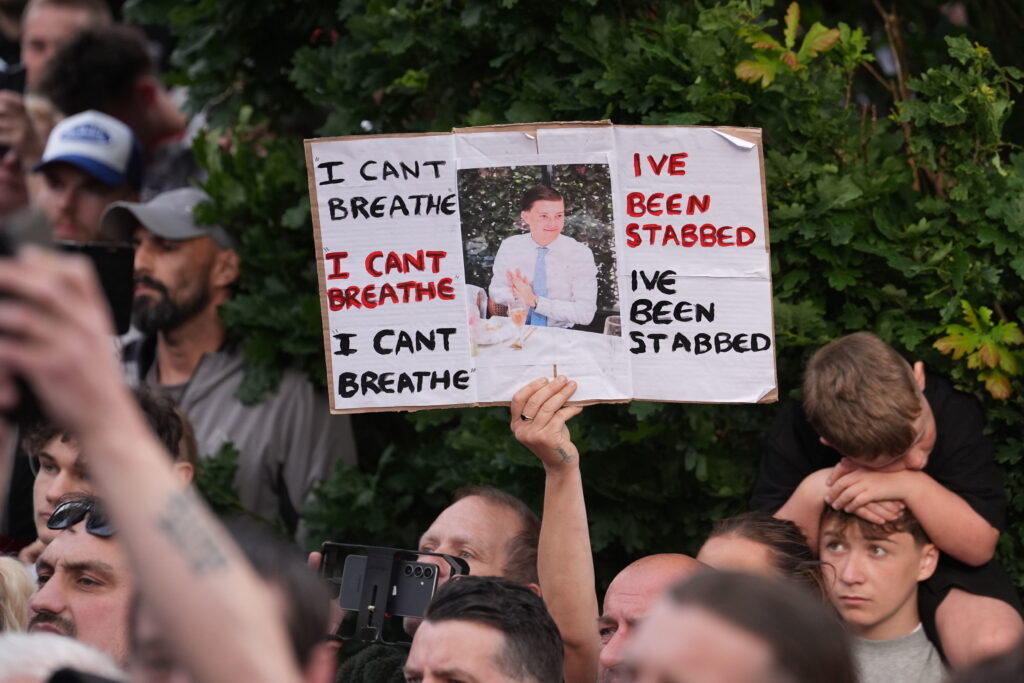
Henry Nowak, age 18, died on Dec. 3 in southern England. “He was careful and principled, full of humour, warmth and promise,” and “you, Vickrum Digwa, murdered him.” So began Judge William Mousley’s sentencing remarks on Monday in a case that has sparked an international row. Police ignored the pleas of a young man who was stabbed and in anguish. The tragedy, however, has been sidelined in much media coverage for a discussion about how the “far right” is using the incident to “stir up hatred.” Given such widespread misapprehensions, it’s worth outlining the precise sequence of events.
A little after 11 p.m., Nowak was heading home after an evening out with friends. He was walking down Belmont Road, a residential street in Southampton, recording himself on Snapchat singing songs. He wasn’t drunk; tests later confirmed that he was well below the legal driving limit.
Nowak encountered Digwa, then 22, by chance and began to film him, asking if he was a “bad man,” likely a reaction to seeing the large ceremonial knife that was attached to his belt. Digwa replied in the affirmative — “I am a bad man” — and seized Nowak’s phone, which is where the recording ended. The court found that Digwa then attacked Nowak and stabbed him four times, piercing his chest, “catching a lung and cutting an important vein, behind the collar bone.” The judge noted that although the Sikh faith calls on adherents to wear a concealed knife, the murder weapon was a second, larger blade associated with the Nihang order, which isn’t compulsory.
Digwa filmed Henry as he tried to escape, making his way to the driveway of an adjacent property. Digwa’s home was nearby, and his parents and brother Gurpreet soon arrived. While his father attempted to help the dying young man, Digwa falsely claimed that Nowak had racially abused him, a lie his brother repeated in a call to the emergency services. Digwa’s mother then hid the murder weapon before the police arrived.
During this entire scene, and even after the police appeared, Digwa continued to film Nowak as he pleaded for help. Because of the deception, and the charges of racism, the police were evidently unwilling to believe Nowak. “I’ve been stabbed,” he said, “I can’t breathe, call an ambulance.” The body-camera footage, released only after Digwa was sentenced, reveals a callous disregard for the victim. When Nowak told the police again that he’d been stabbed, one officer is heard replying: “I don’t think you have, mate.”
Then, while repeatedly telling officers that he couldn’t breathe, Nowak was handcuffed. It took about three minutesbefore they realized he was dying and needed an ambulance. The injuries sustained were so serious that Nowak couldn’t have survived even if attempts at resuscitation were made, but it is striking that the charge of racism was deemed so incontrovertible that his pleas were automatically dismissed.
Later, while in the police car and speaking Punjabi to his brother, Digwa agreed that they would pretend it was an act of self-defense. He wasn’t aware that he was being recorded. At every turn he sought to pervert the course of justice, even keeping Nowak’s phone with the incriminating footage from the police. Digwa was found guilty of murder and sentenced to a minimum term of 21 years.
The political fallout has already begun, with opposition leader Kemi Badenoch arguing that there needs to be a reckoning with the “pernicious identity politics” that were “amplified in 2020 by the Black Lives Matter (BLM) movement.” Reform UK leader Nigel Farage has said the public ought to react to Nowak’s murder with “pure, cold rage,” with Prime Minister Keir Starmer in turn accusing Farage of stoking “grievance and division.”
Starmer forgets, or doesn’t realize, that there is nothing more divisive than the misleadingly branded “anti-racism” policing guidelines in Britain that have been implemented in recent years. It is bizarre to see the prime minister deny the existence of “two-tier policing” when it is overtly built into the policy documents and police training manuals freely available online. The “Police Anti-Racism Commitment,” published in March 2025 by the National Police Chiefs’ Council and the College of Policing, explicitly requires differential treatment based on skin color. It promotes “racial equity,” which it insists “does not mean treating everyone ‘the same’ or being ‘colour blind’ (racial equality).”
This is activist language and violates the fundamental principle of equality before the law. Many well-intentioned people have been duped into supposing that “equity” and “equality” are synonymous. Whereas equality means that no one is discriminated against on account of race, “equity” means treating people unequally to equalize identity-based outcomes. The NPCC guidance is explicit on this score, stating that a commitment to equity entails producing “equality of policing outcomes.”
The police, in any case, are aware that they are operating under a two-tier system. Colin Sutton — a former detective chief inspector with the Metropolitan Police Service and now a Reform adviser — said this week that “things are dealt with by police officers in a different way depending on the race of the people they are dealing with.” Another whistleblower, a senior police officer, reportedly told journalist Allison Pearson: “What you have to understand is most chief constables would rather mess up a major murder inquiry than be accused of being racist.”
Many will doubtless dismiss these testimonies as lies, pretending that police guidance doesn’t mean what it plainly states. But for the adults in the room, there is a need to confront the reality of two-tier policing and the deep resentment it has generated. Britain is still reeling from the “grooming gangs” scandal in which thousands of British children were raped and tortured by men of predominantly Pakistani heritage. The 2014 report by Alexis Jay, chair of the inquiry into the Rotherham grooming scandal, clearly showed that the “fear of being thought racist” led to inadequate investigations. One inquiry into rape gangs in Telford found that suspects were disregarded out of a desire not to be “politically incorrect.”
Many have drawn comparisons between Henry Nowak and George Floyd, but a more accurate precedent would be the case of Stephen Lawrence, a teenager of Jamaican heritage who was murdered in a racially motivated attack in London in 1993. That horrific crime led to a much-needed overhaul of police practice, with a report by Sir William MacPherson identifying that racism within the force had led to widespread failures in the investigation of crimes of this nature. The death of Nowak should lead to a similarly urgent reappraisal.
Today’s police forces suffer from a different form of institutional bias, which prioritizes group identity and the tenets of diversity, equity and inclusion over impartial and rigorous law enforcement. Hampshire Constabulary, the force whose officers handcuffed Nowak instead of trying to save his life, have admitted as much. In 2022, Olivia Pinkney, then chief constable, declared that “being anti-racist, ethical and inclusive is top of our agenda.” One might argue that this was an inevitable “overcorrection” for the police racism of the past, and yet there is nothing remotely “correct” about an outcome that disobliges officers from fulfilling their primary duty.
The officers who disbelieved Nowak and unthinkingly accepted the false allegations of his murderer are the products of a law enforcement system that is overtly and indisputably ideological. The infantile smearing of those who expect equality before the law as “far right” or “racist” is no longer an effective strategy. A police force that serves without fear or favor is surely not too much to ask.
The post The murder of Henry Nowak and the failure of British policing appeared first on Washington Post.