Last summer, Amy Gleason became a true believer in the wonders of artificial intelligence.
Her daughter Morgan had spent more than a decade battling a debilitating autoimmune disorder. But when the 27-year-old uploaded 16 years of meticulously kept medical records into ChatGPT, the machine reported that Morgan was suffering from a different ailment than the one diagnosed by doctors. The new assessment granted her entry into a coveted clinical trial.
Gleason is not your typical mom. The leader of the U.S. DOGE Service, which she took over from billionaire Elon Musk, Gleason is now tasked by the Trump administration with bringing AI into the health care system as an adviser to Health and Human Services Secretary Robert F. Kennedy Jr.
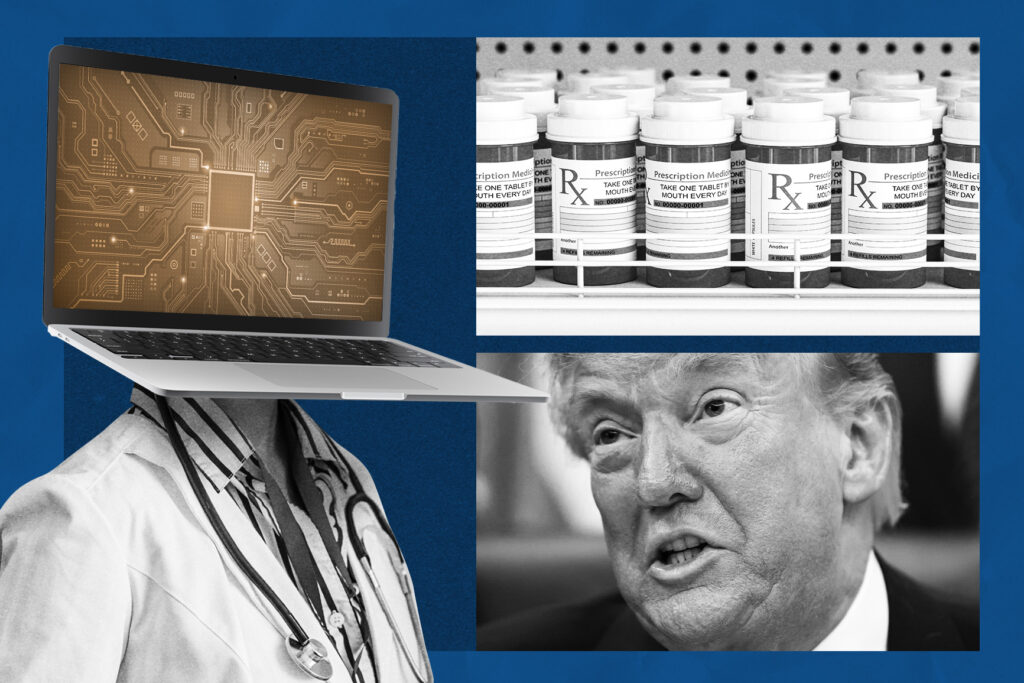
She’s part of a cohort of MAHA and tech-allied officials who are quietly paving the way for a future in which AI chatbots and robots are an integral part of medical care: diagnosing illness and prescribing medicine with limited or no human oversight. The longtime Silicon Valley dream is taking shape, some entrepreneurs say, thanks in part to a new approach within the Trump administration.
Today, chatbots can only legally offer medical guidance with a disclaimer attached: Neither the U.S. Food and Drug Administration, nor any state licensing board, allows a fully autonomous AI to practice medicine.
But Trump officials — citing concerns about the prevalence of chronic disease and issues such as the shortage of rural doctors — are driving a significant shift.
They have backed a controversial three-month-old pilot program in Utah that allows AI chatbots to refill prescriptions instantly. (Currently humans oversee the chatbot’s decisions, but there are plans to make the program fully autonomous). The Cicero Institute, a think tank funded by right-leaning tech entrepreneur Joe Lonsdale, is pushing a bill that would allow states to create similar pilots.
Officials are taking steps to integrate AI into the health care system. The administration plans to offer more than $50 million in research awards to developers of conversational AI software that can deliver cardiovascular care, so that when a person calls a medical provider with symptoms of a heart attack, a chatbot might field the call. (Anthropic, Amazon Web Services, start-ups Certuma and Doctronic and several top-tier universities are providing support to the program.)
Amazon founder Jeff Bezos owns The Washington Post.
Within the FDA, officials have created a regulatory fast track for digital health technology including AI chatbots and wearables; another program enables Medicaid to reimburse AI-powered wellness apps for the first time. Both programs are aimed at tackling chronic disease through digital monitoring tools.
And in internal discussions, administration figures are working a pathway to regulate independent AI doctors, likening the change to the decades-long process that moved self-driving cars from test tracks to cities across the United States, Gleason said in an interview.
“People are seeing the difference the AI is bringing,” she said. “And it’s like the genie is out of the bottle.”
Many appointees are hailing the era of AI in medicine, touting it as the answer to the doctor shortage crisis, the chronic disease epidemic, and other ills of the medical system. Mehmet Oz, the administrator of the Centers for Medicare and Medicaid Services, said at an industry conference in March that agency officials are in talks to bring AI agents to “every beneficiary” by the end of this year, citing a shortage of rural doctors.
The changing attitude in Washington, coupled with rapid technological advances, is powering a shift in the zeitgeist. Tech companies, including Google’s DeepMind, OpenAI, Certuma and Doctronic are pouring tens of millions of dollars into AI systems that can read medical records and tell people how to act on the information.
Entrepreneurs are newly emboldened to argue that AI can perform medicine independently, even though it’s currently not legal, said Robert Wachter, chair of the Department of Medicine at the University of California, San Francisco.
“They are saying the quiet part out loud,” said Wachter, who recently published a book, “A Giant Leap,” about AI in medicine. “You’re combining a general anti-regulatory, pro-business administration with very close ties to an enormous amount of wealth to a segment of society that wants us to go fast.”
But this idea is on a collision course with the medical profession itself. Many doctors argue that the incursion of AI chatbots into medical care will introduce a range of new problems to an already-overburdened system, from misdiagnoses to eroding the medical judgment of clinicians.
Some experts see a slippery slope between advice and diagnosis: One-third of Americans now turn to chatbots for medical guidance, according to the health research group KFF. Some doctors say chatbots are already dispensing casual information in violation of medical licensing laws.
A political backlash is growing, too. Pennsylvania Gov. Josh Shapiro (D) announced this month that his state is suing the startup character.ai, alleging its chatbot illegally presents itself as a licensed medical professional. And after Utah launched the prescription pilot, the state’s Medical Licensing Board called for an immediate suspension, saying in a letter to regulators that while it might seem like the program outsources an innocuous task, “there is a reason prescription refills require physician authorization.”
Wachter said studies like the Utah pilot will provide valuable data to demonstrate whether medical tasks can be offloaded to AI safely. But the bold claims of entrepreneurs can overstate the tech’s current capabilities, he said, and gloss over kinks that could cause harm.
“At some point there will be cases where we have given the AI a level of trust that it doesn’t yet deserve, and people will get hurt and probably people will be killed,” Watchter said. You can “just feel the backlash growing.”
The last doctor
When entrepreneurs Martin Varsavsky and Armando Cuesta sat down to write a book tentatively called, “The Last Doctor,” they were already building a chatbot that could one day put many doctors out of a job.
Varsavsky, a serial entrepreneur best known for creating a large chain of fertility clinics, started his AI doctor chatbot Certuma out of frustration while waiting weeks for an appointment with a dermatologist.
“Why should I have to wait three weeks?” he said, noting that half of U.S. counties lack a single practicing cardiologist and an ob-gyn, according to professional bodies and academic research.
Varsavsky says he wants Certuma to be the first FDA-approved independent AI physician: a chatbot that can check symptoms, issue a diagnosis and prescribe medications.
Varsavsky and Cuesta, a physician and Certuma’s chief medical officer, are actively debating their book’s working title: Cuesta likes the provocation while Varsavsky thinks it goes too far. But both men believe that in a few years many medical services, especially primary care, will be conducted entirely by stand-alone AI.
In other countries, tests are moving faster. Certuma worked with the medical regulator in Varsavsky’s native Argentina to offer prescriptions and medical advice on Certuma’s medical chatbot website, fast.doctor, which has been championed by right-wing Argentine president Javier Milei.
Doctronic, which is partnering with Utah to run its pilot, raised $65 million over the past year. Co-founder Matt Pavelle now sees an opening from the federal government. “There’s a willingness to try new things in this administration that I have not seen in any other administration,” he told me.
Cicero plans to press for its model bill in state legislative sessions later this year. Lonsdale, the tech entrepreneur and investor behind Cicero, is a main funder of Certuma.
While an emerging body of research on medical chatbots is mixed, it points to serious risks. In a February Nature Medicine study, researchers at the Oxford Internet Institute asked 1,200 volunteers to read detailed medical scenarios and then to pose as patients in conversations with chatbots from OpenAI’s GPT and Meta’s Llama.
The chatbots determined medical conditions accurately just 34 percent of the time and were essentially no better than Google in guiding users to the right medical decisions.
While AI systems have already passed medical licensing exams and have outperformed doctors in diagnosing certain complex ailments, the systems falter in the real world. People don’t explain their symptoms to a chatbot the same way they would to a medical professional, and medical professionals also listen differently than software does.
“People pleasing impulses that plague chatbots can be even more dangerous in medical settings,” said Monica Agrawal, an assistant professor of biomedical engineering at Duke University, who has conducted a large-scale study of chatbot responses to health-related questions on Reddit.
For example, a separate Doctronic chatbot than the one in use in Utah was recently goaded by researchers into saying it would prescribe fentanyl. (The drug was never prescribed because the system blocks requests for opioids, Pavelle said).
Doctors are trained to pick up on subtle cues and to elicit better information from patients. “As they currently stand, I do not think [AI chatbots] are safe or close to a proper substitute for in-person care,” Agrawal said.
But for die-hard technologists, the promise of AI doctors goes beyond the technology’s current capabilities. They point to what it could become over time. Cicero’s health policy director, Adam Meier, a former director of Montana’s health department, said that today, robotaxis are a reality on the streets of San Francisco, Los Angeles and Phoenix, but “that didn’t happen overnight.”
It became possible, he said, after years of tests, moving from controlled, exam-like settings to the real world, refining the technology and eventually showing that a driverless car can be as safe as a human driver.
Haider Warraich, a cardiologist with Boston Medical Center who is running the administration’s heart-disease research grant program, told me the effort would create safety data that eventually sets the stage for regulatory approval of AI doctors.
“It’s like we have all these new ‘medical students’ ready to graduate, but we don’t have a residency program, we don’t have attendings used to supervising them, we don’t have an accreditation body that ensures a professional standard,” he wrote recently on LinkedIn. “I do believe we can get there.”
The post Inside the Trump-backed push to bring AI doctors into American medicine appeared first on Washington Post.