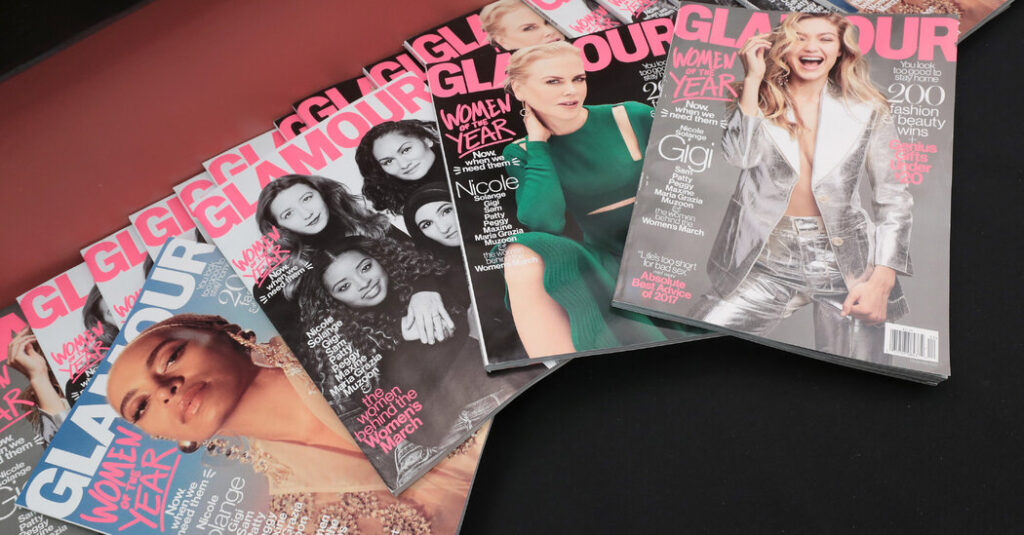
For nearly 90 years, Glamour magazine served fashion, beauty and relationship fare with some award-winning journalism. It won a National Magazine Award in 2023, for example, for coverage demanding federal paid family leave for American women. Its buzzy Women of the Year gala, which came with interviews and photo spreads of recipients, has feted the likes of Hillary Clinton, Britney Spears and Ms. Rachel.
But that era of Glamour appears to be over.
The publication will now be focused largely on shopping posts, according to its owner, Condé Nast — like “Granny Sandals Are the Secret to a Stylish Summer Look” and “The Best Spray Sunscreens for Easy Reapplication,” to take two recent examples. The goal is to earn commissions when readers click links to shops like Amazon and Nordstrom to make a purchase.
The company seems to be betting that Glamour’s site can still generate sizable revenue from display ads and those commissions without the costs required to produce more traditional journalism. As part of the change, Condé cut much of the publication’s already skeletal editorial staff in the United States in April, and parted ways with Samantha Barry, its editor in chief, without apparent plans to replace her.
The changes offer a stark example of how women’s magazines have declined in size and relevance in the digital era. And it could provide a glimpse of the direction more of the remaining women’s magazines take, as people seeking style tips and a knowing, sharp editorial voice increasingly turn to newsletters, social media platforms or even chatbots.
“It’s sad about Glamour — I saw it go through different iterations, and it really did always have a standard of being pro-women and politically being on women’s sides,” said Jane Pratt, the founder of Sassy and Jane magazines, who now runs a website. “By getting out of that, what they’re doing is going more into competition with the shopping portals.”
After the staff cuts in April, Glamour’s U.S. homepage — it stopped publishing in print in 2019 — has a few regular articles, like a broadcaster’s account of receiving plastic surgery, which was contributed by a laid-off staff member. The majority of headlines go to shopping recommendations. The homepage now lists the photos and titles of one of its remaining editors and four “commerce” editors and writers, who focus on shopping posts.
Condé Nast said in a statement that Glamour “recently transitioned to a new integrated structure combining staff and functions across the U.S. and U.K.,” and that figures on the remaining U.S. staff “do not reflect the current organizational model.” It did not specify the number of remaining writers and editors.
Glamour will continue publishing digital versions in Britain and by license in markets including Brazil and Australia, while closing those in Germany, Spain and Mexico, Condé Nast’s chief executive, Roger Lynch, said in a memo in April. It will also focus on social media and videos, he wrote.
Condé Nast started the magazine as Glamour of Hollywood in 1939, making it one of the company’s oldest titles, but shortened its name when World War II reshaped the lives and ambitions of American women. It instead focused on “the girl with a job,” which would guide coverage for decades. Its glossy pages contained fashion, beauty and sex tips but also coverage of abortion, sexual violence and women’s growing financial independence. Gloria Steinem was an early contributing editor, and Glamour was one of the first major American magazines to feature a Black woman on its cover.
The magazine’s Women of the Year awards, introduced in 1990, became a cultural touchstone and a major undertaking for its journalists, featuring interviews and photo shoots. Those it recognized included Anita Hill, after she accused Clarence Thomas, then a Supreme Court nominee, of sexual harassment in testimony before Congress in 1991.
“I don’t know very many magazines, neither Time nor Newsweek, that gave me that much interest,” Ms. Hill, now a professor at Brandeis University, said in an interview, adding that it had given her hope. It took a place like Glamour, she said, “to understand what the moment could mean to women.”
But like its peers, the magazine got pinched by the digital age. It went online-only soon after hiring Ms. Barry, a former executive producer for social and emerging media at CNN Worldwide, as its top editor in 2018.
Glamour and Ms. Barry struggled to find their footing amid the loss of print advertising, and as the site’s traffic fluctuated with the whims of Google and Facebook. Its ad salespeople often struggled to pitch the magazine to brands, which were increasingly uncertain about whom the outlet was trying to reach, said four former employees, who spoke on the condition of anonymity, citing confidentiality agreements. At the same time, readers increasingly found their beauty and style information through Facebook groups and individuals on Instagram, YouTube and Substack, rather than magazines like Glamour.
“These were places that were so big that they needed to be for the everyperson, and that’s the opposite of what’s happening right now,” said Becky Malinsky, a former fashion editor at Glamour and The Wall Street Journal who now runs a style newsletter with more than 100,000 subscribers. “People are looking for individuals with a point of view.”
Glamour started emphasizing commission-driving links to the staff during the Covid-19 pandemic, the former employees said. And annual revenue from the shopping content rose to several millions dollars, said two people with knowledge of the figures.
It seemed to be a rare bright spot, especially as the Women of the Year event was often overshadowed by other Condé Nast events, like Vogueworld and The New Yorker Festival, three of the former employees said.
Many publishers, from New York magazine to The Wall Street Journal, now make some revenue through commerce-related content, earning a commission after people click links from their reviews and shopping guides, and then buy products from places like Amazon, REI, Zappos and more. (The New York Times does this through Wirecutter.)
The people who create posts with affiliate links, as they’re known, typically operate separately from a publication’s primary news staff, though they often use the outlet’s voice.
The line between editorial and commerce jobs can be blurry at lifestyle publications. For example, a recent job listing for a commerce editor at Allure, another Condé Nast title, asks applicants to work with affiliate link companies to “optimize revenue opportunities” and tap into Google and chatbot searches for shopping posts.
Glamour has “long maintained a successful commerce business, with editorial and commerce operating as one team,” Condé Nast said in a statement. “The brand only features products it believes in editorially and that it considers relevant to its audience.”
Ms. Malinsky said Glamour’s challenge would be maintaining trust with readers even as more of its content focused on shopping.
“It’s very clear who is recommending something, because they’re making money off it versus what is an honest product review, and I think people and brands have to be really careful with that,” Ms. Malinsky said.
Ms. Pratt said that after she left her site, xoJane.com, which was sold to Time Inc. in 2015, it continued generating income through display ads and affiliate revenue without new content, even as site visits declined to around two million unique visitors a month from roughly eight million.
“You can ride that traffic for a while,” she said. “It makes short-term sense because you can save a lot of money on all that editorial.”
But, Ms. Pratt added, “I don’t think it’s ultimately a direction for growth.”
Sapna Maheshwari reports on TikTok, technology and emerging media companies. She has been a business reporter for more than a decade. Contact her at [email protected].
The post At Glamour, a Once-Mighty Magazine, a Skeleton Crew Churns Out Shopping Links appeared first on New York Times.