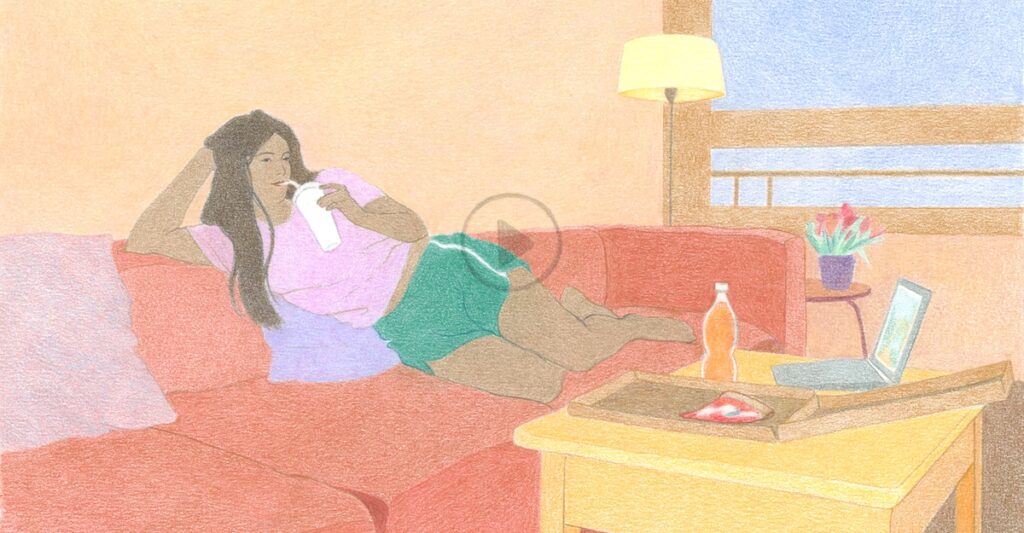
Lana Isa has 195,000 followers on Instagram, for videos that mostly consist of her shuffling around her quiet, tidy apartment. She slides a premade pizza into the oven, pours herself a wineglass full of Diet Coke, and settles in on the couch. Or she plays a crackling fake fireplace on her TV screen, dims the lights, and watches the rain fall outside her window. Sometimes she takes walks, tries new cafés, goes shopping. No one else ever shows up in her videos, though she occasionally mentions FaceTiming her mother. A typical subtitle reads: “POV you’re single, have no friends, live alone and won’t be having kids so this is your Friday night.”
Isa, a 24-year-old in Toronto, is what you might call a solitude influencer: someone who gives followers a peek into mundane solo moments. Not all of these creators claim to have zero friends, but they generally take pride in the peaceful existence they’ve constructed. They use tags like #cozyathome, #introvertdiaries, and #alonenotlonely. One proclaims in her bio: “nyc with no friends and no complaints.” Another posts about being happily single in her mid-30s, living with her parents, and interacting only with them; taglines include “It’s ok to live a life others don’t understand” and “it’s only embarrassing if you’re embarrassed.”
These videos are popular enough that, much of the time I’ve mentioned them in conversation, people know exactly what I’m talking about. Some relay their bafflement. No friends at all? Not even a couple? Others, with a tone of knowing cynicism, declare the genre depressing but unsurprising: a dark corner of the internet, symbolic of rampant loneliness and the emptiness of modern life.
I can understand those reactions. Yet the clips keep pulling me in—keep pulling a lot of people in, judging by follower counts. They seem to serve, paradoxically, as watering holes for a community of commenters, who arrive in droves to chat about their anxieties, their beloved pets, their food preferences, their favorite novels. And they remind me of something I’ve learned while reporting on social connection over the years, speaking with sources who are at once busy and burned-out, lonely and restless, distrustful and hungry for kinship: Many people have a complicated relationship with aloneness, whether they have too much of it or not enough.
The solitude influencers are not the only people who say they walk through life almost entirely alone. A few years ago, I wrote about nocturnal ultra-introverts who go about their business at night, specifically because of the peace that comes when most others are asleep. They, too, were resolute in creating a life that suited them, and they, too, cherished the tranquility of their home and mind. Psychologists have told me that some people probably do need very little social interaction. It’s merely an individual difference.
The influencers, though, are different in one obvious way: They’re motivated to share their lifestyle online. On a call, Isa told me that influencing doesn’t get in the way of pure solitude; she has notifications turned off on all her social-media platforms, and she makes a point not to check them right after posting. The only people who text her, she said, are her mother and sister—and her phone provider, when her cellphone bill is due. Yet it’s hard to deny, scrolling through her videos, that she’s taking part in something inherently social.
Sometimes she chats away as she drives to town or whispers to her viewers from inside a store. One of her captions reads, “pretending like you guys are my friends and we’re on facetime  .” And many of her commenters seem to think of themselves as just that—her friends. They cheer her on when she gets out of the apartment. They compliment her hair. They recommend books and makeup products. “Omg I loved this long video! It felt like we were all just hanging out together!” one wrote. “I’ve been a happy loner all my life and I watch vlogs while I eat meals for a little ‘company’ lol,” another confessed.
This was one of the more supportive corners of the internet I’ve seen. But it was also odd: strangers gathering, to celebrate being alone.
Isa’s work made more sense to me when I heard her origin story, which she shared with followers in a series of videos. Growing up, she says, her home life was chaotic. At school she was picked on for being poor, for having crooked teeth because her family couldn’t afford braces, for her shyness and frizzy hair. At an early job, she became close friends with one co-worker and developed a crush on another; she started dating the latter when she left. Then she realized that the two were seeing each other behind her back. So she learned: Other people will hurt you. Now she’s a kind of mentor for legions of people who also want “a little company”—at a safe remove. She shows them that you can take yourself to the hospital when no one is there to accompany you, or go to the movies when you want to “feel community” without really having it. “If you are on this journey of being alone,” she said in one video about spending Christmas solo, “I’m so excited to be a part of it with you and to show you how amazing it can be and how fulfilling it can be to make yourself happy and not rely on other people.”
Other people, it’s true, are complicated and messy and sometimes not worthy of trust. They can make life harder, or at least less simple. Solitude influencers tend to have two main types of commenters, I noticed. There are the ones on a “journey of being alone,” who appreciate Isa’s guidance and validation, or who just like seeing their lifestyle represented. But there are also the ones who pine for more solitude than they’re getting: who are tired of sloppy roommates or bickering friends or demanding families. Some of them appear to be devoted but exhausted wives and mothers. “I love my husband and the sweet life we’re doing together, but I would have wanted to spend time alone like you’re doing right now so I wasn’t still trying to figure out who I am at 42,” one commented. “I find your videos very relaxing,” another person shared. “No drama, no one with demands on your time and energy, freedom to do what you want, how you want, when you want.”
[Read: You’ve probably already met your next best friend]
This type of commenter seemed to watch in the same way as people who follow ultrarich influencers on vacation in Bali—with envy, or simply with vicarious pleasure. When I first encountered the solitude influencers, I’d been so busy, running from work to drinks to work to dinner, that I could see why people found their posts so soothing, even aspirational. I let myself imagine how I’d enjoy my own seclusion: I’d read all the unread books sitting on my shelves. I’d chip away at the films on my long to-watch list. I wouldn’t always have to be so on, so attuned to sensitive social dynamics—whom I was due to check in with, who was annoyed with whom, who had slighted me without even realizing it.
Most people, to some degree, are torn between different psychological needs. They might feel loneliness if they have too much solitude but experience what psychologists call “aloneliness” when they don’t have enough. They might crave connection but also resent it for asking so much of them. In the United States, as in many other places, a lot of people are spending ample time alone. They’re ordering in a ton of delivery; they’re streaming a ton of Netflix. But many are also stretched thin: working long hours, maintaining side hustles, caring for kids or aging parents without much help, living with parents because they can’t afford rent. There is a reason the solitude influencers’ homes are always so neat, the decor so bland, the music smooth and unremarkable. It’s a fantasy for overextended viewers, watching from the homes they don’t have time to clean, while they’re covered in baby food or tuning out the neighbor shouting through paper-thin walls.
[Read: The anti-social century]
Isa—the person, if not the persona—seems to embody all these contradictions. When I spoke with her earlier this month, she seemed more ambivalent about her lifestyle than I’d expected. As much as she values her peace, she would love to have a small group of close friends someday, she said. She imagines going out for drinks with them, giggling and chatting and slightly buzzed. “I’ve never really had that, so I can’t really tell you if that would be better than what I currently do,” she said. “But the concept of it sounds fun.”
In adulthood, though, new friends don’t just fall in your lap. You can’t know if someone’s worth trusting until you try putting your trust in them. To build the relationships she does want, she acknowledged, she’d have to make a concerted effort. She’d have to take a risk.
I knew that after we hung up, and after I finished writing this story, I was going to walk through the warm evening to my friend’s house for dinner and piña coladas. I’d been stressing about getting everything done, about not having a break in between, about going to bed late again. Now I felt almost guilty, and immensely grateful. I’ll probably never find the right balance of solitude and connection, I thought. But what I had, in that moment, felt close enough for me.
The post The Strange Appeal of the Solitude Influencer appeared first on The Atlantic.