In the debate over Britain’s legacy as a global power, the figure of Winston Churchill has become a culture war litmus test.
To plenty in the country, the man who saved the nation from Nazi tyranny is no less than the greatest Briton who ever lived. To others, Churchill’s fervent defenses of Britain’s imperial project crossed the line into racism.
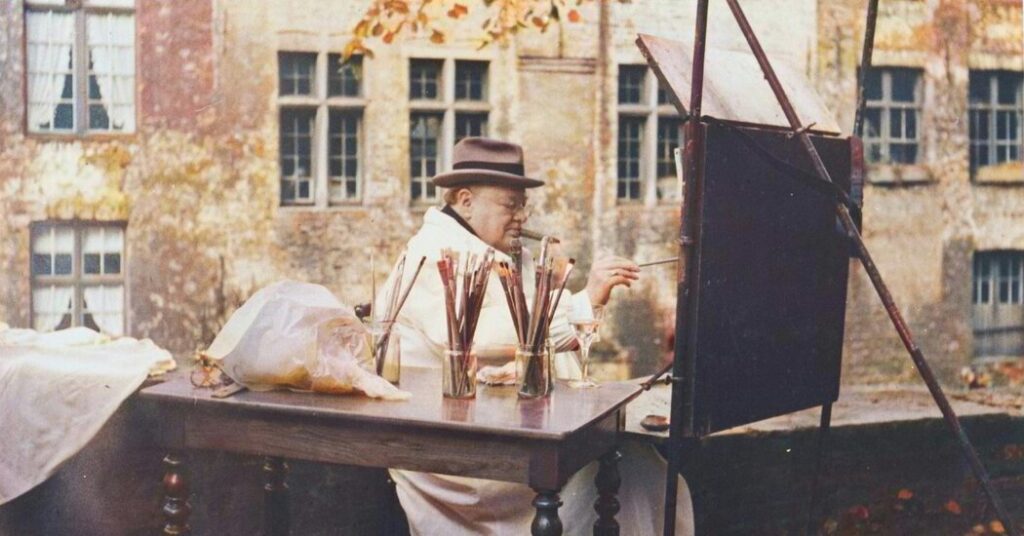
The Wallace Collection, a London museum, is seeking to sidestep that debate by presenting a vision of the man that might be unrecognizable to many on either side: Churchill as an artist.
In the first major British retrospective of his paintings for over 65 years, the museum’s curators have cast the statesman as no mere hobby painter, but as both an artist worthy of serious consideration and a leader whose vulnerabilities are visible on the canvas.
“This show is about assessing him as a painter, which has not really been done before,” Xavier Bray, the Wallace Collection’s director, said during a recent tour of the exhibition, which runs through Nov. 29. “It also shows that leaders are not untouchable,” he added. “They have their own fragility.”
Bray said that art critics were unfair to dismiss Churchill as a dilettante, when “actually, his skill is pretty good.”
Churchill picked up painting during World War I when he was in his early 40s — a trying time, by his own account. In 1915, he had been blamed for the catastrophic failure of Britain’s naval campaign on the Gallipoli Peninsula of Ottoman-era Turkey and demoted to a minor government position.
A few months later, he took up a command post on the Western Front and took his easel with him. An early canvas depicted a bombed-out British battalion in a Belgian village.
As Churchill later cycled between the heights of power and grim political defeats, he would return to the canvas hundreds of times, tackling subjects like the goldfish pool at Chartwell, his beloved country estate, and the coves of the French Riviera. Some have fetched millions of dollars at auction, but no major museum in Britain has exhibited his work since 1959.
It’s true, Bray conceded, that Churchill’s style was always at least 30 years behind the fashion of the time. His affinity for oil on canvas and landscape subjects was influenced by late 19th-century French art, said Bray, particularly Claude Monet and other Impressionists.
But even if their style was already passé by the early interwar period, compared with the avant-garde movements of Cubism and Surrealism, the canvases still offer a glimpse into the interior life of a man who steered Britain through some of its most defining 20th-century moments.
“They provide a sight of him that is joyous and passionate,” said Bray, “which might surprise people.” Churchill could sometimes dwell on life’s more difficult moments, but he also clung to hope, Bray added: “The painting is an expression of that.”
On a tour of the British administrative territory of Palestine as colonial secretary in 1921, Churchill painted a cityscape of Jerusalem at sundown. Days earlier, he had chaired the Cairo Conference, carving up the Ottoman Empire’s former territories into the precursor states of the present-day Middle East.
But by the early 1930s, Churchill was again out of power and sidelined. In 1938, as Britain adhered to its policy of appeasing Nazi Germany, Churchill painted bathers frolicking on a beach in southeastern England. Looming on the right of the canvas, a Napoleonic-era cannon points forebodingly in the direction of continental Europe. “It’s a moment of him saying, ‘We cannot trust Nazi Germany,’” Bray said.
There may also be clues to Churchill’s frame of mind in his palette choice, which was filled with color even in moments of despair.
Jennie Churchill, a great-granddaughter, said that his brilliant use of color “could well be construed as a form of defiance,” adding that painting doubled as a way for Churchill to deal with his mental woes. Churchill frequently described a “black dog” following him through life, although historians have contested the question of whether this could be a reference to depression.
“His paintings gave such enormous relief and pleasure to him,” his great-granddaughter added, “seeing him through good times and bad times, dark days and bright days.”
In a 1921 essay explaining the appeal of painting as a pastime, Churchill himself described the art form as a type of emotional therapy. “Whatever the worries of the hour or the threats of the future,” he wrote, “once the picture has begun to flow along, there is no room for them in the mental screen.”
In 1943, when Churchill had been prime minister for nearly three years, he painted his only known canvas during World War II. At the Casablanca Conference in Morocco, he had secured a diplomatic coup for Britain: a commitment from President Franklin D. Roosevelt that Allied troops would launch their initial invasion of Axis-held Europe through Italy rather than Normandy.
Afterward, he invited Roosevelt to Marrakesh for a few days’ rest, and the two shared an evening on the rooftop of their villa, admiring the view. After Roosevelt left the next day, Churchill stayed on to paint the scene, which he titled “Tower of the Koutoubia Mosque.”
“I think many of his best pieces really capture the sense of a fleeting moment,” said Catherine Katz, a historian who has studied Churchill, “as if he’s trying to command the moment to remain through his art.”
The canvas was presented to Roosevelt as a gift, which Katz said represented a high mark of soft power diplomacy. “This is the moment when he’s capturing the twilight of Britain’s heights of power, and also the peak of his friendship with F.D.R.,” Katz said.
At an auction in 2021, “Tower of the Koutoubia Mosque” broke a record for Churchill’s art by fetching 8.3 million pounds, about $11.5 million. The seller was Angelina Jolie, who had received the painting as a gift from Brad Pitt.
Many of Churchill’s other paintings have ended up in the hands of private American collectors drawn to “Churchilliana.” About half of the exhibition’s works have been lent from rarely accessible private collections, and Bray said that most of the private lenders were American.
In total, Churchill produced over 500 canvases before ultimately putting his paintbrush down in 1962, when he was in his late 80s.
“The volume of Churchill’s art is really an insight into how much anxiety and worry he did feel about the world, about the future, his place in it, but also humanity at large,” Katz said. “It’s easy to lose the person within the titanic heights of history. But through the art, you can see the person that is Churchill.”
Winston Churchill: The Painter Through Nov. 29 at the Wallace Collection in London; wallacecollection.org.
Leo Sands is a correspondent for the Breaking News Hub of The New York Times based in London.
The post Was Churchill a Serious Artist? This Exhibition Says, ‘Yes.’ appeared first on New York Times.