LAND, by Maggie O’Farrell
Cartography has never been a neutral discipline. Maps offer a partial view of a landscape, informed by what the mapmaker wishes the reader to see. A colonizing army will mark the features of the terrain that serve its purposes and exclude inconvenient signs of prior habitation. And they will do this in their own language.
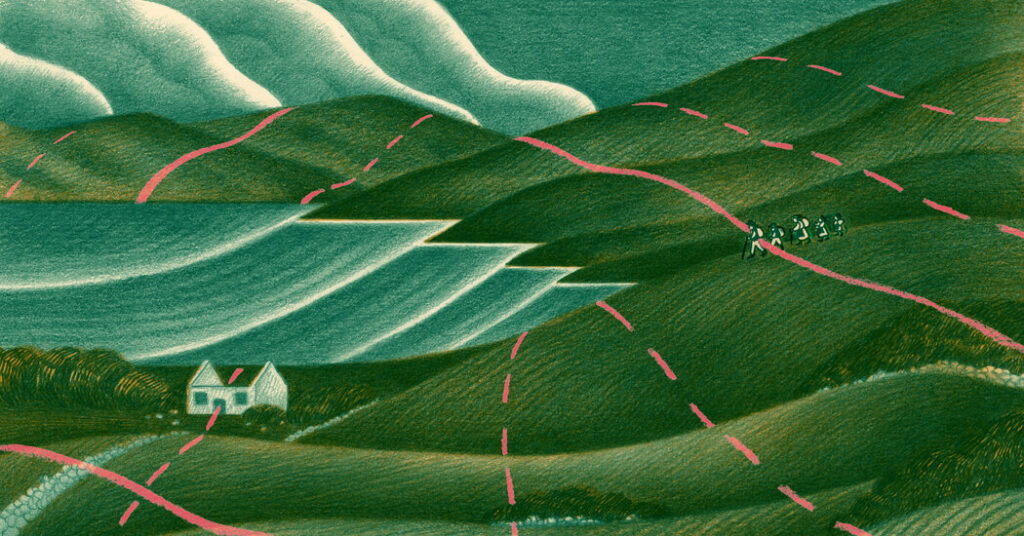
“Land,” Maggie O’Farrell’s 10th novel, is set in Ireland in the 1860s. It has been more than a decade since the Great Hunger killed over a million people and forced an even higher number into exile, and the landscape is dotted with empty villages and over-full graves. Tomás — an Irish mapmaker working for the British “redcoats” — and his young son, Liam, are charting a remote peninsula on the country’s west coast when Tomás has a sudden, revelatory experience at a pre-Christian holy spring.
What he encounters there inspires him to abandon his official job and counter the efforts of his erstwhile employers by drawing his own, dissident map of the area. It will reconstitute the terrain as its inhabitants understand it, in their language, honoring the communities that have been annihilated, the woods and waterways that rightly belong to them, and the old cultural landmarks the British have no use for.
The task, for Tomás, is personal: Both he and his wife, Phina, were orphans of the Hunger, forced from their rural lives into urban workhouses. He moves his family from Dublin to the countryside as an act of reclamation and renewal. But Phina is more ambivalent. She worries about money now that her husband has forgone his regular salary, and about her daughters’ future prospects given that in their new village Catholic schooling is reserved for boys.
Like much of the Irish-British author’s previous work, including her most famous, the 2020 book “Hamnet” — adapted into a 2025 film by Chloé Zhao — “Land” is a historical novel imbued with O’Farrell’s signature interest in absorbing family relationships. The first half sows the seeds of a defiant, multigenerational reckoning with the British Empire, and to an extent the Catholic Church. We encounter a windswept landscape; a menacing, nameless viscount; a kindly widow who represents all the grieving folk of the land; a condescending priest. O’Farrell takes us on a lively deep dive into the land’s prehistory — a place of hill forts, druids, wanderers and wolfhounds, where virgins are ritually sacrificed to stave off bad weather.
Great period novels balance larger historical context with personal details and textures, and at first “Land” feels poised to do just that, deftly situating a rich portrait of family life amid Ireland’s centuries-long struggle against British rule.
But as the novel proceeds, this promise largely dissolves. Tomás’s cartographic ambitions, initially presented as the story’s engine, fall from focus as the narrative shifts to his children’s comings of age and their own varied relationships to the Irish diaspora across the British Empire.
Unfortunately, O’Farrell leaves these relationships and their wider ramifications mostly unexplored. Liam joins the Jesuits and travels as a missionary to South India, where he briefly considers the connection between his role and that of the British in Ireland, but ultimately loses his faith because of homesickness rather than any true engagement with the locals’ plight.
His sister Enda journeys to Quebec on an emigration permit she’s stolen from Liam, and struggles to make a living there as a domestic laborer and street musician. She meets her love interest in the immigration line: an Eastern European teacher turned cook who picks up work as a logger in the summers to make enough money to bring the rest of his family to Canada. But the novel pulls its punches when it comes to the parallels between deforestation in the Americas and that in Ireland.
O’Farrell’s writing is propulsive and luscious throughout, and there are some moving passages told from the perspective of Phina’s nonverbal youngest child, Eugene. But the problems with “Land” stem from its reluctance to question the moral clarity of its core characters. They are all unimpeachably good. Tomás loses his grip on reality, and their other daughter, Rose, resents her siblings for leaving her behind on the peninsula; but the real darkness in the novel lies outside the family unit — with the redcoats, the viscount, the church. The evils of imperialism do not require its victims, real or imagined, to be pure and incorruptible, especially when their own migrations make them the dominant presence in other colonies.
At its best, “Land” evokes weighty, time-slip novels like Alan Garner’s “Red Shift,” drawing associative lines across eras and grappling with the long afterlives of colonial violence. But it is deflated by characters whose confrontations with the forces around them are too shallow to constitute a serious reckoning with the moral dilemmas the novel poses at the start.
LAND | By Maggie O’Farrell | Knopf | 384 pp. | $32
The post Maggie O’Farrell Draws a New Map of 19th-Century Ireland appeared first on New York Times.