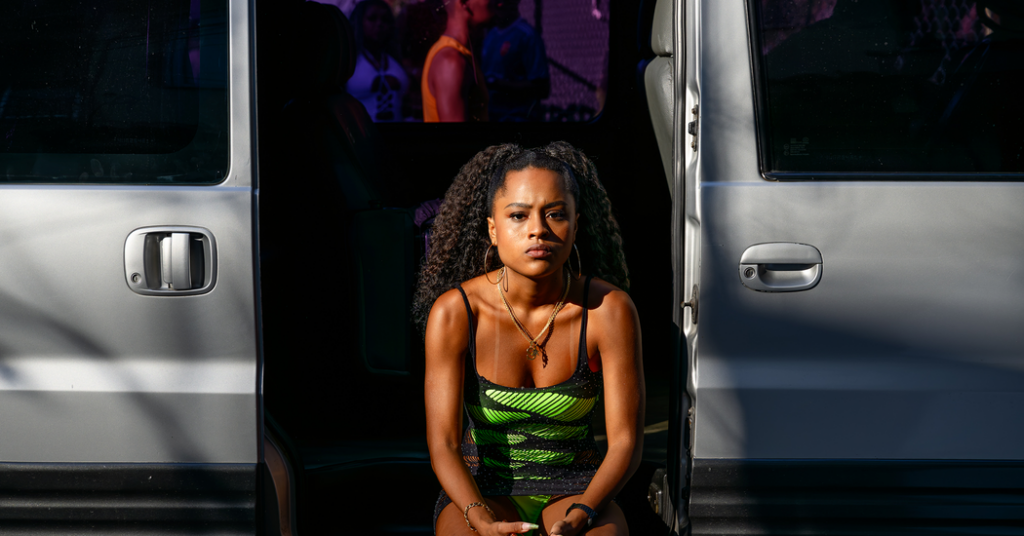
“Art is the antidote,” an acting coach named Melanie (Ari Graynor) proclaims in Sophia Takal’s “Act One,” a standout at this year’s Tribeca Festival. A wickedly charged thriller, the film follows a teenager who’s inducted into a local theater company. Enthralled by the troupe’s adult promise, she falls under the sway of Melanie, a tantalizing and terrifying mentor who steeps the plays in self-mythology. They are “change agents,” Melanie crows, with a duty to “show people the path to living their truth.”
Takal wants Melanie to sound ridiculous, a spout of highfalutin creative babble. But the character’s rhetoric reminded me a little of the Tribeca Festival itself. For years now, the event has lived in buzzword land. Premieres occur alongside summits, performances and showcases led by “storytellers” and “creators.” Some attendees may skip movies for live podcast recordings or video game demos. The festival has long been known for its kitchen-sink mélange of high and low, mixed with lots and lots of mushy middle.
This edition marks Tribeca’s 25th anniversary, a milestone, and an occasion to celebrate the wins. Chief among them is the festival’s track record of elevating first-time filmmakers, some of whom — like Nia DaCosta and Damien Chazelle — have gone on to become major Hollywood figures. Founded in the wake of 9/11 with an aim to revitalize Lower Manhattan, Tribeca was never going to be a Cannes or even a Sundance. But now, securely in early adulthood, Tribeca has become its own known quantity: maximalist and scattershot, but worth moviegoers’ attention.
This year, several highlights center on artists living their truth, to borrow Melanie’s line. That’s certainly the case with “Funk,” directed by Aly Muritiba, about a Brazilian music artist dead set on making it big. Freestyling rap lyrics in venues across the favelas of Rio de Janeiro, Sabrina (the magnetic Duda Santos) goes head-to-head with chauvinist industry hotshots while boasting a no-holds-barred raunchiness onstage and off. Crackling with energy, the film plays like a Brazilian funk version of “A Star is Born,” if that star spent as much time twerking as vocalizing.
In “Act One,” set in the 1990s, Hannah (the captivating Ella Beatty, the daughter of Annette Bening and Warren Beatty) is a friendless 17-year-old thespian who enrolls in Melanie’s acting studio. She becomes teacher’s pet, then watches her boundaries erode as she sacrifices more and more for the cultlike troupe. An erotic freakout, the film hangs on Takal’s knack for baring the dark side of female bonds, or maybe the scarlet side, given that she often ends scenes by fading to red — a flourish that nods to Ingmar Bergman’s 1972 drama “Cries and Whispers” while cuing the carnage to come.
An equally insular artistic program takes center stage in “Mother Future Self,” the directorial debut of Tori Lancaster, who was the art director on indies like “The Sound of Silence” and “The Miseducation of Cameron Post.” A simmering exercise in tension and release, the film takes place at an experimental dance residency in rural Maine, where ex-besties Sofi and Jordan (Imani Jade Powers and Betsey Brown, both entrancing) cross paths and rub salt in old wounds. The film draws from the somatic practice of the dance artist K.J. Holmes, who, playing the women’s instructor, inspires them to channel their buried feelings through their bodies, not always in the gentlest ways.
Female friendship and its complexities are also examined in Alisa Kolosova’s “I Spy With My Little Eye,” a lovely German drama. It tracks Yalda (Soma Pysall) and Lou (Svenja Jung) after their childhood friend, Solveigh (Saskia Rosendahl), dies by suicide, leaving behind a daughter. As the women sort out post-loss logistics and argue over child custody, long-festering resentments become a blame game. The actresses sensitively portray the three women across life stages, their ages signaled by changing clothing and hairstyles. What emerges is a view of friendship in long exposure, as they grow, and grow apart.
The restless “Here I’m Alive,” from Joshua Z Weinstein (“Menashe”), unspools over a more condensed period: a single evening in New York City. Bouncing from an agoraphobic gamer’s online forum to a sugar baby date to a crowded women’s shelter, this ensemble film is part of a tradition of hyperlink cinema. As in “Crash” or “Babel,” the paths of Weinstein’s band of strivers (mostly played by first-time actors) cross only fleetingly before whirling off in different directions. Linking the characters is a preoccupation with social media: a yearning for connection while engaging with the world primarily through screens.
An earlier form of media is collaged into a moving ancestral story in “Mexicanamerican,” from Eddie Sánchez. For his feature debut, the filmmaker sifted through hours of home video recorded by his parents, Lalo and Beby, to assemble the tale of their meeting in Mexico and move to Oregon, where they raised their children. The footage originally served as a kind of visual missive, captured by Lalo and Beby to mail to relatives in Mexico. Pairing the video with candid interviews about his parents’ passage to the United States and efforts to assimilate to a new culture, Sánchez crafts a portrait of diasporic identity that pulls from the past while tilting hopefully toward the future.
Melanie might have seen art as an antidote, but as all critics know, it is also grist for furious analysis. There are few more seasoned in that endeavor than the subjects of Alison Chernick’s “House of Criticism,” an amiable profile of the married art critics Jerry Saltz and Roberta Smith (formerly the co-chief art critic for The New York Times). A New York love story, the film captures their affection and their competitive streak. It also reveals that Saltz came to criticism long after his wife, and his early ledes were shaped — sometimes dictated — by her.
Chernick records the voluble Saltz and the reserved Smith inside their bibliophilic apartment and at galleries, where, as their goddaughter Lena Dunham remarks, spotting an art critic is like seeing an endangered species in the wild.
As a critic, my takeaway is that to watch these giants compare notes on the ecstasies and agonies of the profession is a dream. To write about it is hell. Who wants to be judged by the judgers? When he became a critic, Smith said to Saltz: “If you don’t get better, I’m going to kill myself.”
The post The Tribeca Festival at 25: Artists Reign appeared first on New York Times.