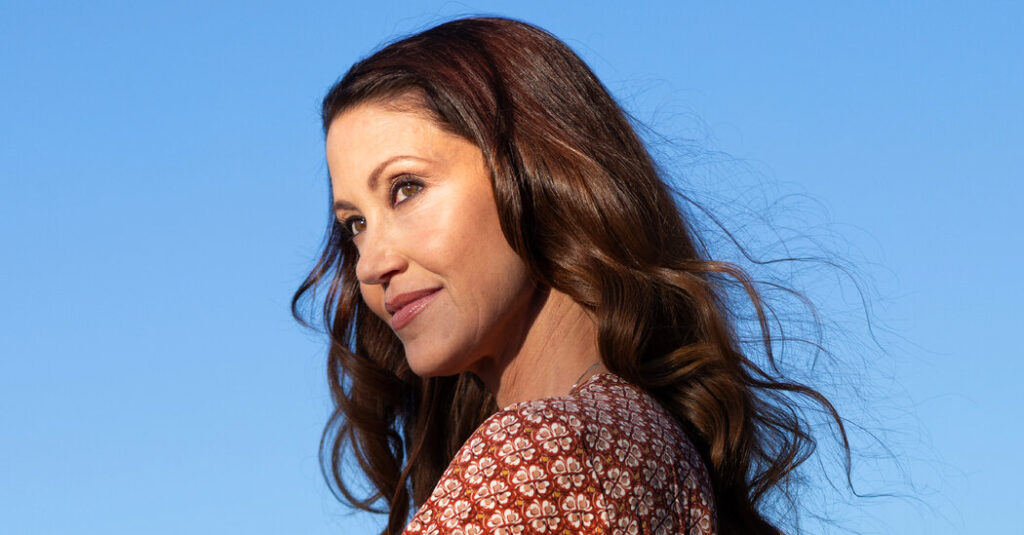
When Shannon Elizabeth’s character, the foreign exchange student Nadia, peeled off her clothes in the 1999 summer blockbuster “American Pie,” jaws dropped and hormones thrummed in theaters across the world.
In the spicy scene, Nadia — stunning, tan and long-limbed — presumes she is alone while changing clothes in the bedroom of the bumbling teenager Jim, played by the newcomer Jason Biggs. When she finds a dirty magazine, she proceeds to masturbate. But unbeknown to her, she is being secretly livestreamed on a webcam. And the feed, intended to be viewed by a cadre of horny teenage boys, is instead streamed to everyone at their school. When Jim enters the room, she’s into him, but he can’t contain his, well, excitement.
By pushing taboo-defying irreverence and full-on cringe to the brink, the scene helped cement the movie as the pinnacle of the raunchy Y2K teen sex comedy.
It’s also a moment that predicted a fast-approaching era when technology and voyeurism would converge — and a moment that today would more likely leave audiences aghast. But in 1999, it made Elizabeth, despite her limited screen time, a breakout star of the film, which made nearly $250 million at the box office worldwide and was filled with soon-to-be household names including Biggs, Natasha Lyonne, Mena Suvari and Alyson Hannigan. “American Pie” would spin out three sequels, two of which starred Elizabeth, making it a nearly billion-dollar franchise.
When Elizabeth and I spent an afternoon together in February, she recalled being compared to Phoebe Cates, who famously undressed in the bawdy 1982 coming-of-age film “Fast Times at Ridgemont High.”
Nadia was “a throwaway character at first,” as she put it, that changed the trajectory of Elizabeth’s life. The part led to a string of memorable film roles in the years that followed: in the horror parody blockbuster “Scary Movie” (2000), where she flexed her comedy chops; the horror film “13 Ghosts” (2001), alongside Tony Shalhoub; and the director Kevin Smith’s cult classic “Jay and Silent Bob Strike Back” (2001). (The day we met, she was racing to the airport for a flight to Florida, where she’d join Smith and others for the Jay and Silent Bob Cruise Askew, hanging out with fans on the high seas.)
A Playboy shoot timed to coincide with “American Pie” cemented her as the bombshell of the era.
“What’s weird is that it’s not me,” Elizabeth, 52, said with a laugh. “I am like the last person that’s comfortable being naked like in my own life.”
Still, in April, she announced she was joining OnlyFans, a powerhouse social media site populated mostly with racy, and often explicit, content. Elizabeth joins a small but growing number of celebrities on the platform; Denise Richards, an OnlyFans success story and a friend of Elizabeth’s who’d appeared alongside her in “Love Actually” (2003), was “invaluable to helping guide me.”
Within 10 days, Elizabeth had made over a million dollars, an amount she’d previously expected could take a year. “I was blown away,” she told me in May. “My fans have really shown up for me, and they’ve supported me. And they’re still there supporting me, which I just never would have expected.”
She sees her presence on the site as an extension of her “American Pie” days, when she created a personal website to interact with fans, one of the first celebrities to do so. “The tech wasn’t ready for it yet,” she said. “We kept crashing the servers.”
So far, Elizabeth’s OnlyFans subscribers have seen peeks into her everyday life mixed with a bit of sexiness and glamour. “People have asked what my boundaries are, and I don’t even know my boundaries yet,” she said. “I’m just getting started on this.”
“This has kind of allowed me to find that side of myself again, especially being at an older age, you just kind of like assume, ‘Oh, well, that’s gone,’” said Elizabeth, who split from her husband Simon Borchert in September. (Her first husband, Joseph Reitman, is her friend and manager.)
“In the past, women at that age just weren’t seen,” she said. “Nobody considered what they wanted or how they felt. We’re hearing that more and more, with women in their 40s and 50s finding this whole new zest for life. And I’m quite excited.”
It’s safe to say Elizabeth has very different plans for her new revenue stream than the typical online influencer. Primarily, she hopes to bolster the Shannon Elizabeth Foundation, her charity that provides a 2,300-acre sanctuary of protected wilderness in South Africa, where she’s primarily lived since 2016.
She felt called to the cause and the country after learning about the black rhino poaching crisis and watching a video about the threat of poaching and the illegal wildlife trade. “I had no idea these animals were suffering the ways they were,” said Elizabeth, who’s hosting her second Rhino Rumble poker championship, a benefit for her foundation, in Las Vegas in June.
Her decision to join OnlyFans also dovetails interestingly with the legacy of “American Pie,” and that webcam story line in particular. In the decades since, it has been revisited and litigated for the fact that Nadia, filmed without her consent, is shamed for what transpired — sent back in disgrace to Europe and not seen again until the sequel.
“Look, that movie wouldn’t work today,” Elizabeth told me. “It would have to be a very different film.”
I read her an excerpt about Nadia from Sophie Gilbert’s 2025 examination of millennial-era misogyny in pop culture, “Girl on Girl,” that says Nadia is “less a real, authentic character, than a prop, a pair, a punchline.” Elizabeth paused to consider the assessment. “She could be right,” she said.
“Were things wrong with it? Possibly. Depends what lens you look at it through. But did it shape a lot of people’s lives the way it is? So why take that away from them.”
“And if the movie was so politically correct in every way, would it have been funny?” she added. “Would anybody have paid attention? Would anybody have watched it?”
Biggs, like Elizabeth, holds both truths at the same time: understanding that the movie, and that scene in particular, is highly problematic in retrospect, but incredibly grateful for its place in cinematic history and the opportunities it afforded them.
When we spoke recently, Biggs couldn’t say enough about how meaningful it was to him to have shared that formative, vulnerable experience with Elizabeth.
“Shannon didn’t achieve what she achieved, and this movie didn’t achieve what it achieved, and this scene didn’t work the way it worked, just because she’s beautiful and has great physical attributes,” Biggs, 48, said.
“The reason every guy was so infatuated, they didn’t even realize it, is because there was so much more to her,” he said, recalling how, after the movie came out, his friends would endlessly pester him for information about her. “There was something about Shannon that jumped off the screen.”
Well before her big hit, Elizabeth, who was raised in Waco, Texas, had been a successful catalog model for years, working in the United States, Japan, France and Hong Kong. “Catalog was where the money was,” she said. “I was never really the runway, no-smile girl. I was always the smiling catalog girl.”
Eventually she made it to Los Angeles, where she got traction booking spots in commercials and on TV, then before long in film.
“From the moment I met her, she helped make my dreams come true,” Kevin Smith told me. And Smith means that literally. “It was landing the girl from ‘American Pie’ that made Dimension [Films] go, ‘OK, you got the green light,” he said of “Strike Back.” “Shannon made that movie happen.”
In it, Elizabeth stars as the lead female character, Justice, who both plays into the “girl next door” conceit and subverts it.
“She treats the job seriously,” Smith said. “I don’t know that anyone’s ever going to make this comparison, but much like Matt Damon, Shannon comes incredibly prepared for a movie.” (Smith has directed Damon in a couple of his films, including Damon’s starring role in 1999’s “Dogma.”)
Elizabeth applied that same intrepid mentality when she pivoted to poker around 2003, beginning with Bravo’s “Celebrity Poker Showdown.”
“I just went on to raise money for my charity,” she said. “In the beginning, it was a great way for me to distract myself from film and TV, and not getting auditions.”
But she quickly found her groove, focusing specifically on no-limit Texas hold ’em tournament style, and soon she was competing against some of the game’s top professionals. She had impressive showings at the World Series of Poker, and in 2007 even made it to the semifinals of the NBC National Heads-Up Poker Championship.
“In the beginning, part of why I did well is because I wasn’t playing properly,” she said. “I wasn’t doing what they expect me to do because I didn’t know any better.”
Many of those on the poker circuit became like family to her, she said. But “after a while, it got really dark,” with her competitive nature getting the best of her, leading to some low moments after losses. “It was very clear to me that the universe was pushing me in a different direction.”
But as she looked forward, she also began to look back — considering why her acting career had fizzled in the first place. There were the times powerful men bristled at her not being as pliable on set as they’d expected. Thinking back to those early years in Hollywood, she remembered an incident during the final stretch of filming on the set of “13 Ghosts.”
The movie was practically in the can, she said, when a producer informed her that a decision had been made to shoot a previously unplanned scene that would have her expose part of her chest during an action sequence.
Concerned she might be perceived as a “bitchy actress,” she put her strong-willed nature aside and reached out to her manager. They agreed that she wouldn’t do the shot. But a number of months later, she and her manager were called into the producer’s office, she said. “And he’s like, ‘Look, I really wanted this one shot, so I did it with a body double.’”
It was another producer, though, “who tried to blackball me because I was standing up for myself on another film, not wanting to do this kind of thing.”
“I found out later that he had made calls to a lot of people and told people not to work with me,” she continued, “and that’s when work slowed down for me.”
When the #MeToo movement exploded around 2017 and other actresses spoke out about their reputations and careers being unfairly damaged for similar reasons, Elizabeth saw her experience reflected.
“It was only after all the Harvey Weinstein stuff, and I heard other girls talk about being blackballed, other actors, and what happened to them, I was like, ‘That’s what I think happened to me, actually,’” she said. “Now I know that it actually happens. It’s a kind of a common thing. I didn’t realize it.”
“It’s a bummer, because I don’t know what I lost out on, and what might have been, and cool projects I could have done. But the one thing I give Hollywood, or just people in general, is they give second chances.”
As Shannon and I finished our conversation, huddled in a corner of an airport terminal in Newark, she was getting excited to see Smith again and — having never done a cruise with fans before — to see how she adapts to another new environment. It’s how she’s navigated her career since the start.
“She’s not afraid of reinvention,” Smith had emphasized. “Whether it’s because it’s her choice or chosen for her, she’s been comfortable reinventing more times than most people in our business.”
Maya Salam is an editor and reporter, focusing primarily on pop culture across genres.
The post What the Y2K Generation’s ‘Hot Girl’ Thinks About It All Now appeared first on New York Times.