Andy Halliday, an actor and playwright whose elastic face and comic timing made him a beloved stage presence, particularly in his work as an original member of Charles Busch’s Theater in Limbo repertory company — the crew behind the demented camp classic “Vampire Lesbians of Sodom,” one of Off Broadway’s longest-running plays — died on May 5 in Palm Springs, Calif. He was 73.
His death, at a hospital, was caused by complications of Parkinson’s disease, his sister and only immediate survivor, Susan Cohen, said.
Mr. Halliday “was irresistible,” Paul Rudnick, the playwright, novelist and screenwriter, said in an interview. “And helplessly funny, like a combination of Carol Burnett and Imogene Coca.”
But he never envisioned himself as a comic actor. He had planned on a career as a dancer. He and Mr. Busch met as teenagers at a theater camp in New Hampshire, where they were cast as dancing newsboys in the musical “Gypsy,” despite Mr. Busch’s lack of skill in that department. They had a tap number that confounded Mr. Busch; Mr. Halliday rehearsed with him for hours to get it right, and the two became fast friends.
More than a decade later, in 1984, Mr. Busch had the accidental fortune, or misfortune, to be offered a two-night run of a production that didn’t yet exist at a spot called the Limbo Lounge in the Alphabet City neighborhood of Manhattan.
The venue was “goth and gay and very decadent,” Mr. Busch recalled in an interview, “with a clientele of downtown American kids who all spoke with a slight Bulgarian accent.” He had just read Anne Rice’s novel “Interview With the Vampire” and was a devotee of the old Hollywood canon. In a few hours, he wrote a short sketch that wreaked havoc with both.
Mr. Busch commandeered his roommate, Ken Elliott, to direct. Next, he needed actors and a crew. Mr. Halliday was his first call.
“The place was in a terrifying neighborhood, and there was no bathroom,” Mr. Busch said. “My own sister turned me down. But Andy was in.”
Mr. Busch used the photo copier at his temp job to make fliers, and he and Mr. Halliday wheat-pasted them throughout the Village. Tickets were $3.
The show, such as it was, had the winning title “Vampire Lesbians of Sodom.” The plot involved two warring lady vampires from biblical times who had become silent film stars. Mr. Busch played one of the vampires; Mr. Halliday was her rival’s nervous butler.
To everyone’s surprise, the play was a hit with its downtown audience, and the Limbo Lounge’s owner asked the group to be its in-house company. Mr. Busch kept writing, and the company added “Sleeping Beauty or Coma,” a parody of 1960s London, to its repertoire, with Mr. Halliday playing a spinster secretary to an evil fashion designer. Other pieces included “Times Square Angel” — a noirish mash-up of the holiday classics “A Christmas Carol” and “It’s a Wonderful Life” that Mr. Busch wrote with Mr. Halliday — and “Theodora, She Bitch of Byzantium,” which has a plot too chaotic to describe.
The ticket price for the troupe’s productions went up to $8.
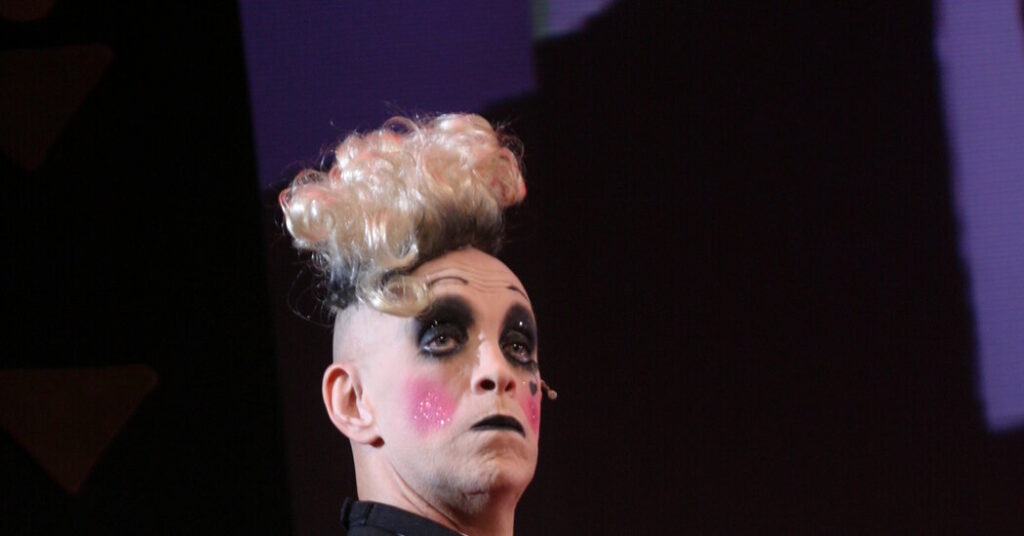
“Everyone in the cast was eccentric in their own way, and I wrote parts that took advantage of what I called their trip,” Mr. Busch said. “Andy had this kind of fragile Pierrot quality. He moved beautifully. I had made him this ugly spinster in ‘Sleeping Beauty,’ so for ‘Theodora’ he was a slave boy who could show off his body. He was a very shy person, and very inhibited, but onstage he could release all that and play these outlandish characters.”
Within a year, Theater in Limbo had outgrown the Limbo Lounge and moved to the Provincetown Playhouse on MacDougal Street, where the company performed “Vampire Lesbians of Sodom” and “Sleeping Beauty or Coma” on a double bill. Again, the production was a hit.
“Demolition by laughter,” D.J.R. Bruckner declared in his review for The New York Times in 1985. “Costumes flashier than pinball machines, outrageous lines, awful puns, sinister innocence, harmless depravity — it’s all here.”
Of Mr. Halliday, he wrote, his “hands and mouth are silent instruments of wit, whether he is playing male or female roles; he can turn his face into a dozen masks in a few minutes.”
The play ran for five years, breaking Off Broadway records and drawing audiences from around the world. Forty years later, “Vampire Lesbians of Sodom” is still being performed at professional, community and college theaters.
“It was one of the first great crossovers of the wild East Village,” Mr. Rudnick said, “a high-low, downtown-uptown moment.”
Mr. Halliday was a standout in “The Lady in Question” — one of the nine plays Mr. Busch wrote for his company — a spoof on World War II dramas that was staged at the Orpheum Theater in the summer of 1989. He played Lotte, a homicidal Nazi youth that Frank Rich described in his review for The Times as “a psychotic hybrid of a Trapp Family Singer and Patty McCormack in ‘The Bad Seed.’” (It was a compliment.)
At the same time, Mr. Halliday was working on his own productions at various Off Off Broadway venues. He wrote and starred in “Sex Slaves of the Lost Kingdom,” a bit of kitsch set in ancient Baghdad — he played a male siren clad in a gold loincloth — and “I Can’t Stop Screaming,” about a former child star of the silent film era.
Despite, or perhaps because of, the Busch imprimatur, Mr. Halliday felt that agents didn’t know what to make of him.
“I think I have a great face, and I can make it go three or four places at once,” he told The Times in 1989. “But I’m so off-the-wall that people don’t know what to do with me.”
Andrew Joseph Cohen was born on March 31, 1953, most likely in Connecticut. As a baby, he was adopted by Rose (Rocklen) Cohen, a substitute teacher, and Avrem S. Cohen, who owned a moving and storage company in New Haven.
An excruciatingly shy, slight child, he loved the theater and was bullied at school. His sister recalled that he was once stuffed inside a locker for an entire class period, among other indignities.
After early studies in theater and dance, he moved to New York City and changed his name to Andrew Kelly Halliday, in homage to his best and, he said, only childhood friend, Bobby Halliday.
One of Mr. Halliday’s last plays, “Up the Rabbit Hole,” which he wrote but did not star in, was staged at the Theater for the New City in the fall of 2017. It was autobiographical, a grueling account of a young gay man’s struggle with self-esteem, his descent into cocaine addiction and his recovery. Mr. Halliday got sober in 1992.
“Andy was all opposites,” Mr. Busch said. “Beautiful and very eccentric looking. Terribly shy and tender and solitary, but with an outrageous stage presence. He had great strength of character, but he needed a lot of encouragement.”
Late last month, Mr. Halliday was inducted into the Off Broadway Hall of Fame by the Off Broadway Alliance.
Penelope Green is a Times reporter on the Obituaries desk.
The post Andy Halliday, a Star of ‘Vampire Lesbians of Sodom,’ Dies at 73 appeared first on New York Times.