
The formula that defined a generation of career advice is breaking down.
New data from the Bank of America Institute reveals the starkest generational divide in the labor market in years — and it cuts directly against the career gospel that defined the last decade. Job switchers saw their after-tax wages grow just 8% year-over-year in Q1 2026, compared to 5% for workers who stayed put. That 3-point gap is the smallest it has been in seven years. At the peak of the Great Resignation in 2022, that same gap was nearly 11 points, with switchers pulling almost 18% wage growth while stayers settled for 7%.
This isn’t to say that the era of job-hopping your way to higher pay is over, but it appears to be closing fast. And a look under the hood shows it isn’t closing equally for everyone.
The inversion
For most of the past decade, the math was simple and brutal, as BofA calculated from 2022’s switch-heavy labor market: stay at your company and collect 7% annual raises, or leave and see your wages jump nearly 18% in a single year. Compound that over a career and the loyal employee, the non-switcher, could find themselves hundreds of thousands of dollars behind. The advice followed naturally: move every two to three years, treat loyalty as a financial liability, never let inertia cost you money.
That math has inverted four years later, after 12 months of what former Federal Reserve Chair Jerome Powell called a “low-hire, low-fire” labor market.
The Bank of America data, drawn from anonymized internal deposit accounts tracking workers with consistent paychecks, shows the switching premium has eroded steadily since 2022, the peak of the so-called “Great Resignation,” as the labor market cooled. The “low hire, low fire” environment that now defines much of the U.S. economy has removed the competitive pressure that once forced employers to offer rich packages to lure switchers. Separately, ADP data shows the switching premium hit a record low of just 1.9 percentage points in early 2026 — the smallest gap since the firm began tracking the data in 2020.
When companies aren’t aggressively poaching talent, they don’t need to pay premiums to attract it. The result is a labor market that looks almost nothing like the one that produced the career advice most workers under 35 were raised on. Switching, in other words, is so 2010 and the Gen Zers and younger millennials who learned to hop to better wages are colliding with a different reality, and a certain person sitting in the corner office is finally vindicated for staying put.
The winners
The workers benefiting most from this inversion are older, tenured, and for years were told they were leaving money on the table by staying put.
Bank of America’s data shows Gen X and Baby Boomer job stayers are now seeing steady pay increases, while workers in those same generations who switched jobs saw flat or declining wages in Q1 2026. More striking still: the top 5% of earners — a cohort that skews older and more experienced — are the only income group where staying put now unambiguously outpays switching.
Structurally, the economy is aging, as nearly one in four U.S. workers is now 55 or older, a share growing nearly twice as fast as overall employment. The average age of a new hire hit 42 in 2025, up from 40.5 in 2022 and 40 in 2016, according to workforce data firm Revelio Labs — the oldest ever recorded. Employers, in a slower, more selective market, are prioritizing experience and institutional knowledge over long-term potential.
The adoption of artificial intelligence (AI) may be exacerbating this, as its potential to augment skills accrues to workers who already have skills, rather than to those at the start of their careers. As Wharton management professor Peter Cappelli recently told Fortune: “I think one of the myths about AI is that there are big skills required to use it. We are confusing the complexity of the tools themselves, which are enormous, with the requirements for using them: You don’t need any skill to use LLMs. If you can use a search engine, LLMs are even easier to use. If you want to use AI to do statistical analyses, for example, yes, you need some statistical knowledge, but much less so than if you didn’t have an LLM.” Gen Z, which lacks these hard skills just by nature of their age, “just happens to be in the wrong place in life at the wrong time.”
In the upside-down labor market of 2026, the valuable worker is the one you already have in place, with decades of skills that may be unlocked with new AI tools, or the 42-year-old with ready-made skills, ready to plug into your company.
The squeeze
Gen Z is still moving. In Q1 2026, more than one in four Gen Z workers changed companies — a rate more than twice that of Millennials and more than three times the rate of Baby Boomers. And switching still outpays staying for that cohort: Gen Z switchers saw over four times the wage growth of Gen Z stayers in Q1 2026. But four times of a shrinking number is still shrinking — a “shrinking ice cube,” to paraphrase Treasury Secretary Scott Bessent. Gen Z switchers’ wage gains have dropped roughly 20 percentage points since 2022. The generation is running the same play in a market returning less and less on it.
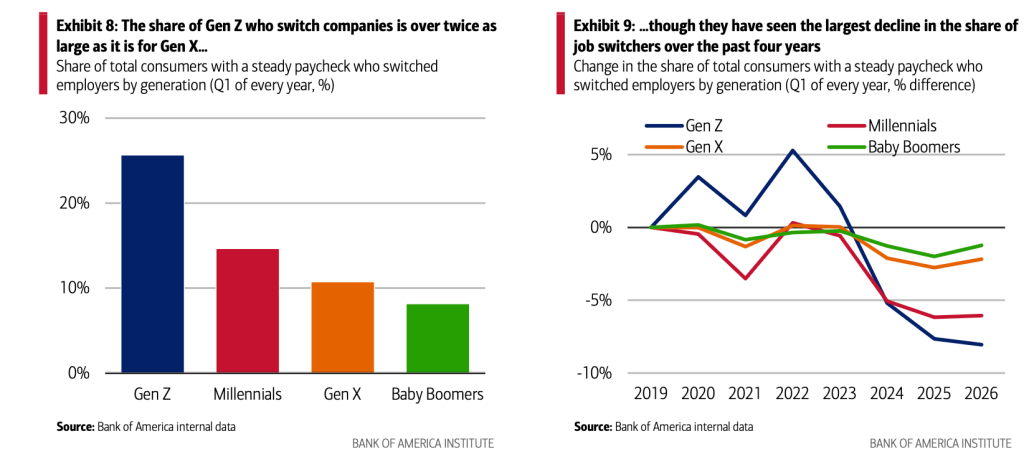
The pipeline itself is narrowing, and you can’t benefit from job-switching if you can’t get hired in the first place. Revelio Labs finds that Gen Z’s share of new hires collapsed from 14.9% to 8.8% between 2022 and 2025, with hiring inflows for workers under 25 down 45% since 2019. Meanwhile, more than 55% of Gen Z are now delaying major life decisions — marriage, family, financial independence — according to Deloitte’s 2026 Gen Z and Millennial Survey.
The advice written for someone else
The data suggests something more complicated than a generational betrayal.
The career advice wasn’t cynically wrong. It was structurally obsolete. The executives who preached job-hopping and the career coaches who built careers around hacking your way to more money were describing a market that genuinely rewarded those behaviors at a specific moment in time. But that moment appears to be passing.
What worked for a senior manager in a cycle with stable business models and a long-established human resources strategy has to be rethought in a slowing, AI-anxious, demographically clogged labor market a decade later. As ADP Chief Economist Nela Richardson told Fortune recently, “No one ever promised a 50-year cycle for white-collar work … I think there was this embedded assumption that these jobs would just keep going on and on forever. Really what started with the boomer generation would just be handed down through millennials into Gen Z. But that was never a guarantee.”
Looking ahead, the BofA economists flagged two forces that could eventually rebuild the switching premium: a continued labor market recovery and a potential supply crunch driven by slowing immigration, which could force companies competing for highly skilled workers to start paying up again. AI disruption, cutting in the other direction, may keep workers risk-averse and reluctant to move regardless.
For now, the most counterintuitive career advice of 2026 is also the most data-supported: stay put.
The post As loyal Boomers win and job-switching Gen Zers lose, the labor market of 2026 reveals a decade of bad career advice appeared first on Fortune.