I couldn’t do it anymore. I had a toddler to chase and a baby to feed and a home to manage and a book to write and a body I didn’t recognize and a life I felt throttled by. I just wanted everything to stop. So I reacted the way I did whenever I faced what I optimistically called a setback: I worked harder.
A certain kind of woman (me) loves a good challenge. We work at work. We work at home. We work out. We work for our family and friends. We do the work at therapy. And we believe that with all this effort, eventually it will all work out. We can do hard things.
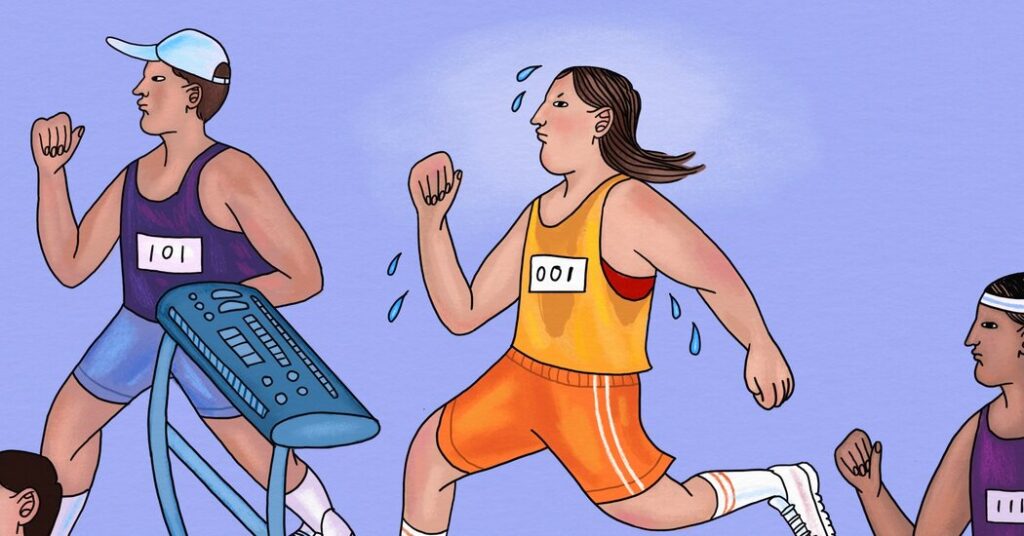
What about men? Despite all the “take it like a man” narratives, men often quit, especially when conditions are hard and stakes are high. In 2018, I watched a Boston Marathon in brutal weather, and I noticed, and then confirmed, that women endured at higher rates than men. (A later study of nearly one million marathoners found that men were more likely to crash.) I wrote an essay about the phenomenon for The Times with the triumphant headline “Why Men Quit and Women Don’t.”
Not all men, obviously (or women, either). But this tendency is backed up by research. Under stress, women downshift but make it through. Men under stress go to extremes. They take more risks and walk away with nothing or all. It tracks with what the masculinity scholar Richard Reeves argues about how we’re raised: Boys are like orchids. They are fragile and protected. Girls, he says, are like dandelions — surprisingly tough.
For most of my life, I was the cheerfully-die-trying dandelion type. If someone tried to help put my suitcase in an overhead bin, I declined and was proud. In high school, I spent Saturdays studying for the SAT before heading off to run around a track. I taped a poster over my desk that read, “Pain is temporary, pride is forever.” Sure, I lost those races, and I didn’t ace that test. But doesn’t every eventual champion first endure defeat?
And then there I was, squarely in my 40s, expecting to reap the benefits of all my life’s hard work but instead frenetically pushing harder as I failed more.
Now I think those men were onto something I missed. Too much grit can work against us. I thought my willingness to push, no matter what, was bold (and virtuous). But what is the point of overcoming every obstacle if the effort leaves you exhausted and stuck? In a marathon, there’s a finish line. In life, we can grind forever.
Society bombards us with messages of perseverance. Women like me are eager (and able) disciples of the “Never give up” dogma. We might benefit from opting out, but we dismiss that option before we ever consider it. Then we pay the costs. We start out as resilient dandelions, but what good is that if it sets us up to be trampled on?
Women live longer than men, on average, but we do not necessarily live better. Our rates of depression and anxiety (and the related mental health prescriptions) soar above men’s. While problem drinking is declining in the United States overall, it has risen significantly in recent years among women in their 30s and 40s, precisely when we’re grappling with the pressures of careers and motherhood and marriage. Alcohol use as self-medication is especially pervasive among higher-income women — women who could afford help yet still don’t necessarily take it.
Our head-down tendencies start early. When researchers examined children’s responses to ineffective teaching methods, they found that boys tended to abandon approaches that led nowhere and seek better options. Girls were more likely to continue following directions, even when those directions led them to fail. Girls learn to work. Boys learn to win.
Women finish high school and college at higher rates than men. But once we hit the work force, we’re less likely to make the C-suite. Of course, that has many explanations. (Patriarchy comes to mind.) But look at how we respond. Researchers tracked nearly 30,000 management-bound employees and found that when women were passed over for promotion, they were more likely to stick with their companies than men in similar situations. The men were more likely to walk away. And they were rewarded for it. They got retention benefits where they were, or they left.
Women are more likely to remain in shrinking industries and lower-paying roles. According to McKinsey Global Institute, projections show that by 2030, less than two-thirds of women will work in growing fields, compared with over three-quarters of men. As Noam Scheiber recently explained in The Times: “A job gets worse in some way — say, it pays less or becomes more grueling or monotonous or generally less prestigious — at which point men become less interested in doing it. Employers then turn to women to fill the ranks.” Women need to remember that we can look elsewhere for work, too.
Women often persevere in bad relationships. “Dating is hard,” we might persuade the ceiling at 3 a.m. A woman who ends things early is too picky; a man who quickly realizes he isn’t interested has standards. Same after “I do.” So many of us choose quiet quitting our marriages over filing for divorce. Why leave when you could put up with it instead?
Last month Prime Minister Sanae Takaichi of Japan shared that she spent a holiday weekend rereading policy documents and clearing out her inbox, as well as making time to iron her undergarments — and finally logging five hours of sleep, instead of her usual “zero to three.”
A man who chooses to rest probably doesn’t think of that choice as quitting at all. But for women, the options feel self-defeating: Take the rest and feel guilty or skip the rest and feel exhausted — and mad.
The joke is on us. Our lives won’t be measured by how late we stay up answering all our email. We forget that surviving is not the same as success.
Giving up on things that don’t work is the only way to find things that work better or to go farther than before. If we treat quitting and persevering as opposites, we lose.
Last year, I was wiping my 3-year-old’s vomit off my dress when my calendar popped up on my phone. On my schedule was an informational interview with a friend’s aunt’s neighbor’s son (or someone) and an appearance on an online panel where I was completely unnecessary. I could have asked someone else to do these things or, even better, simply declined. Instead, I did everything. (What a hero!) I didn’t do any of it well.
Looking back, I realize: Women do quit, all the time. We quit on ourselves.
I don’t pretend to have a magic solution. I can’t get men to opt out less or solve capitalism. But I can at least recognize that just as quitting is a choice, so is not quitting.
Now when I’m grinding, convinced the finish line is just one push away, I ask myself a simple question: Why am I still doing this? “Because I can” doesn’t automatically mean that I must.
Lindsay Crouse is the author of the forthcoming book “The Case for Quitting,” from which this essay is adapted. She was a senior staff editor in Opinion, where her reporting on women’s sports helped bring maternity rights to professional athletes. She commissioned The Times’s Academy Award-winning film.
The Times is committed to publishing a diversity of letters to the editor. We’d like to hear what you think about this or any of our articles. Here are some tips. And here’s our email: [email protected].
Follow the New York Times Opinion section on Facebook, Instagram, TikTok, Bluesky, WhatsApp and Threads.
The post The Case for Quitting Like a Man appeared first on New York Times.