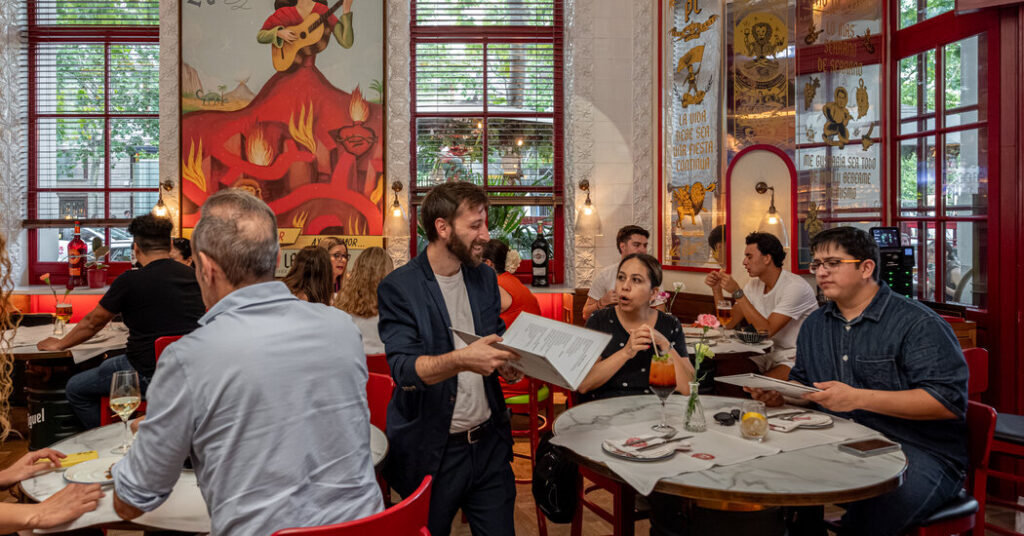
For generations, dinnertime for the Terrazas family, as in many households in Spain, was late. It usually began after 10 p.m. and often stretched past midnight.
But now, Antonio Terrazas, a tax adviser in Madrid, says his family sits down to eat around 9 p.m. When they dine out, they’re also eating earlier, and have noticed their friends are, too.
“At first it was strange. We’d look at each other like, ‘Madre mía, who would believe that we’d be seated at a restaurant and eating at 9 o’clock?” Mr. Terrazas said. “But not anymore.”
In Spain, known for its night-owl energy, a quiet revolution appears to be unfolding in one of its best known cultural institutions: the late-night dinner.
Spaniards have long eaten later than people elsewhere in Europe, a tradition that many see as part of the national identity. By custom, families gather around their dinner tables late at night and restaurants remain filled long past the time when much of the industrialized world has turned in.
Spain held fast to the practice even as experts debated whether it was a drag on the economy, producing a work force that was more tired and less productive than it could be.
But evidence suggests that Spain is moving dinnertime up.
CoverManager, an online platform that manages reservations for thousands of Spanish restaurants, reports that half the dinner bookings now are for before 9 p.m., compared with 27 percent a decade ago. TheFork, a similar platform, said its 8 p.m. bookings in Spain have nearly tripled from 2019, while 10 p.m. reservations have halved.
In Spanish homes, too, there are subtle signs of a shift. A government survey conducted in 2024 in the Catalonia region suggests that people there are starting their evening routines, including dinnertime, moderately earlier compared with 2010. National data are not yet available, so experts said it was too early to draw broader conclusions.
While the reasons for the change are not entirely clear, Marta Junqué Surià, the director of Time Use Initiative, a nonprofit based in Barcelona that advocates for policies around sleep and wellness, pointed to the pandemic, which ruptured old routines, and suggested more people were seeking the health benefits associated with earlier mealtimes.
“We are heading toward more biological rhythms that allow us to eat better and, above all, get better rest,” Ms. Junqué said.
Mr. Terrazas, 58, a father of two, said that he and his wife simply wanted better sleep.
“It’s been a positive change,” he said.
‘The Late Dinner Is Dying’
The New York Times asked CoverManager, which handles online bookings for about 16,000 Spanish restaurants, to analyze the roughly 330 million reservations it had recorded in the country over the past decade.
The data show a clear pattern, said Thomas Jeanjean, chief executive of Hospitality Tech Group, which owns CoverManager: “The late dinner is dying.”
The typical dinner out in Spain today begins an hour earlier than before the pandemic, according to the data.
Later reservations are increasingly rare: 10 p.m. seatings made up 15 percent of dinner bookings last year, down from 30 percent in 2016. Tables for 11 p.m. accounted for 1.9 percent, compared with 5.7 percent in 2016.
“Dinner times have moved earlier,” Mr. Jeanjean said, “and the curve is still bending.”
The late dinner hasn’t disappeared: People typically eat an hour later on weekends and about 20 minutes later in the summer than in the winter, the data indicates, and 9 p.m. remains the most popular reservation time.
TheFork, which works with more than 12,000 restaurants in Spain, said that surging foreign tourism was one factor in the shift, though it noted that about 70 percent of its reservations come from Spanish phone numbers.
CoverManager said tourists weren’t driving the change, noting that users with Spanish numbers, who accounted for around 90 percent of its reservations, were booking tables for around an hour earlier than a decade ago.
Spanish society is transforming, having added more than a million foreign-born workers since 2018, many from Latin America. But in a country of 50 million people, the turn toward earlier dining is “a homegrown change of habit,” Mr. Jeanjean concluded.
A Pandemic Pivot
Dining late is a relatively modern Spanish custom. During World War II, the dictator General Francisco Franco pushed clocks on the Spanish mainland forward an hour. Spain never reverted, meaning its official time runs ahead of its geographic position.
Late dining was also reinforced by the poverty of the postwar years, Ms. Junqué said, when many people worked two jobs, eating dinner only after their second shift. The Spanish workday, often punctuated by a long afternoon break, ends later than elsewhere in Europe.
The coronavirus pandemic, which prompted a nationwide 11 p.m. curfew in October 2020, encouraged people to dine out earlier and contributed to a revival of tardeo, the custom of eating, drinking and socializing in the late afternoon, according to bookings by CoverManager. Sometimes, experts say, Spaniards now replace dinner with tardeo.
After pandemic restrictions eased, many restaurants kept the earlier schedules to save on labor and operating costs, said José Luis Álvarez Almeida, the president of Hostelería de España, a business confederation representing the hospitality sector.
‘Not the Spanish Spirit’
In conversations this summer, many Spaniards said they were eating earlier than in years past. All seemed to have their own reasons — age, young children, a desire for better health or more energy in the morning.
Nacho Calvo Vila, 53, a restaurant owner in Barcelona, said he made the change around five years ago to improve digestion and get better sleep. Now he goes to bed around 10 p.m., his old dinner time. Better rest has helped him make healthier decisions around his diet, temper his anxiety and regulate his emotions, he said.
“Sleep is fundamental,” he said. “I think it’s one of the biggest areas where mind-sets are changing, especially here in Spain.”
Out for drinks with colleagues in Madrid, Sol Fauquier, 46, said she now preferred to dine at 8 p.m. and suspects others want to eat earlier, too, but social pressure discourages people from being the first to suggest it.
“I don’t really face any resistance — quite the opposite,” she said. “I’ve found that when I suggest meeting early — say, at 8 or 8:30 — people never say no.”
Her colleague Isabel Cano, 23, interjected that dining so early was “unthinkable” and “not the Spanish spirit.”
If someone invited her to dinner at 6:30, Ms. Cano said she’d tell them to wait. “Like, just have a muffin.”
A Happier Country?
Experts argue that Spain could reap a host of benefits if people ate and went to bed earlier.
It would be “a more productive, healthier and happier country,” Ms. Junqué said. She cited studies showing that, in countries where people sleep more, “productivity increases and the mental health of the population is better.”
In 2013, a parliamentary commission found that Spaniards were getting about an hour less sleep than the European average, and linked worker fatigue to lower productivity and absences on the job.
But official measures to encourage earlier dinner times appear likely to face resistance. When Spain’s left-leaning labor minister, Yolanda Díaz, suggested in 2024 that a late-night culture that pushed restaurants to remain open past midnight was “madness,” Madrid’s conservative regional president, Isabel Díaz Ayuso, retorted that the national government preferred Spaniards to be “bored and at home.”
Ms. Junqué argued that even if late dining fades, what it means for Spaniards to sit at the table with family and friends would not.
“We love being around people and socializing,” she said. “Our Spanish culture is going to remain exactly what it is.”
Carlos Barragán contributed reporting from Madrid.
The post The 10 p.m. Dinner Is a Spanish Tradition. Are People Giving It Up? appeared first on New York Times.