Director Sarah Arnold’s “Too Many Beasts (L’Espèce explosive)” is one of those well-made, handcrafted pleasures whose thrills feel old and new. I’m not sure there’s another “wild boar crime thriller” out there, which means it gets to claim that subgenre all to itself. Meanwhile its structural DNA, focusing on small town corruption between powerful political figures, state agents and its scruffy, hardened citizens, feels like a throwback to the crime thrillers that used to proliferate (not unlike the boars in the film) screens.
Thankfully, Arnold’s work proves that directors are keeping this tradition of cinema alive and understand that sometimes, there’s nothing more thrilling than seeing the rich and powerful get their sanguine comeuppance, anchored by characters whose flaws make them easy to root for and even easier to love.
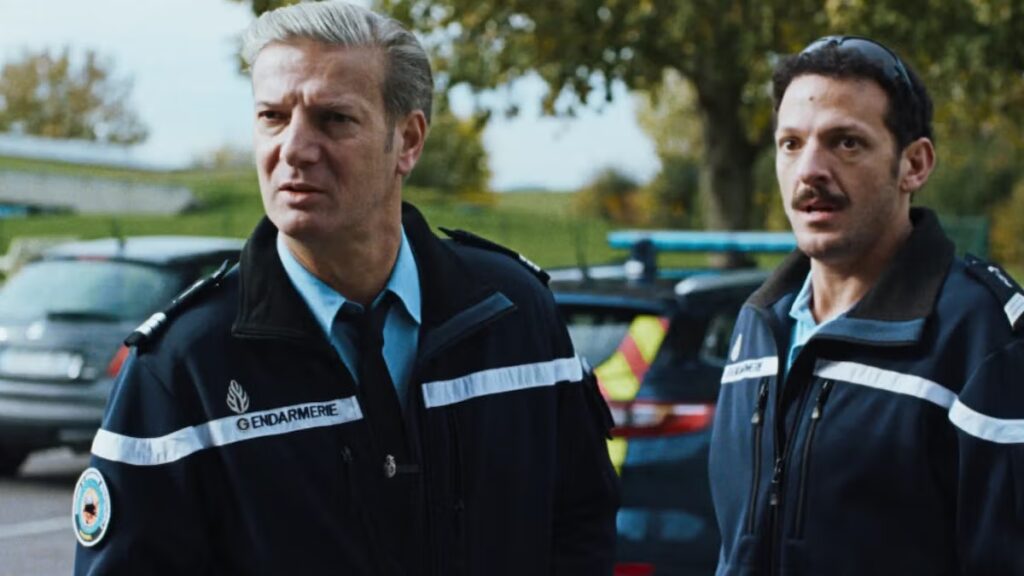
In a prologue that immediately sets the film’s wavelength of dark humor, we meet Brun (Jean-Louis Coulloc’h), a gamekeeper who murders a landowner who has been overfeeding the boars, causing them to run rampant. Flashing forward, we meet Fulda (Alexis Manent), a cop who has been assigned to look into the escalating feud between hunters and farmers. Tensions have only gotten worse, with new game hunters coming into town to pick off the wild boars, which seem to be doubling in size. There’s a conspiracy that the political leadership within the town is fattening up the livestock so that wealthy clients can hunt more easily, which angers those who have been hunting the traditional way for their whole lives.
When more boars end up dead, and on the lawns, the political leadership of the town, Fulda, is tasked with uncovering whether Brun has returned. He finds an unlikely ally in a psychologist, Stéphane (Ella Rumpf), as the two realize that they may be the only ones in the town not on the payroll of someone with wealth and power.
There’s a delightful, off-kilter sense of humor, too, populated by characters who speak with just enough realism to make it feel grounded, but also have line deliveries that wink to the film’s more absurd wavelength. “I won’t be putting condoms on [the boars],” a hunter declares seriously when the problem of overpopulation is brought up. In another scene, Fulda’s partner critiques Brun for his violent extremity, berating, “He gutted a man!” to which Fulda retorts, “Sure, but with respect.” These characters often feel like they know exactly what movie they’re in, and they seem to have as much fun in their deliveries as we do hearing them.
It’s worth seeing for Rumpf and Maneti’s fire and ice dynamic, he the well-intentioned but clumsy buffon, she the competent yet nervous shrink. There’s evident sexual tension between them, but they’re also connected by a shared sense of justice, a desire to do the right thing even if they look silly doing it. In a town obsessed with keeping up appearances, they’re the ones who are willing to sacrifice ego and reputation to achieve peace, which makes their story not only compelling but the source of laughter whenever their noble aspirations clash with the violent reality around them.
As human-centered as the stories are (one wishes that we could see even more boars in the film), cleverly, cinematographer Noé Bach is always making sure that what we see visually is a rebuttal to the pride spoken by the characters. Bach frequently uses wide shots to showcase how small the human characters are in the vastness of the world around them, while not being afraid to frame the animals the way one might do with humans, with intimate closeups where one can see the nuances of their faces.
It’s simple work, but it underscores the powerful idea that no matter the guns, infrastructures and cars humans have, no matter how much they may try to imprint themselves as masters on the land, the beasts have been here for longer and will win. Arnold’s film becomes not just a mystery but a musing on humanity’s volatile relationship with nature, how capitalism not just destroys interpersonal relationships but fundamentally shifts our dynamic with the natural world in such a way that the effects become irreversible.
It’s humorous to consider that as the plot only grows more convoluted, and Fulda and Stéphane get drawn into wackier situations, that Arnold is intentional about showcasing scenes of the boars around them going about their business, completely unbothered by the machinations around them. We make things too complicated in our pursuit of more, forgetting the virtue of contentful grazing.
“Too Many Beasts (L’Espèce explosive)” won the Europa Cinema Label at the festival, and it’s hard not to see why. The award comes with the promise that it will come with additional theatrical backing. This is the type of broad comedy deserving of the big screen treatment that has just enough wacky humor to appeal to the arthouse crowd while also being mainstream enough with its themes and stories to satiate audiences with broader tastes.
Arnold has crafted a film that is conducive to easy affection thanks to its charming cast and gripping premise. In other words, this one is very easy to get on boar-d.
The post ‘Too Many Beasts’ Review: Sarah Arnold’s Rustic Crime Thriller Mixes New With the Old appeared first on TheWrap.