TEHRAN — The elaborate funeral rites for Iran’s slain supreme leader that drew huge crowds of mourners offered a show of strength by the country’s surviving leadership as key senior officials boldly emerged into public view for the first time since the war. And in its posture toward the United States, Tehran also now seems emboldened.
Escalated Iranian attacks on ships in the Strait of Hormuz have enraged President Donald Trump, derailed a tentative truce, and provoked U.S. retaliatory strikes that not only throw future talks into doubt but threaten to reignite the war with deadlier violence. The regime is betting that Trump, despite his bluster, wants a way out.
Even as Trump declared the ceasefire “OVER,” life continued as normal in Tehran. Traffic returned to city streets, freshly swept clean of the litter left behind by the crowds that attended days of mourning and prayer. What remained of Ayatollah Ali Khamenei’s funeral were posters and billboards, depicting him at different stages of his life, emblazoned with the slogan: “We must rise.”
Iranians shrugged off the attacks and threats. This was the “new normal” several said, explaining the lack of public alarm.
At that point, there had already been multiple rounds of U.S. strikes since the ceasefire was signed, mostly confined to the country’s southern coast. And in Tehran, more than 700 miles away from the Strait of Hormuz, the airspace remained open, allowing a Washington Post team to fly out of Imam Khomeini International Airport on Wednesday after covering the funeral.
Iran’s more hard-line leadership “sees their survival as tied to escalation rather than engagement,” said Behnam Ben Taleblu, an Iran analyst with the Foundation for the Defense of Democracies, a Washington think tank known for promoting hawkish Iran policies.
Anti-engagement views have long had a place in Iran, according to Taleblu, but what makes this moment different is “how public the military deep state has become.” Referring to the country’s willingness to take the U.S. military head on, he added; “They are comfortable with moving the conflict out of the grey-zone.”
In a written statement posted on social media on Saturday, Kahmenei’s son and successor, Mojtaba Khamenei, said that vengeance for his father’s assassination was “the demand of the nation” and “must certainly” occur. “We pledge to avenge the blood of the martyred leader,” the message stated, without specifying the form of revenge.
Even before the funeral events ended, Iran struck three ships trying to transit the strait using a southern route outside its control. In response, the U.S. struck more than 170 sites, a greater number of targets and far deeper in Iranian territory than at any other time since the truce. U.S. strikes also appear to have expanded beyond military targets, to include infrastructure such as a bridge in the country’s north and a rail line connecting Tehran to Mashhad.
Just over three weeks since Iran and the United States agreed to an initial peace accord, Tehran has made the Strait of Hormuz the central sticking point, refusing to allow maritime traffic to pass through without Iranian coordination. Trump’s stated objectives for going to war, notably ending Iran’s nuclear program, are not a focus.
“The terrorist American army used all its capacity to remove the Strait of Hormuz from the will of the country’s armed forces,” said Mohammad Hassan Abutorabifard, the interim prayer leader at Friday prayers in Tehran, who often uses his platform to advance the supreme leader’s message. “What they did not achieve in hard battle, they will never achieve by violating the understanding.”
The position reflects the country’s new, more hard-line leadership, buoyed by the massive crowds that turned out for Khamenei’s funeral.
Throughout the funeral events in Tehran, there were strong currents of opposition to negotiation with the U.S. and frequent calls for revenge. Crowds chanted “death to the traitors,” alongside the more common “death to America” and “death to Israel.”
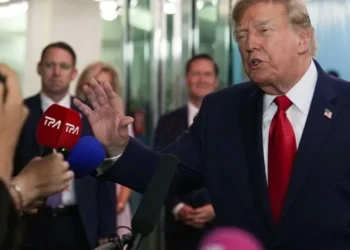
Trump late Friday, issued new threats in response to reports on intelligence indicating Iran wants to assassinate him. “1000 Missiles are Locked and Loaded and aimed at the Islamic Republic of Iran, with thousands of more to immediately follow, should the Iranian Government act on its threat,” he posted on social media.
“The U.S. Military is ready, willing, and able, for a one-year period of time, subject to extension, to completely decimate and destroy all areas of Iran,” Trump wrote. Previously, Trump has threatened to destroy Iran’s entire “civilization.”
Also late Friday, during a briefing for reporters, senior U.S. officials said that Iran had described the recent attacks on ships in the Strait as the actions of a rogue unit of the Islamic Revolutionary Guard Corps.
The officials, speaking on the condition of anonymity to discuss sensitive negotiations, said they expected Iran to issue a public statement within days declaring the strait to be completely open and committing that Iranian forces will stop shooting at ships in the waterway.
“They’re either going to give us that statement or we’re not going to have a good outcome for them,” one of the officials said.
A second official said that back-channel discussions being conducted with Qatar as an intermediary were pointed toward reaching a broader peace agreement. “I think that Iran is showing a lot of signs of wanting to make this deal,” the second official said.
At one of the gates of the Grand Mosalla religious complex where Khamenei was lying in state, mourners scrawled notes of devotion to the late leader. Also on the massive concrete slab were vicious insults directed at Trump and Israel Prime Minister Benjamin Netanyahu, but also at Iran’s foreign minister, Abbas Araghchi, and its parliamentary speaker, Mohammad Bagher Ghalibaf, the two leaders most visibly involved in talks with the Trump administration.
Leila Merati, 51, a homemaker from Tehran, said she supports the bolder, riskier stance of her country’s leadership and that she credits Iran’s aggressive counterattacks and posture in Hormuz for forcing the United States and Israel into a ceasefire. “We showed Trump and Netanyahu how we respond with our missiles and our precious drones,” she said.
Merati, who was sitting in the shade of a tree in Azadi Park as massive crowds gathered there on Monday for Khamenei’s funeral procession, said she worried about a return to war. Her neighborhood was hit heavily. She shuddered describing the “horrifying” impact of the airstrikes.
“We used to lie on the ground to avoid the shock waves,” she said. There was no advance warning system and, like many Iranians, Merati doesn’t have a shelter in her building. One blast was so strong, she said, it blew the gate off her parking garage.
“While Trump is in office we have a concern,” she said, about the prospect of another round of fighting. But she said that she isn’t “afraid” because she trusts the new supreme leader — Khamenei’s son, Mojtaba. “He is following in his father’s footsteps,” she said.
Some speculated that Mojtaba Khamenei, who was reportedly injured in the same strike that killed his father, would use the funeral to make his first public appearance since being named as successor, but he did not — fanning further questions about who is leading Iran.
Iranians like Merati, who make up the government’s base of support, however, are estimated to make up just a small fraction of the country’s population of some 90 million. And Iran’s leadership knows that if it wants to avoid further rounds of civil unrest, after killing protesters earlier this year in a crackdown that reached a rarely seen level of violence, it must deliver economic relief quickly.
In Tehran alone, local officials say more than 44,000 residential units were damaged or destroyed. And on a national level, Iranian officials estimate the cost of reconstruction to be at least $270 billion.
The initial deal to which Iran and the United States agreed last month contains major economic incentives for Iran, but following the escalation along the strait, some have already been rolled back.
On Tuesday, the United States rescinded a waiver on Iranian oil sanctions that also allowed Tehran to sell oil in dollars, a provision that would have made it easier to both sell oil and access oil revenue. And on Friday, the Treasury Department announced new sanctions on Iran’s financial sector.
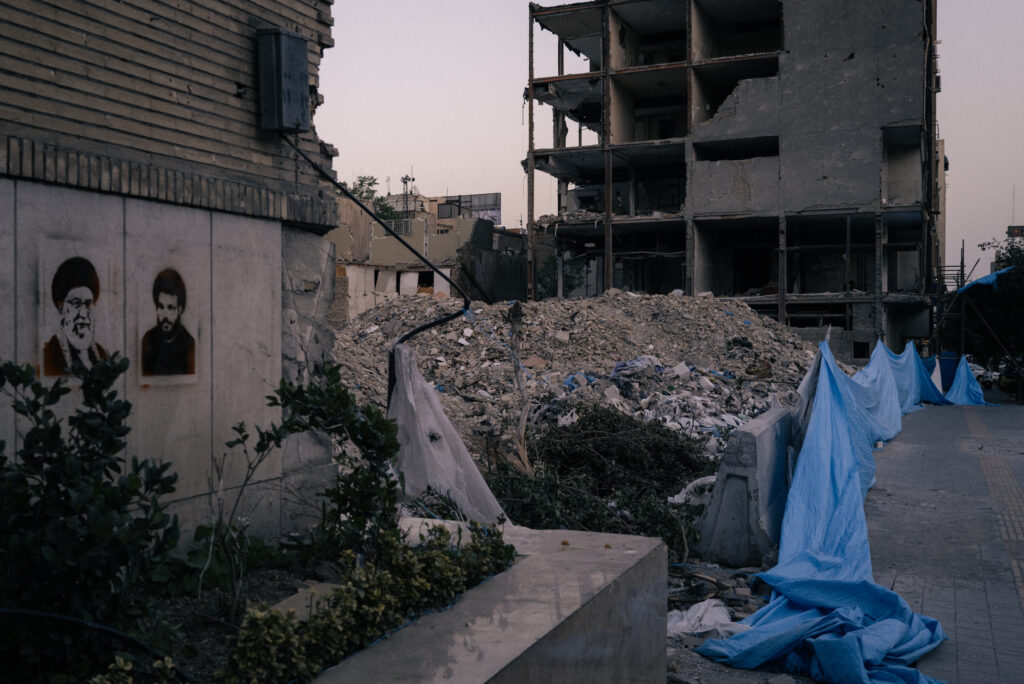
At sites of U.S. and Israeli attacks in Tehran, there are few signs of government aid to those affected. In the city center, at the site of a March 1 strike near Niloufar Square, most of the debris has been cleared away and what’s left has been flattened, leaving a large empty plot where a building once stood.
While only one building in the area was hit directly, roughly a dozen other structures sustained heavy damage and about two dozen people died, residents said.
Parsa Kojoori, 32, a voice-over artist from the city of Shiraz, lived in an apartment across the street which sustained so much structural damage in the blast it must now be torn down.
The terms of the visa granted to Washington Post journalists that allowed reporting from Iran in recent days largely limited coverage to Khamenei’s funeral, but the team was permitted to take photographs around Tehran, under restricted conditions and in the company of a government-approved guide and translator.
Kojoori said since living through two rounds of war, he doesn’t feel he can predict what’s to come. “My personal feeling is that the war isn’t really over,” he said, explaining that he fears fighting will soon resume.
After the strike that destroyed his house, he said his parents are thinking of moving out of Tehran rather than trying to rebuild. Given the level of inflation, his family can’t afford to replace their home.
“When you lose something in Tehran — or in Iran generally,” he said, “replacing it is incredibly difficult, maybe even impossible.”
Abutorabifard, the interim prayer leader at Friday prayers in Tehran, appeared to acknowledge the hardships the country faces, devoting a significant portion of his remarks to “patience.”
“Your patience against problems must be more than that of your enemy,” he said, calling on Iranians to carry forward the unity with which he characterized the supreme leader’s funeral. “The power equation has changed in favor of the Iranian nation. The era of aggressive deterrence has begun.”
The post After leader’s funeral, an emboldened Iran tests Trump, risking renewed war appeared first on Washington Post.