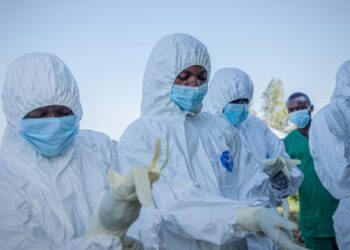
For weeks, the media has been fixated on whether a hantavirus outbreak on a cruise ship, which killed three people, could lead to the next pandemic. (The answer is almost certainly no.) Meanwhile, a far more dangerous public health situation has been festering with far less attention: Ebola in the Democratic Republic of Congo.
The outbreak has already killed more than 100 people and is suspected to have infected around 400, including one confirmed case in an American doctor. Ebola is a rare but extraordinarily deadly viral disease, with an average fatality rate of 50 percent. In some past outbreaks, as many as 90 percent of infected patients have died.
Early symptoms such as fever, muscle aches and fatigue are nonspecific and mimic those of other illnesses. Clinicians may mistake early Ebola for malaria, influenza or other more common infections, and may not use appropriate protective equipment and become infected themselves. During the epidemic in West Africa between 2014 and 2016, which ultimately killed over 11,000 people, more than 800 health care workers became infected and two-thirds died. That was a catastrophic loss for countries that already faced severe shortages of doctors and nurses.
Later symptoms are terrifying. The virus damages blood vessels and disrupts the body’s ability to clot, leading to internal bleeding, multi-organ failure and shock. Patients may vomit and cough up blood, bleed from their gums and rectums and leak blood from IV sites. Severe dehydration and cardiovascular collapse then follow, eventually leading to death.
While Ebola is not airborne, it is highly contagious through direct contact with bodily fluids such as blood, saliva, semen, vomit or diarrhea. People can also become infected by handling contaminated bedding, clothing and other objects and by touching the body of someone who has died from the disease.
Most prior outbreaks, including the 2014-16 one, were caused by an Ebola variant known as the Zaire strain (referencing Congo’s former name). As a result, research has focused heavily on that virus, resulting in a vaccine and two approved antibody treatments that can improve chances of survival. But the virus in the current outbreak — called the Bundibugyo strain — has no approved vaccine and no proven treatment.
Moreover, standard rapid tests were designed primarily to detect the Zaire strain and may miss Bundibugyo infections. That means samples must be sent to specialized laboratories for confirmation. The World Health Organization has said these diagnostic limitations contributed to delays in recognizing the outbreak.
So far, only about a dozen case have been confirmed despite hundreds of suspected infections. This creates a major problem: As we saw in the early days of the covid-19 pandemic, when testing becomes the bottleneck, many infections go undetected and sick patients continue to expose others unknowingly.
It also means the outbreak may be substantially larger than official numbers suggest. That concern is heightened by conditions in Congo, where most cases have been reported in the deeply impoverished Ituri province. Some infected patients may never seek medical care and could die at home without ever being diagnosed, potentially infecting caregivers and family members.
Past Ebola outbreaks have also been fueled by traditional burial practices in which guests unknowingly handled highly infectious bodies. Compounding these challenges is Ebola’s incubation period, which can extend up to 21 days, so it could take weeks before infected individuals show symptoms.
Congo has also struggled with armed conflict and political instability for decades. One case has already been reported in Goma, an eastern city largely controlled by the rebel group M23, which limits the government’s ability to guarantee safe access for international aid workers.
The country also borders nine nations, several of which have fragile health care systems and ongoing instability themselves, including South Sudan. Although neighboring countries have introduced stringent border screening measures, the virus has already spread into Uganda, where two cases have been identified in Kampala, a densely populated capital city and major regional transportation hub.
On Monday, the Centers for Disease Control and Prevention announced an entry ban on foreign nationals who have recently been in Congo, Uganda or South Sudan. But travel restrictions alone will not be enough, especially if the virus continues spreading across borders.
The lesson from prior Ebola scares is that the best way to protect Americans is to stop outbreaks at their source. Tom Frieden, who led the CDC during the 2014-16 outbreak, warned that there are already more reported cases now than during the early days of that calamity. The world must focus on containing this outbreak before it spirals to anything approaching that scale.
The post Why Congo’s Ebola outbreak is far more alarming than hantavirus appeared first on Washington Post.