MOJAVE NATIONAL PRESERVE — In the heart of the Mojave National Preserve, a scientist hunted for a baby Joshua tree that would never make it to adulthood.
She parted some creosote branches to reveal a shriveled shrub, just ankle-high. This doomed seedling was part of a National Park Service planting effort to replace dozens of Joshua trees cut down by a Southern California Edison contractor tasked with protecting the company’s power lines.
But of the 193 babies planted here roughly five years ago, only 27, or 14%, are still alive, according to the Park Service. If researchers don’t figure out why so few survived, an imperiled icon of the California desert may disappear even more quickly.
“Joshua trees are so resilient — they’ve been around for millions of years,” said Anne Polyakov of the Society for the Protection of Underground Networks, who led the expedition. “But now they’re facing too many stressors all at once.”
Described by some as spiritual guides or even family members, Joshua trees have inspired a wide range of artists and writers, from Indigenous people and pioneers to U2 and the creators of “Euphoria.”
The spiky succulents are signifiers of what makes the desert special to people, said poet Ruth Nolan, the Mojave Desert literary laureate. Unique and a bit weird, they speak to something deep and ancient. And although their shaggy boughs somewhat resemble teddy bears, they’re sharp if you step too close.
“They kind of represent the whole spirit of the desert,” she said. “It’s beautiful and inviting, but it’s also really tough and acerbic.”
Joshua trees also play a key role as a linchpin of the Mojave Desert ecosystem. They’re typically the largest structures on the landscapes where they grow, and dozens of animals rely on them for food and shelter.
But human development and the wildfires we create have destroyed swaths of their habitat, and climate change is threatening to make much of what remains inhospitable. “If they all die and we can’t restore them properly, it’s going to be a big problem,” Polyakov said.
She believes the clues to addressing this crisis may lie deep below the surface of the sun-baked sand, where microorganisms known as mycorrhizal fungi form a vast network that can help plants reach nutrients and water. Research suggests these connections can play a crucial role in helping Joshua tree seedlings make it through their perilous early years and reach maturity.
And Joshua trees need all the help they can get.
By the end of the century, up to 80% of their range is expected to become too hot and dry to sustain them — a pace the plants are ill-equipped to handle, said Drew Kaiser, senior environmental scientist at the California Department of Fish and Wildlife.
They are slow-growing and take 50 to 70 years to start producing seeds, which are dispersed primarily by ground squirrels and wood rats who don’t travel far from their burrows. That means it takes a long time for Joshua tree populations to shift to cooler, higher-elevation areas.
“Climate change is pushing this habitat suitability window faster than the trees can be dispersed and start producing new individuals,” Kaiser said. As a result, he said, Joshua trees are losing much more habitat than they’re able to gain by establishing in new, more favorable areas.
At the Mojave National Preserve — a 1.6-million-acre stretch of desert between Las Vegas and Los Angeles — the challenges facing the iconic plant are evident.
Here, two wildfires have killed up to 2.3 million Joshua trees in the last six years alone. In 2020, the Dome fire decimated what was then known as the world’s densest Joshua tree forest. Three years later, the York fire scorched more than 145 square miles amid unprecedented heat and near-record dryness.
“We seem to be breaking records every other month,” said Jim Andre, director of the University of California’s Sweeney Granite Mountains Desert Research Center. The center bordering the preserve recently recorded its hottest March — by far — with a mean temperature of 11 degrees above average, he said. Though we’re only halfway into May, the month is running about 4 degrees warmer than average after a slight cooldown in April, and conditions remain very dry, he said.
Adult Joshua trees are more resilient than seedlings, but they can still succumb to intense heat waves and drought. Such extremes can also spur desperate pocket gophers and antelope squirrels to strip off their outer layer of bark for sustenance, which can be fatal to the trees.
And then there are the high-voltage transmission lines that buzz above the preserve.
In 2017, a Southern California Edison contractor cut down more than 100 Joshua trees over fears they could come into contact with these power lines and spark a fire. The utility later agreed to pay the Park Service $440,634 in damages, said spokesperson Jeff Monford.
“While vegetation work by a contractor was undertaken to address identified power line safety concerns, we worked with federal land managers to resolve the issue and support restoration efforts,” he said.
The Park Service gathered seeds from the landscape, grew them in greenhouses and planted them in the preserve in 2020 and 2021 when they were 2 to 3 years old, Polyakov said.
Of course, some mortality was expected. Young Joshua trees can be nibbled to death by hungry rabbits and rodents, or wither in drought, disease or fire. Of 3,622 Joshua trees planted between 2021 and 2024 to replace those burned in the Dome fire, roughly 23% have survived, the Park Service said.
But in the case of the power line planting, temperature and rainfall data failed to fully explain why so many of the seedlings didn’t establish, Polyakov said. ”Since the aboveground variables aren’t telling us the reason why all these seedlings are dying, it’s likely something is going on below.”
There, mycorrhizal fungi attach to the cells of a plant’s roots and spread out threadlike filaments, searching for nutrients and water to supply to the plant in return for carbon. The result is what Polyakov calls an “intimate symbiosis” that can help Joshua trees growing in dry desert soils reach pockets of nourishment that their roots alone would struggle to access, she said.
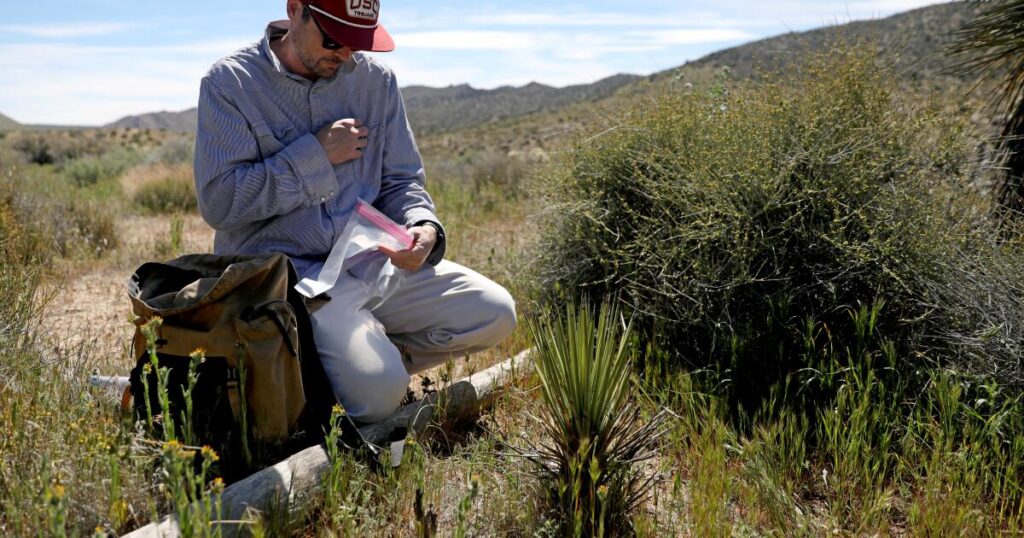
But the 193 planted “Joshies,” as Polyakov calls them, were grown in potting soil, so they may not have formed these partnerships with native fungi, she said as she knelt beside the dead seedling on an unseasonably warm March afternoon.
She used a mallet to pound a metal tube into the rocky sand. After giving it a few twists, she lifted it out and deposited the soil into a baggie.
“There’s a whole world inside this little bag, but it’s invisible,” she marveled.
Researcher Cameron Egan, an ecologist and professor at USC, will extract DNA from each soil sample and send it for sequencing to learn what species of mycorrhizal fungi are present. The team will compare results from the dead Joshua seedlings with those that survived, as well as with samples from older Joshua trees growing nearby.
Depending on what they learn, the fix for future planting projects could be as simple as mixing a bit of native earth into the potting soil where the Joshua tree seedlings are grown.
The Park Service is interested in exploring ways to improve the success of its restoration projects and would be open to trying soil mycorrhizal treatment, a spokesperson wrote in an email.
The research is part of the Society for the Protection of Underground Networks’ mission to map fungal networks across the globe. The Mojave Desert is under-explored, and the organization’s maps predict it to be rich in fungal diversity.
The fieldwork also took the team to Joshua Tree National Park, which some research suggests will eventually become largely devoid of its namesake plant.
They rumbled along rocky trails in a rented Kia, sampling soils from the sweeping flatlands of Lost Horse Valley to the slopes of Eureka Peak, where massive Joshua trees grow alongside manzanita, juniper and pinyon pines.
They hope to gain insight into whether, as Joshua trees shift to higher areas, the fungal communities that help them withstand hot, dry conditions in their lower environs are moving with them.
Such observations could help California decide where to prioritize Joshua tree conservation as it implements a sweeping plan to protect the plants from climate threats. They could even open the door to the possibility that people could help the plants migrate by inoculating certain areas with specific types of mycorrhizal fungi, Egan said.
“Any time rapid environmental changes happen, evolution has to try to keep up, and if evolution doesn’t keep up, well, then the species goes away,” he said as he looked out over a stretch of savanna-like grassland inside the national park. “Our hope is to give these populations a chance to keep up.”
Behind him, a mature Joshua tree was dying, its graying limbs drooping sadly. In the shade beneath the fading giant, a seedling had sprouted.
The post Humans are killing California Joshua trees. Can fungi save them? appeared first on Los Angeles Times.