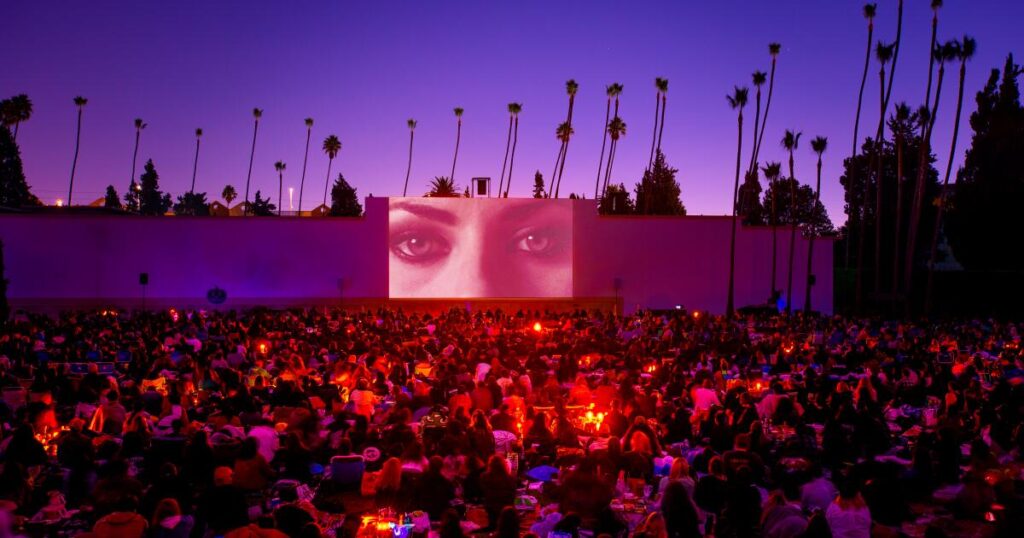

On most summer weekends, the Douglas Fairbanks Lawn at the Hollywood Forever Cemetery is transformed from a green expanse of land in the middle of metropolitan Los Angeles to a Victorian-era communal picnic and film screening for an audience of 4,000.
Since its inception, Cinespia has become a beloved Los Angeles institution. And, for 25 years, founder John Wyatt has been spearheading the effort. “I still make sure that I’m at every single screening,” says Wyatt. This must be part of the secret sauce — Wyatt’s dedication and consistency.
In 2002, Cinespia — an Italian portmanteau for “movie theater” and “cinema spy” — screened Hitchcock’s “Strangers on a Train” at the cemetery for members of Wyatt’s film club, which he ran with Richard Petit. “The whole idea was that it doesn’t have to be boring. It doesn’t have to be stuffy. It can be really fun,” says Wyatt. Back then, the once-abandoned 62-acre cemetery was under new ownership and seeking ways to activate the space.
“Hitchcock was the perfect choice, because it draws you in,” says Wyatt. “My friend was working at the LA Weekly, and he put out the teeniest little blurb. All these people showed up who weren’t in our film club. It was such a moment.”
Little did Wyatt know that this first screening was just the beginning. For the next 25 years (even during the COVID-19 pandemic), Wyatt and his team would screen over 650 films for over a million people, with no end in sight.
I’ve been attending events at Hollywood Forever since my early 20s. A rainy Belle and Sebastian concert on the Douglas Fairbanks Lawn. A Paris Review reading in the Masonic Lodge. And, of course, countless Cinespia screenings. Along with sandwiches and a sweating bottle of orange wine, I always bring a bouquet of flowers to leave on my grandparents’ graves. When my family first immigrated to Los Angeles from Soviet Belarus in the early ‘90s, we lived a few blocks away from Hollywood Forever. Both my maternal grandparents are buried there. My aunt and uncle will be too. My parents have a shared plot waiting for them, nearby. When I sit on the lawn under the stars surrounded by the ghosts of Hollywood’s Golden Age and thousands of Angelenos collectively experiencing art — or an impromptu dance party, or a suspense-induced collective scream or a shared bout of laughter — I feel as if my grandparents are on my picnic blanket beside me, watching the film.
Cinespia has an uncanny ability to transport the audience away from modernity, away from scrolling on their phones alone in their living rooms, away from the surrounding strip malls and seemingly endless traffic, to a communal utopia. “You’re not just watching a movie and leaving. You’re seeing people, you’re being seen,” says Wyatt.
Ahead of Cinespia’s 25th summer season, I spoke with Wyatt about Cinespia’s evolution, how he goes about selecting the films, and the only time he ever felt starstruck. His passion for Los Angeles, classic films, and Cinespia’s devoted audience was palpable. Tears welled in his eyes as we walked down memory lane, deep into the archives.
Diana Ruzova: I know you started off with snail mail and word of mouth to promote the screenings. Do you think this slow deliberate start helped maintain the authenticity that permeates today?
John Wyatt: The reason we had a snail mail list is because a lot of people at that time didn’t have an email. This gave me an opportunity to make these little cards. The front of the card would be a still from the movie that we picked, and then the back would be a brief description. I remember being at the post office with bins and bins, stressing out, trying to put stamps on everything, trying to get these out. A retired military service guy was on my mailing list. When we switched to email, he wrote me a letter asking what happened to the little cards.
Around our second season, we got invited to go on the “Today” show. I thought about it for a long time. I thought it might change the nature of what we were doing. And I said no to the “Today” show. The producer said, “Hey, if you say no, we’re never asking you again.” And he was serious, 23 years later, they never asked us again. I was so protective of it. I think that sustains to this day.
DR: Cinespia is star-studded. Ben Stiller, Jordan Peele, Ryan Coogler, Paul Reubens (Pee-wee Herman) have intro’d their films, plus Werner Herzog, and lots of celebrity guests like Drew Barrymore, Harry Styles, Emma Stone and many many more. What is your relationship to celebrity?
JW: I was born and raised in L.A., so it’s part of living here. Some people I went to Crossroads with are now well-known celebrities. I honestly think I see the best side of people who are in the limelight. They’ve always been really supportive. When [Suzy] Eddie Izzard was coming, [she] was like “I want everyone to know about this,” and brought Minnie Driver.
It was the early days. We were still just taking donations and figuring it out. I literally was setting everything up myself and testing everything. And we were doing things on 35mm, which meant bringing these massive projectors in, putting them into the back of these trucks. I’d be there all night.
Drew Barrymore was coming, and she called it “the tradition.” And Paul Reubens too. Paul Reubens was like, “I know everybody. I can vouch for this.” And he wasn’t lying. He knew everybody. I keep it really low-key. They’re watching a movie with 4,000 people, and nobody’s bothering them.
DR: Have you ever been starstruck?
JW: I don’t get starstruck that often, but with Stevie Wonder, I just lost it. He was so cool. And he wanted to come for the experience. He wanted to feel everything and see what it was like. I watched people burst into tears as he walked by and I couldn’t help it. I was just totally starstruck. I could barely speak.
DR: Why is incorporating music important to Cinespia?
JW: I was a DJ around L.A. and I’m still a record collector and a fanatic about music, as well as film, and so I wanted to create an atmosphere. We are very strict: The DJ has to start the moment the gates open. So, you’re walking through the cemetery towards the music.
The music is curated. Maybe it’s not even directly related to the film. I did DJ in the very beginning, and it was really hard to do everything, and I didn’t do the best job. I had to call in the professionals like Questlove, Cut Chemist and Daisy O’Dell. I like to give them lots of freedom. I trust them. “It’s a party.” That’s what I tell them. I don’t want them to overthink it, but I want them to be inspired.
DR: When were the elaborate set-designed photo booths incorporated? What do you think they add to the Cinespia experience?
JW: About 15 years ago, we screened “Saturday Night Fever,” and I had this giant piece of fabric with sequins in my truck from when I worked as an art director. I was looking around at everyone dressed up. Gen X has a special connection to the ’70s disco era. And people were wearing all these vintage clothes. I was so impressed. So, we put this giant sequin fabric thing up and I had my photographers — who were usually shooting people having picnics and things — focus on it, and I was all, “I’m just going to bring people in, one at a time, and we’re going to shoot their picture.” Everyone did a disco pose. And I was like, “I got to do this all the time.” And so, from there, we started building backdrops. We build everything that day and then we take down that day. Luckily, I have an incredible art team.
What our photo booths evolved into from the piece of fabric is a riff on the film in the form of a set. We build a little set and furnish it and decorate it. And then we bring in professional lighting, we bring in a professional photographer, and we figure out how to shoot one person alone or 18 people together. We have a high bar. People are expecting a lot. We have over 1,000 people in the photo booth per show. And we’re going to keep doing it. I’ve talked to people who say, “I have stacks of the prints.”
DR: Los Angeles is constantly erasing itself. With the recent closure of Taix and Cole’s, and the attempt to resurrect the Cinerama Dome, to name a few examples. Was there ever a time that you feared Cinespia might be erased?
JW: It’s not always a given that Cinespia is going to be there. We work so hard every year to make sure that it’s there. The pandemic was the big test. It was like a bull’s-eye to our business. It’s the only time that we’ve halted the screenings at the cemetery since we started. The city would not allow it.
In 2020 we did our annual Valentine’s Day screening, and then COVID lockdown started. So, we spent months working with the city, figuring out what we could do, and we created a series of drive-ins at Griffith Park. The city made everybody stay in their car for most of the time. You couldn’t mingle. We did dozens and dozens and dozens. It wasn’t easy. My crew was very faithful, risking their lives to be there.
It gets wild up at the very top where we were putting all the cars. It’s just a giant piece of grass and wilderness. The coyotes would come down. The deer would come down. The moon would come up.
In June 2021 the city told us we can start Cinespia at Hollywood Forever again. I’ll never forget the first little crowd coming in. Usually, I’m on the field when the gates open, seeing everyone come in. I was with Daisy O’Dell. She was like, “Are you OK?” I didn’t know if I’d ever see this again. And there they all were.
DR: How has the Hollywood Forever Cemetery changed over the last 25 years? After my grandfather was buried in Hollywood Forever Cemetery in 2009, I have watched the little path that leads to his tombstone go from a muddy dirt trail to neatly paved with bricks.
JW: A lot of the money we were raising was going straight into restoration, a stained-glass window here, the bells in the bell tower there, a broken monument restored. And, like you said, paths and lighting. It’s gone from abandoned to stunningly gorgeous. A lot of the people interred there are from the Golden Age of Hollywood, and now it’s becoming a place where filmmakers and musicians and artists are considering for their final resting place. David Lynch is now interred there. We’ve really brought it back to its glory days.
DR: With the film industry in major flux due to AI, social media and our changing attention spans, why do you think Cinespia’s outdoor screening model is important?
JW: People still want to sit down and watch a movie with a crowd, that has not changed. And I’m seeing more kids coming. They’re Gen Z and younger. They’re interested. They love it the same way we love it. It’s kind of this eternal thing: humans love great stories, and they love being together in a place and being entertained. And everything is magnified when you’re in a crowd. Laughter is infectious, and suspense is infectious. I’m feeling like it’s stronger than ever. And maybe that’s local to L.A., we’ve had not the best of times.
Once, a couple came up to me and told me that they met at Cinespia. It was their first date. Now they’re married. I’m like, “that’s incredible.” And then they come back and say, here are our kids. Their kids are so excited to go see these movies, and the parents feel comfortable dropping off their teenagers.
Things in L.A. change so fast. You turn around and a beautiful building is gone or a great deli is out of business. So, something that survives 25 years and is consistent, and is not changed in any fundamental way, is comforting. You know what you’re going to get, and it’s going to be good.
DR: And you get to see L.A. reflected back on the big screen.
JW: One of my favorite movies to show is “Sunset Boulevard” because it’s meta. There’s moments where the main character is shouting out the names of all these people buried all around us. She’s talking to the audience. It becomes this incredible experience that you can only have right there.
DR: How do you go about picking the movies?
JW: We pick the movies really carefully. We spend a lot of time on it. We do have a formula. I’m putting myself in the audience’s shoes. Is this going to rock your world? Is it going to entertain you? Is it gonna thrill you? Are you gonna laugh? Is it going to keep your attention? That’s a big one we think about.
Sometimes we pick things because someone passed. Sometimes we pick things because we hadn’t thought of them before. You should never underestimate an audience. I’ve learned that. Early on, we had a movie that got maybe boring. An audience can cheer and they can also all boo, and I have not forgotten that.
Tastes change. Familiarity changes. Some of the things I would show 20 years ago, I wouldn’t show now. Culture changes. Some things just don’t work like they used to. Other things are eternal. Sometimes things come back around and suddenly make sense again. One thing I never thought would happen was that I’d show movies that came out in the past 25 years. Those films are classics now, and some of them have really stood the test of time.
We’re excited to show “Mulholland Drive” this year. It’s 25 years old, just like us. And it’s about L.A. It’s got the feeling of L.A. The mystery. It’s at times challenging, and at times very entertaining. We’re excited to honor David Lynch, whose final resting place is close to where we screen the films.
Cinespia’s 25th Season begins on Saturday, May 23, with “E.T. The Extra-Terrestrial.” Learn more.
Diana Ruzova is a writer from Los Angeles.
The post 650 movies later, Cinespia turned a Hollywood cemetery into L.A.’s summer utopia appeared first on Los Angeles Times.