Two men walked through livestock pens with .22-caliber rifles, killing Art Schaap’s cows. One man would raise his rifle, its barrel inches from a cow’s forehead. A shot would ring out, the cow would fall and the men would move on to the next cow.
There were 3,665 cows at the Highland Dairy in Clovis, N.M., a city in the flatlands near the Texas border. After six hours of gunfire, there were none.
Mr. Schaap felt he had no choice but to have his herd killed. Testing showed that the water he had pulled from wells on his property contained exceptionally high levels of PFAS, also known as forever chemicals, which have been linked to birth defects, liver and heart disease and some cancers. State and federal regulators pulled his permit to sell milk and quarantined his herd. Selling his cows for beef was out of the question.
“I don’t want this farm no more,” Mr. Schaap said.
The source of the contamination, state environmental officials say, was his next-door neighbor, the Cannon Air Force Base, home to the 27th Special Operations Wing. For years, firefighters there had conducted exercises using a foam that contained PFAS. Runoff had seeped into the aquifer where Mr. Schaap and other farmers and ranchers drew their water.
Similar scenarios have played out at hundreds of military facilities across the United States. But New Mexico has become the center of the nation’s reckoning with PFAS. The state is suing the federal government for turning bases like Cannon into epicenters of forever chemical contamination.
Gov. Michelle Lujan Grisham has led this campaign. Weeks after she became governor in 2019, her administration filed suit against the U.S. Air Force over the PFAS pollution at Cannon. Because the accusations in New Mexico are so clear-cut, a federal judge in South Carolina picked New Mexico’s suit to be a bellwether for similar litigation nationwide.
The designation means the outcome of the New Mexico case will become an important benchmark in how the more than 15,000 similar PFAS suits nationwide are treated in court, lawsuits filed on behalf of people like Mr. Schaap, who claim harm from forever chemicals in firefighting foam.
“It was a very clean-cut case,” said Zachary Ogaz, the general counsel for the New Mexico Environment Department. “It’s pretty darn obvious where the PFAS is coming from.” That, he said, will allow the court to explore the issue at the heart of the case: Who should be held accountable for the human, economic and environmental costs of PFAS contamination?
New Mexico’s legacy of military pollution dates to World War II, when the effort to build an atomic weapon, the Manhattan Project, was based there. Radioactive elements last a long time; so do bitter memories. Ms. Lujan Grisham was born in Los Alamos, the nerve center of the Manhattan Project. Her sister, Kimberly, was diagnosed with brain cancer when she was 2. Her parents believed the illness was linked to nuclear research.
“I can remember being in grade school and hearing the community talk about how many brain tumors there were,” Ms. Lujan Grisham said in an interview.
Kimberly, who died at the age of 21, continues to motivate the governor. “If you’re going to do something that hurts the citizens of my state, you’ve got to come through me,” Ms. Lujan Grisham said.
Earlier this month, the state scored a victory, when the Air Force made concessions regarding a Clovis cleanup. It agreed to provide funding and technical resources for groundwater testing outside the military base, including at dairies, according to a joint statement released on May 12 by the Air Force and the state environment department.
Yet the legal fight continues — the agreement will not affect New Mexico’s lawsuit or the thousands of others nationwide. “The federal government has to be accountable, right? It’s got to happen at some point,” Mr. Ogaz said. “That’s what we’re fighting for, at least.”
A Plume That Spreads Southeast
PFAS — the acronym stands for perfluoroalkyl and polyfluoroalkyl substances — are not only forever; they’re everywhere. Until recently, these synthetic compounds enjoyed widespread commercial and industrial use — in takeout food containers, dental floss, drinking water and water-resistant clothing.
Studies have linked the substances to a wide variety of ailments in humans and animals, including heart disease, low birth weight, infertility and cancers of the kidney, testicle and breast. Though the risk and extent of health impacts from forever chemicals remain uncertain, the federal government and many states have set strict regulatory standards for PFAS in drinking water and food packaging.
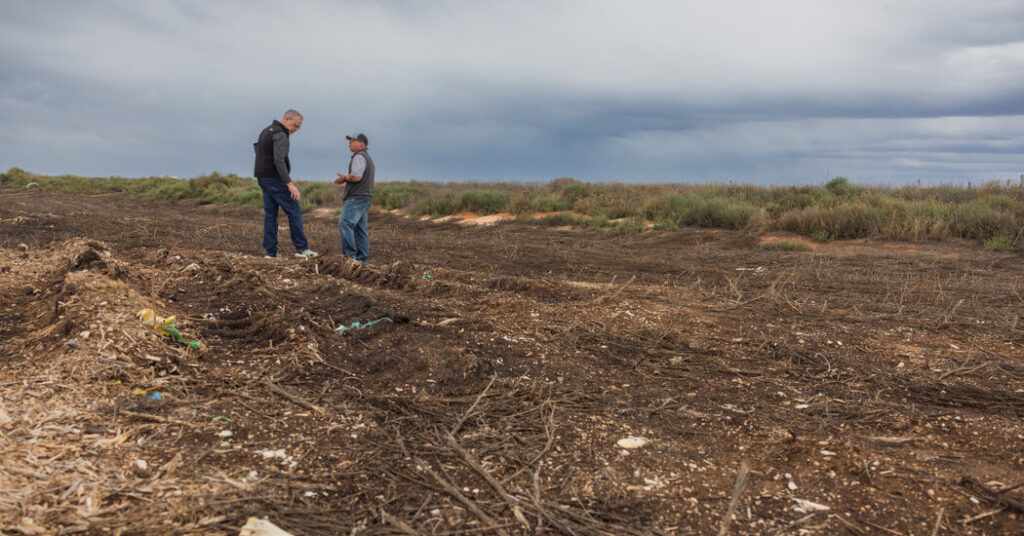
None of this is abstract for Mr. Schaap. After the killing of his cows, he and his workers spent two days hauling the carcasses into a pit on his property. Four years have passed, but the mass grave at Highland Dairy is still a barren plot. Animal remains protrude from the mud: hide, a hoof. Only weeds grow.
Preliminary testing revealed that Mr. Schaap’s well water had a concentration of 14,320 parts per trillion for PFOA and PFOS, two of the most ubiquitous forever chemicals — 205 times greater than the Environmental Protection Agency’s recommended limit of 70 parts per trillion in drinking water.
The base offered bottled water and filtration, but did nothing for the well water that was crucial to Highland Dairy and other farmers and ranchers near Clovis. By 2021, the PFAS concentration in one of Mr. Schaap’s wells registered 37,733 parts per trillion. The following year, the E.P.A. also issued much stricter recommendations for PFOA and PFOS. On May 14, however, the agency indicated it intended “to rescind the regulations and reconsider the regulatory determination” for some other forever chemicals, including what are known as GenX substances, angering activists.
The corner of the base closest to Mr. Schaap is where the firefighters trained. As at most American military sites, Cannon firefighters put out fires with aqueous film forming foam, or A.F.F.F. A-triple-F, as it’s known, is exceptionally good at fighting fuel fires, which it does by creating a barrier against oxygen. It does so thanks to PFOS.
One former Cannon firefighter “described incidents where firefighters would spray each other with the foam as a form of horseplay, and that they would spray the foam and allow visiting children to play in it,” according to New Mexico’s lawsuit. Firefighting foam now uses other forever chemicals, thought to be somewhat less harmful than the ones that found their way into Mr. Schaap’s water.
The foam that percolated into the base’s soil formed an underground plume that slowly spread southeast and now extends four to six miles from Cannon. “It’s not contained,” said James Kenney, the secretary of the state environment department, at a public meeting in Clovis last year. “The horse got out of the barn.”
Mr. Schaap draws water from the Ogallala Aquifer, which is in the path of the PFAS plume. Last summer, a state health department study found that people who lived or worked within the plume’s area had blood concentrations of PFHxS — a common forever chemical, more durable than PFOA and PFOS — three times higher than the national average.
Mr. Schaap has his own lawsuit against the Pentagon. “We’re not letting them off the hook,” he said.
Military bases are PFAS hot spots. According to a report by the Government Accountability Office published last year, the Pentagon has identified 718 military installations where PFAS chemicals may have been released. Another G.A.O. report found that about 1,500 military facilities worldwide were still using A.F.F.F. to suppress fires.
A spokeswoman for the Air Force said the Department of Defense was “committed to replacing A.F.F.F. with fluorine-free alternatives,” referring to other formulations that do not contain PFAS. The spokeswoman also said that the Defense Department can meet its deadline for doing so, Oct. 1.
Then in early May, New Mexico officials quietly traveled to Washington for a meeting at the Pentagon. They came away with what Mr. Ogaz, the environment department’s general counsel, described as a “verbal agreement” from the Air Force that it would pay for groundwater monitoring around Cannon, an important step in the cleanup process.
The agreement resolves a practical matter for landowners like Mr. Schaap, but does nothing to address the deeper questions of responsibility. Nor does it address contamination at other bases across New Mexico, like the one next to a lake animals drink from.
A Lake That Is Not a Lake
If cows tell the story of Cannon, ducks tell the story of Holloman Air Force Base, a four-hour drive southwest.
Lake Holloman, just outside the base, is a popular stop for migratory birds, including ducks. Designated an Important Bird Area by the Audubon Society in 2002, it is a rare body of water next to the undulating expanse of White Sands National Park.
But it is not a lake, exactly. Created in 1965, the Holloman Evaporation Pond collects runoff from the base, including firefighting foam. Initially, swimming was forbidden, but not other recreation. “Just as recently as a few months ago, people were camped next to it,” Joseph Cook, a biologist at the University of New Mexico, said last year.
Last summer, Dr. Cook and Jean-Luc Cartron, a biologist at the University of New Mexico, and their colleagues published a study that found “massive” PFAS contamination around Lake Holloman. A dead killdeer chick collected on its shore had the highest PFAS concentration ever measured in a bird. According to Dr. Cartron’s calculations, a kangaroo rat found at the lake carried a PFOS burden 360 times that of Mr. Schaap’s most contaminated cow.
“Dime-size amounts of breast meat” from waterfowl, Mr. Kenney said at the public meeting in Clovis, “can have a lifetime exposure of PFAS.”
Public access to Lake Holloman was terminated around the time the study was published. Today, the lake is a flat blue expanse ringed by chain-link fencing. The only sign of human life is the roar of F-16 Fighting Falcons taking off and banking over the Sacramento Mountains. Birds land on the lake. Bigger animals drink its water. Then they disperse across the state.
The town of Santa Rosa, in Eastern New Mexico, is 200 miles from Lake Holloman, but migratory birds and animals easily traverse those distances. To understand how PFAS is spreading through water fowl, Matthew Monjaras, who founded Impact Outdoors, a nonprofit that conducts environmental programs, including hunting trips for veterans, and Christopher Witt, a bird biologist at the University of New Mexico, set out into a series of wetlands outside Santa Rosa called Tres Lagunas.
In the predawn darkness, the men parked, loaded rifles and moved in silence through the snake-infested grass of Tres Lagunas. They waded into cold water, which quickly reached their waists. Then they stood, waiting, as pink bands of light appeared in the sky.
Mr. Monjaras used duck calls to produce a series of convincing quacks. Ducks answered the call. Shots rang out. Birds fell into the water.
After the hunt, Dr. Witt dissected each bird, shaving off liver samples to be tested as part of a statewide survey.
PFAS tend to concentrate in liver tissue. Mr. Monjaras estimates he has eaten dozens of duck livers. He has grown so concerned that he drove three hours to the meeting in Clovis. Carter Monjaras, his 5-year-old son, wearing hunting camouflage, tagged along.
As the presentation was concluding, Mr. Monjaras asked about the game he and his family consume: “How do I guarantee that I’m not inviting PFAS to my dinner table?”
“I would personally choose not to eat wild game that was hunted around Holloman,” Mr. Kenney answered delicately. But he also acknowledged the impossible position Mr. Monjaras and others were in, having to guess the toxic exposure of every bird they hunted.
“That should never have happened,” Mr. Kenney said.
The post Military Bases Are Rife With ‘Forever Chemicals.’ New Mexico Wants Them Cleaned Up. appeared first on New York Times.