Events promoting real estate investment in Israel and the occupied West Bank have been held across the New York area for years. But in recent months, an energized pro-Palestinian movement has drawn public attention to these events through rancorous protests outside synagogues that have hosted them.
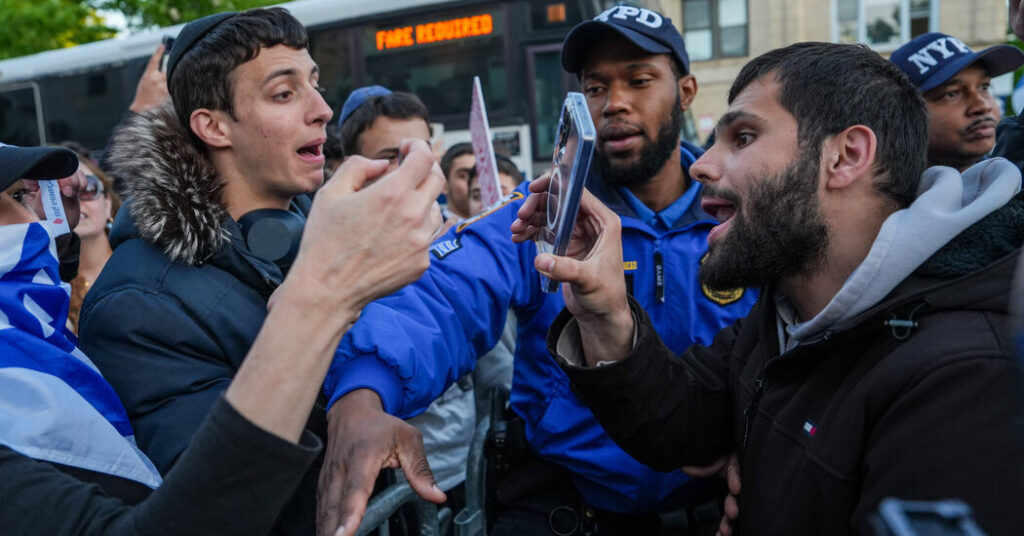
Supporters of Israel have rallied to defend the events and the synagogues where they are held. At least twice in recent weeks, the dueling groups of demonstrators have hurled slurs and threats, pushed and shoved one another, and wished death and destruction upon their political opponents outside buildings dedicated to the worship of God.
The pro-Palestinian demonstrators have succeeded in injecting into the city’s political debate the issue of West Bank settlements, which most of the world considers to be illegal, and local synagogues’ role in promoting them.
But the protests have also unnerved many New Yorkers and aggravated the uneasy relationship between Mayor Zohran Mamdani, who has vocally opposed the real estate events, and some Jewish residents. They are dismayed by the raucous scenes outside synagogues at a time of rising antisemitism, and want the mayor to speak out more forcefully when protesters cross into menacing territory.
The demonstrations have often erupted into heated and sometimes physical confrontations between pro-Palestinian demonstrators, some of whom have expressed support for terrorist groups or chanted in support of intifada, and supporters of Israel, some of whom have used slurs and chanted far-right slogans, including “Bring ICE here!”
Each night of protest has seen the conflict in the Middle East spill into the busy streets of Manhattan and the leafy neighborhoods of Brooklyn and Queens.
‘The Great Israeli Real Estate Event’
The recent demonstrations have focused on a traveling presentation of investment opportunities known as “The Great Israeli Real Estate Event.” Similar events organized by Israeli companies have drawn protests in New York and other cities in the past.
The events advertise properties in Israeli cities like Tel Aviv and Jerusalem, but also in Israeli-occupied settlements in the West Bank, including some that have been the site of escalating violence against Palestinians in recent years.
The fairs have been publicized by Tivuch Shelly, an Israeli firm that markets real estate to English speakers. The firm’s chief executive, Shelly Levine, an American immigrant to Israel, declined a request for an interview.
Prospective attendees apply for invitations and are screened before being granted admission. The events are closed to the news media, and New York Times reporters tried and failed this month to gain access, with one being turned away at the door.
But several reporters for other news outlets were able to enter last week’s event, which was held at Park East Synagogue in Manhattan, one of New York’s most prominent Modern Orthodox houses of worship. They posted pictures of brochures they received inside, which advertised apartments in the West Bank settlements of Kfar Eldad and Karnei Shomron.
Researchers say the settlements have disproportionately large American populations: While American citizens account for roughly 1 percent of the people who live within Israel’s 1967 borders, they make up 15 percent of the people who live in the settlements.
It is not clear whether real estate is actually sold at the events. Attendees have spoken of receiving brochures and floor plans for housing developments in Israel and the West Bank, as well as information about securing bank loans to help pay for property there.
A picture posted online by Tivuch Shelly the day after last week’s event in Manhattan shows Ms. Levine and others seated at folding tables in an event space, surrounded by posters advertising Israeli cities and the West Bank settlement of Ma’ale Adumim.
The firm’s website describes Ma’ale Adumim as “an established and growing Anglo-focused community just 20 minutes from Jerusalem” with “a relaxed suburban feel” and “a country club with indoor and outdoor pools.”
It says housing there “is being offered at exceptional early-stage pricing, with no purchase tax where applicable.” It does not mention that the settlement is on disputed land.
Steven Saphirstein, 39, went to one of the recent fairs, held Tuesday inside a Queens synagogue.
“Nobody’s buying anything in there,” Mr. Saphirstein said in an interview outside the event, holding a brochure for an area west of Jerusalem. But he said he would like to own a home in Israel one day, and that he had attended the event to learn how to make that dream a reality.
Dueling Protests Turn Rancorous
A day before the Queens event, pro-Palestinian demonstrators gathered outside a real estate fair being held at Young Israel of Midwood, a synagogue and senior center in a Brooklyn neighborhood with a large Jewish population. A significant police presence filled the streets.
The protesters were met by pro-Israel counterprotesters, including many young men. The scene quickly turned chaotic, with fists and insults flying.
Later, a pro-Palestinian group marched through the neighborhood behind a man waving the flag of Hezbollah, calling for the death of Israeli soldiers as families watched from their porches.
Crowds of Israel supporters gathered nearby, chanting “We love Trump” and “Bring ICE here.”
Hundreds of people gathered outside Park East Synagogue last week for a similar protest. At one point, pro-Palestinian demonstrators scuffled with police officers, the two groups pushing metal barricades back and forth between them. Both that protest and the one in Midwood led to a handful of arrests.
Mr. Mamdani has denounced incendiary language used at the protests, but has also been clear about his opposition to the real estate events.
Some Jewish leaders have criticized his responses as slow and insufficiently vigorous. After the protests in Midwood on Monday, the mayor did not comment publicly until Tuesday afternoon, when he sent a statement to the news media.
In the statement, he condemned the “antisemitic, anti-Muslim and racist rhetoric” of the dueling protests, as well as their use of “racial slurs, displays of support for terrorist organizations and calls for the death of others.”
“New Yorkers have the constitutional right to protest and to counterprotest, but no one should face violence, intimidation or hatred because of who they are or what they believe,” he added.
Mark Treyger, the chief executive of the Jewish Community Relations Council of New York, a nonprofit umbrella group, said Jewish residents he had spoken to in recent weeks were experiencing “a chilling effect from these numerous ongoing protests that really are spilling into intimidation, hate and harassment.”
He added that he wanted Mr. Mamdani to more assertively speak out against demonstrations that cross into darker territory.
“The mayor needs to be very clear, strong and consistent in saying, ‘We are not going to resolve these international disputes at the doors of houses of worship,” Mr. Treyger said. “Jewish families in Midwood should not have to bear the brunt of hate and harassment for a dispute that’s thousands of miles away.”
Sam Raskin, a spokesman for the mayor, said any delay in a statement from Mr. Mamdani was the result of careful deliberation, not indifference. Many other state and city officials did not comment on the Midwood protest until the day after it occurred.
“Protests and counterprotests are often fast-moving, emotionally charged and difficult to fully understand in real time,” he said. “Mayor Mamdani believes it is important to respond with a clear understanding of the facts, rather than rushing to issue a statement that could inflame tensions or fail to reflect the full scope of what occurred.”
Hadar Susskind, the president of New Jewish Narrative, a progressive group, said he thought some of Mr. Mamdani’s critics needed to “take a breath and look at what is actually happening” on a policy level.
“There are a lot of really strong, positive things the mayor is doing for the Jewish community,” he said.
He pointed to Mr. Mamdani’s announcement this week that he was including in his budget proposal an additional $26 million for the Office for the Prevention of Hate Crimes, an increase of 866 percent from its current level. The announcement, which fulfilled a central campaign promise, drew praise from several Jewish and pro-Israel groups.
The pro-Palestinian group that has organized the protests, the Palestinian Assembly for Liberation-Awda, has been deeply critical of Mr. Mamdani. In a statement, it condemned the mayor for allowing the Police Department to keep protesters from getting closer to the synagogues hosting the fairs.
Varied Responses From Democratic Leaders
As the protests have escalated, elected officials and political candidates have been forced to respond to them. Some Democratic leaders have sidestepped ethical questions about the events and focused instead on safety concerns.
Julie Menin, the speaker of the City Council, said last week that “the ability of individuals to safely access a house of worship without fear or intimidation” must be protected. She said she had been “deeply disturbed” by some of the rhetoric used at the protests, which she said were “horrific, intimidating, and only fuel the flames of antisemitism.”
Micah Lasher, a state assemblyman running in a Democratic congressional primary in Manhattan, told reporters that the tactics of the pro-Palestinian demonstrators made him believe they were more opposed to “the legitimacy of Israel” than to real estate sales in the West Bank.
But other prominent Democrats have recently joined Mr. Mamdani in condemning the real estate events.
Antonio Reynoso, the Brooklyn borough president and another House candidate, called the real estate fairs “an injustice,” adding: “Shame on those that allow these sales to happen here in Brooklyn or anywhere else.”
And Jack Schlossberg, who is running in the same primary as Mr. Lasher, condemned the “antisemitic chants and protests” heard at the demonstrations, but also said the fairs should not be held at synagogues.
“We must be working toward a lasting peace for Israelis and Palestinians,” added Mr. Schlossberg, whose grandfather Alfred Schlossberg was once president of Park East Synagogue. “Events like this do not help achieve that goal.”
Legal Questions, Spiritual Callings
Critics of the fairs argue that synagogues should not host them because they promote the acquisition of occupied land in violation of international law. Some legal experts agree.
Gabor Rona, a professor at Cardozo Law School who focuses on international humanitarian law, said purchasing real estate in a settlement, or organizing or hosting an event that markets it, could make a person liable for aiding and abetting a war crime under the War Crimes Act of 1996.
He said the United States had most likely never prosecuted someone for those activities, but that a person could be prosecuted in a third country under the legal principle of universal jurisdiction. In recent years, that principle has allowed countries, including Brazil and Cyprus, to investigate Israeli vacationers for war crimes in connection with their military service.
Mr. Treyger said that supporters of the fairs view them as an expression of a religious desire to reconnect with Israel that some Jewish people feel, and believe that the right to hold such events is protected by the First Amendment.
Mr. Saphirstein, who attended the event in Queens, said he saw owning property in Israel as a spiritual goal. And if the Israeli government said the settlements were part of Israel, that was good enough for him.
“We live here in New York, we know that, but our home is Israel,” he said. He added: “I visited a few contested areas. But to me, it’s not contested, because to me it’s part of our home.”
Olivia Bensimon contributed reporting.
Liam Stack is a Times reporter who covers the culture and politics of the New York City region.
The post How Fights Over West Bank Settlements Are Unfolding at N.Y.C. Synagogues appeared first on New York Times.