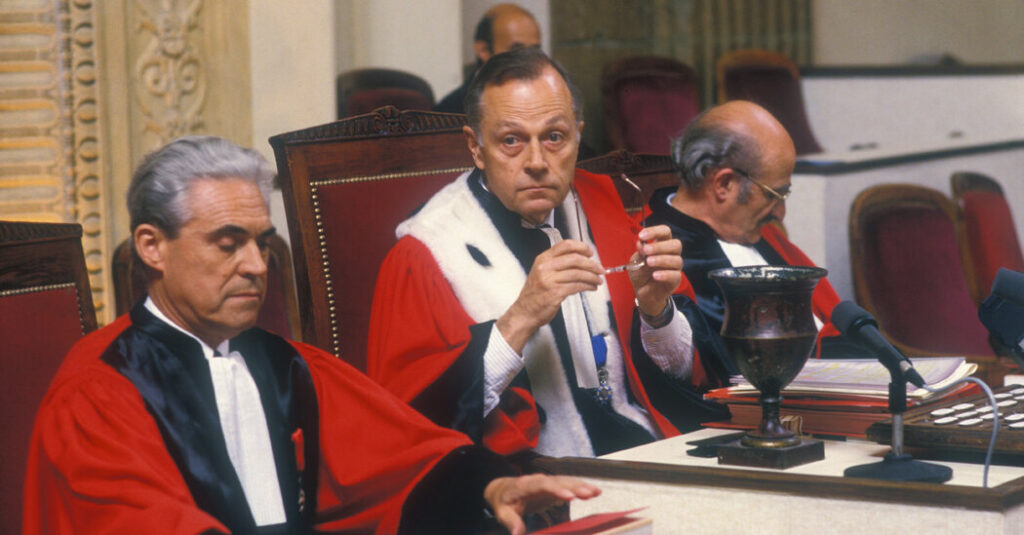
At 12:40 a.m. on July 4, 1987, Judge André Cerdini read out the sentence in a lilting Provençal accent: Klaus Barbie, the former Gestapo chief known as the Butcher of Lyon — a sadistic torturer of French Resistance members and purveyor of Jewish children to the death camps — would spend the rest of his life in prison.
After weeks of wrenching testimony, the packed courtroom in Lyon, France, exploded with emotion. “A little bit of dignity,” Mr. Cerdini pleaded, calling for quiet three times. The crowd finally fell silent.
For the first time, a French court had convicted a Nazi war criminal of crimes against humanity — in Mr. Barbie’s case, on 17 counts — in a trial that has come to be seen as a key moment in the country’s belated reckoning with its wartime past.
Mr. Cerdini died on May 4 in Vals-les-Bains, the spa town in southern France where he was born. He was 96.
His death, at a retirement home, was announced by the French minister of justice, Gérald Darmanin, who paid tribute to him as a “distinguished and appreciated” judge.
Mr. Cerdini, the son of Italian immigrants, was a lifelong provincial magistrate who quietly moved up the judicial ladder in the modest French towns where he was posted as a judge and prosecutor in the 1960s and ’70s.
By 1984, when he became chief magistrate at the assizes court, which tries serious criminal cases, in Lyon, then France’s third-largest city, he seemed unlikely to be headed for a date with destiny.
The journalists at the Barbie trial at first scoffed at the apparently unsophisticated judge who rolled his R’s and hardly appeared equal to the historic occasion. Initial misgivings seemed confirmed on the third day of the trial, when Mr. Cerdini allowed Mr. Barbie to absent himself from the proceedings.
It was the defendant’s right under French law. But it elicited a hail of criticism, and some said the trial was already a failure.
Yet as the process rolled on for nine weeks, from May to July — with testimony from some 90 concentration camp survivors, filmed for archival purposes, in front of an audience of 700 in the great hall of the colonnaded Lyon courthouse — Mr. Cerdini quietly exerted his authority.
It was his prerogative. In a French criminal trial, the presiding judge, or president, is the star of the show, far more so than in the American legal system. The judge arbitrates between the state prosecutor and the defense, and also among the so-called civil party lawyers — 39 of them in the Lyon trial, representing Mr. Barbie’s Resistance and Jewish victims. The judge questions the witnesses, keeps the numerous lawyers on point, and makes sure the accused, no matter how vile, is accorded respect.
All of which Mr. Cerdini accomplished with aplomb, in the view of journalists and historians.
“He’s not really presiding over the court sessions, he’s arbitrating,” the newspaper Le Monde wrote at the time. “He doesn’t make remarks, he doesn’t gibe, he listens. He doesn’t cut people off, he hangs back. If he ever gets irritated or angry, it doesn’t show.”
As Richard J. Golsan, a historian at Texas A&M University, observed in “Justice in Lyon: Klaus Barbie and France’s First Trial for Crimes Against Humanity” (2022), “Throughout the trial, Cerdini maintained the decorum of the courtroom — the ‘dignity,’ he called it — as well as a firm control of his emotions, certainly during most of the trial’s most trying moments.”
Witnesses were “gently admonished by Judge Cerdini when they veered off track,” Mr. Golsan wrote, and he refused to be drawn into the “provocations” of Mr. Barbie’s lawyer, Jacques Vergès, who infuriated the civil party lawyers by arguing that his client’s actions were no worse than those of the French during the Algerian War or the Americans in Vietnam.
During the harrowing testimony of Lise Lesèvre, a Resistance member arrested by the Gestapo in March 1944 and personally tortured by Mr. Barbie, Mr. Cerdini maintained absolute calm.
“I saw, on the table, some strange things,” Ms. Lesèvre told the hushed courtroom on the trial’s 10th day. “They explained to me that these were spiked handcuffs. They would ask a question, and then they tightened. The pain was excruciating. Since I didn’t answer, they passed on to something else: I was hung up by the wrists.”
Her husband and her son were both deported to concentration camps; neither returned.
When Mr. Barbie briefly reappeared three times in the courtroom — twice to face witnesses he hadn’t seen in pretrial discovery, and then at the end of the trial, when he rose to say that the deportation of Jews was not his responsibility and that “it was war, and now the war is over” — Mr. Cerdini “treated him with courtesy,” Jean-Olivier Viout, who served as an assistant to the state’s prosecutor, said in an interview.
In the end, Mr. Barbie was convicted of three major crimes, which Mr. Cerdini described to the court on the night of July 4, as the defendant stood at attention: the deportation of 84 Jews from the Rue Sainte-Catherine in Lyon in February 1943; the deportation of 43 Jewish children, six adult teachers and other personnel from a school in the nearby hamlet of Izieu in April 1944; and the August 1944 deportation of several hundred Jews and members of the Resistance on the last such train to leave Lyon.
The judge was “extremely calm, serene even,” Mr. Viout recalled. “He dominated, but as an arbiter. And he showed extreme gentleness toward everybody, especially the victims. It was his calm that set the tone for the whole trial.”
André Émile Cerdini was born on Dec. 18, 1929, one of two sons of Angiolo and Suzanne Cerdini, who had settled in the Ardèche region of southeastern France, carrying on a family tradition of ice cream and confectionery making that continues today.
After primary and secondary studies in Vals-les-Bain, Aubenas and Le Puy-en-Velay, Mr. Cerdini entered the law school of the Catholic University of Lyon in 1949. Upon graduation, he did military service in Germany and Algeria, then was assigned in 1958 to the courts in Gagnoa, in what was then the French colony of Ivory Coast in West Africa.
On his return to France in 1962, Mr. Cerdini worked as an examining magistrate in Alençon and a prosecutor in Le Puy and Nevers before becoming chief magistrate of the Court of Assizes of the Rhône in Lyon. In 1993, he presided over appeals in trials that resulted after a scandal in which hundreds of hemophiliacs died of AIDS after being given blood infected with HIV. He retired in 1995.
He is survived by his wife, Christiane (Maurin); two sons, Michel and Jean-François; and a daughter, Pascale Cerdini.
In the days before the trial, Mr. Cerdini visited the prison in Lyon where Mr. Barbie was being held, to make sure the defendant was ready, as the law required.
He was astonished to find the old Nazi in his cell reading the Odes of Horace, in Latin, without a dictionary.
“I was surprised,” Mr. Cerdini told the Lyon newspaper Le Progrès in a 2011 interview. “But I’ve always wondered if this wasn’t simply a trick by Vergès, to blindside me.”
Daphné Anglès contributed research.
Adam Nossiter has been bureau chief in Kabul, Paris, West Africa and New Orleans and is now a writer on the Obituaries desk.
The post André Cerdini, Judge in Trial of Nazi Klaus Barbie, Dies at 96 appeared first on New York Times.