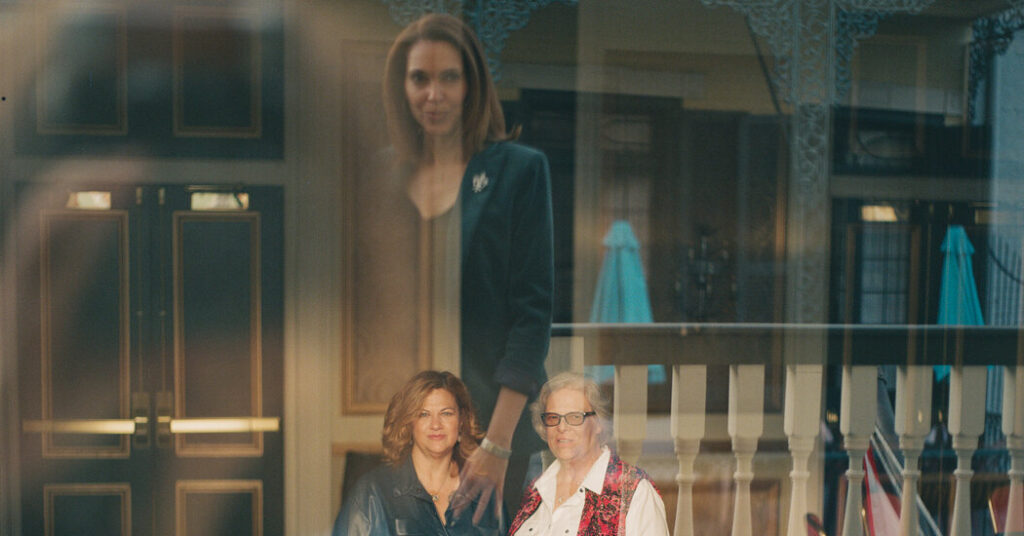
I pushed through the glass door and asked the hostess if the DeGrange party had arrived. Yes, she said, they are seated. I scanned the room, and my eyes locked on three women whose eyes were already locked on me.
It was a fall day in Chicago, and we had arranged to talk about something that in the best-case scenario would be uncomfortable; at worst, combustible.
The three women were Midwestern and white, and I am Southern and Black. I intended to tell them some information that I had only recently learned in detail — that our grandfathers had been together in the 1910s as children at the Lafon Orphan Asylum for Colored Boys, a bygone institution in New Orleans. They were brothers: George and Edward DeGrange. And they were Black.
In sepia-toned photos, George and Edward bear the resemblance of siblings, but they grew to be men a few shades apart in skin tone. George was copper brown; Edward, more of a sandy beige. This slight contrast would make a world of difference as they aged out of the orphanage into the reality of segregation, stunted opportunity and endless humiliation for poor Black people.
The two young men faced a bleak existence together until one day in the early 1920s, when Edward boarded a train to Chicago. Upon arrival, he presented himself as white. Edward eventually married and had children in Chicago — white children — who had children. George, too dark to pass even if he had wanted to, chose to stay behind. He eventually married and had children in New Orleans — Black children — who had children.
One fateful decision created parallel American lives, racial worlds apart.
During the Jim Crow era, a Black man revealed to be posing as white could face charges of race fraud, mob violence, even lynching. So George kept Edward’s secret.
When George died in New Orleans at age 92 in 1990, a protective covenant of sorts had already been passed generation to generation right down to me, the youngest of his 30 grandchildren: We don’t talk about Edward. One phrase in Creole explained why: “Edward, passé blanc.”
White-passing great-uncle Edward. He was not someone I had spent much time thinking about until one day last year, when a stunning headline jolted me (and almost everyone I knew back home in southeast Louisiana): “New Pope Has Creole Roots in New Orleans.” Leo XIV’s maternal grandparents, both of whom are described as Black or “mulatto” in historical records, lived in the Seventh Ward of New Orleans, a historic center of Creole culture, before assuming the profile of a white family in Chicago.
In a flash, I felt the quiet part of so many Creole family histories thrust onto a global stage. Indeed, untold numbers of New Orleans’s light-complexioned Creoles of color took a one-way ride away from Southern systemic racism toward the possibility of a better life as white folks in Chicago. How many joined this silent migration? It’s hard to say, but as the example of Pope Leo’s family makes clear, Edward DeGrange was not alone.
Now I wanted to know everything I could about this gamble, and to grapple with the consequences of his century-old decision, whatever they might be. I wondered, what would the white DeGranges — located through legal research and social media — make of the history I’d present to them and my decision to break the ruse? I was encouraged that they had agreed to show up to our dinner date in the West Loop.
But up until the last minutes before meeting several DeGranges in Chicago, I wasn’t completely sure I wanted to go through with this family reunion, a century in the making. How do relatives broken by the bizarre rules of racism heal themselves after three generations apart?
After sleuthing online, I knew their names but nothing of their personalities. I was aware that this whole thing could implode. But I still wondered, what would it take to have them join me in getting out of George and Edward’s long shadow to deal with our peculiar inheritance in the light of day?
I brought old pictures from Louisiana, a few census records and a number of prepared thoughts jotted on paper, including this line that I hoped might sway them: “Mom, 85. And she’s never known a thing about what happened to Edward. Named son after him. How sad is that?”
The Beginning
My family has always stressed the importance of being focused on the future, a trait I attributed to our plucky American spirit. But now I know it was more than that. The past was too complicated, too uncomfortable.
I am fortunate that an old friend and veteran researcher is a French-speaking expert with a knack for deciphering old documents that would have otherwise been illegible to me. And when I hit a wall tracing my Black heritage, as so many African Americans do, the national research center American Ancestors provided crucial expertise in the recovery of antebellum records.
My first DeGrange ancestor arrived in New Orleans from the Savoie region of what is now southeastern France in 1834 and prospered as a wine merchant. For a man with Alpine roots, he assimilated quickly to the Southern way of life, I’ve been revolted to learn, enslaving women and children within years of his arrival.
A notary’s record of sale from 1840 for “a certain negress slave named Magdelaine, aged about 30 years,” for $550 was for me an intimate, first-time revelation of enslaving among the DeGranges. It was one of many documents that pierced my delusion that our French ancestors had been different; that they had been among the folks who had Southern ways by accident of immigration and geography, not true feeling and action.
In fact, I soon discovered deep feelings and loads of action: The DeGranges were die-hard defenders of the Confederacy. My great-great-grandfather, Joseph H. DeGrange — always referred to as “the Colonel” — was among the first men volunteering to fight for the South in the Civil War at Manassas, Va., according to faded service records for the Confederate States of America.
After the war, the Colonel amassed broad cultural and economic power in New Orleans. When his second son was born, he named the baby George Edward; the family called him Ned. Eventually, the DeGranges settled into a 16-room, 8,000-square-foot mansion (with rear quarters for the enslaved inhabitants) on Prytania Street in the Lower Garden District.
Of all his children, Joseph was perhaps closest to Ned, whom he groomed as a business apprentice. Ned remained with his father at the rambling house on Prytania Street well into adulthood. It was his official address. But he was also living an entirely different life not far away, inside a small cottage on North Robertson Street, in a Black part of town known as Tremé.
Minerva and Ned
My great-grandmother Minerva Davis grew up in a French-speaking, property-owning Black family on the banks of the Mississippi River, about 50 miles south of New Orleans, on land that had once been part of a vast sugar plantation. Her father had grown up enslaved. Sometime in the 1890s, she moved to the city, where she settled in the cottage on North Robertson Street.
How Minerva Davis and Ned DeGrange crossed paths remains a mystery. Both were French-speaking Catholics, and I imagine that the connection helped bridge some of the social gulf between them as New Orleans became increasingly Anglicized in the early 20th century. By 1902, two sons had been born, named after Ned himself: George and Edward.
George’s baptismal record is lost, but a certificate for Eddie Davis DeGrange survives in the archives of the Archdiocese of New Orleans, written in French script and showing that he was born on May 29, 1902.
Minerva and Ned were not known to be coupled with anyone else or to have children outside of their union, which later produced Beatrice and Henry.
While Ned’s life was expanding in Tremé, his decision to have a public relationship with his Black sweetheart and their offspring set off shock waves over on Prytania Street, among the Confederate sympathizers who ran New Orleans.
Ned took his four children around town on buggy rides. He had them sit for portraits. He exposed them to the French Opera House, where the Colonel was a patron.
His actions infuriated his father.
By all accounts, Colonel DeGrange never once acknowledged his mixed-race grandchildren. As a result, when Minerva fell ill with pneumonia and died in April 1912, at age 41, their charmed lives were forever changed.
Ned was now alone with four Black children in a city with racially segregated housing. Still, his first instinct was to bring his little ones to his family home on Prytania Street. To no one’s surprise, the Colonel rejected any suggestion that he should care for his grandchildren.
What happened next I know from my own family’s stories: Ned sought help from an order of Black Catholic nuns, the Sisters of the Holy Family, whose motherhouse was nearby in the French Quarter. They ran orphanages, and Ned proposed that they take the children as boarders.
They did. But once the enormous convent doors closed, the distinction between boarder and orphan hardly mattered. Beatrice was separated from her brothers. The nuns then escorted George, Edward and Henry to a different building. It was called the Lafon Orphan Asylum for Colored Boys.
Ned died in 1920 at age 57. In his will, he left nothing to George, 21; Edward, 18; Beatrice, 12; and Henry, 10. The legal document noted only one person as a beneficiary: Colonel DeGrange.
Despite all this, I never heard Grandpa George say a bad word about the man he called “Daddy” well into old age. While growing up in New Orleans, I never heard him — or anyone — say the word “orphanage.”
Grandpa told me he grew up “with the Sisters” after his mother died, and his tone didn’t signal anything troubling about it. My little-girl mind conjured images of singing sessions and other shenanigans straight out of the convent scenes in “The Sound of Music.”
In fact, Grandpa had been an “inmate” — that’s what the children were called — of the “orphan asylum.” The awful, Dickensian tone of these words and the dissonance from what I was naïve enough to believe have left me wincing and sleepless many a night.
Grandpa George kept a picture of Ned, and I got the sense that his feelings were genuinely warm. But now that I know more, I struggle to think of Great-Grandpa Ned that way.
Ned exasperates me more than anyone on my family tree. Some of what I know about his open dedication to Minerva and to the building of their mixed-race family at a time when it was taboo makes me admire his fortitude in following his heart. But what kind of father puts his children in an orphanage, and then cuts them out of any financial support when they need it most? Was there really no option but cruelty?
I’ve had to learn to be comfortable with such conflicting feelings, because they show up again and again in the sometimes fuzzy lines in the sketch of my family’s history.
I know nothing, for instance, about how teenage Edward came upon the risky idea of passing as white in Chicago. Was George — whose brown skin precluded such an option — supportive, distraught or both?
A 1910 census document labeled George and Edward as B, for Black.
This much I know: George, who identified as “Negro” on a 1918 draft registration card, eventually found work as a bricklayer on a Black crew, and he laid bricks until the day he retired. He never owned a car, or even learned how to drive. During the worst of his poverty in the 1930s, my oldest aunt told me, he’d scour the Mississippi River docks in hope of finding bananas that had fallen off cargo ships unloading from the tropics.
Things were different for Edward: By the time he registered for the World War II draft in 1942 as a man in his 30s, he was married and living in a middle-class Chicago neighborhood, according to paperwork filed with the Selective Service Board. His yellowing draft card notes that he was 6-foot-1 and weighed 185 pounds.
Race: white.
Despite all the risk, the urge to leave the South was high in the early part of the last century, and millions of Black Southerners migrated North. Some light-complexioned Creoles of color in New Orleans joined this migration, but chose to disappear into whiteness.
Over time, a path emerged between the transportation hubs of New Orleans and Chicago, and for the lightest Creoles, it became a well-worn corridor. To those looking for a Northern escape, Chicago was a big city just far enough to ensure anonymity. Decent education, housing, a career, simple human dignity — all these things were potentially at the end of the ride.
This was no Underground Railroad. The transportation was real, and the Black travelers were hiding in plain sight. With cunning and audacity, they used this country’s obsession with skin color to undercut its own rules, proving that race is manufactured and performative, as social scientists have long said.
The cost of the ride was so much more than money. It amounted to the near-total loss of connection to family, community and identity. And the ones who stayed behind, including the darker ones like my grandfather George, paid a high price, too.
George
I remember walking as a child with Grandpa George from his shotgun house on Dumaine Street toward Bayou St. John. On these walks, I peppered him with questions.
Once, I asked why he didn’t have any brothers or sisters. “I do, passé blanc,” he said with a dismissive wave of the hand. “Better opportunities. C’est la vie.”
“C’est la vie,” or “That’s life,” was grandpa’s way of saying, “The end, I am finished talking about this.” It’s a phrase I heard a lot.
Nothing shut down any conversation more quickly than questions about Grandpa George’s family — those who were missing, and those who were living uptown, ignoring him from their high-society perch on Prytania Street. The absences had a haunting, ghostlike presence in his life.
I’ve heard stories about how Grandpa George went to the Colonel’s house once as a young man in his late 20s, hoping that time had eased some of the harsher feelings toward Ned and Minerva, now that they were in their graves. All he got was a fresh dose of rejection.
Grandpa George and his wife, Norma, a Black Creole woman who also grew up in Tremé, owned their home and lived modestly on his single paycheck, their lives much improved after the Great Depression and when their grown children went to work.
Grandchildren started coming in 1947 and continued about one or more a year until 1974, when I was born. Without even having to venture beyond their massive clan — the ultimate fruition of George’s family dreams — he and Norma had a packed social schedule, attending weddings, baptisms and graduations galore.
Beyond the family, the Black DeGranges had the social support of a tight-knit African Creole community that stretched across a network of downtown neighborhoods, Catholic churches and clubs. They fully marinated in their culture, and I grew up thinking that the world revolved around New Orleans because the grown-ups around me made it clear that there was no place they’d rather be.
But one could still sense a hole in my grandparents’ hearts. A framed photo of a young man sat on the top shelf of a china cabinet. He was frozen in time at about 19 years old, and his story was a mystery. Anyone who asked would learn that the teenage stranger was Grandpa’s brother Edward and that he had gone away to live as a white man. “Edward, passé blanc.” And nothing more than that.
The Meeting
The mysterious Edward increasingly felt like the link I needed to better understand my family. I also wanted to be able to tell my mother what had happened to her missing uncle before her creeping dementia wiped out her ability to understand. Without the cooperation of my white Chicago cousins, I could go only so far. I needed them to fill in the blanks.
As I walked toward the table where the three women, Christine DeGrange, Laura Oswald and Lauren Kucera, were seated, I thought about how short and vague my messages to them had been. I hadn’t wanted to scare them off or overwhelm them with minutiae about the past. Also, I kept reminding myself that their grandfather’s decision to adopt a white identity and pass this falsehood to future generations was not their doing, that they were blameless heirs of a complicated choice.
I decided not to take one friend’s advice to open with “Guess what? You’re Black!” Besides, does having one Black ancestor generations ago change someone’s identity in any meaningful way? How someone chooses to incorporate such a data point into life is an entirely personal choice. What would they choose to do with the information I planned to present? They could just ignore it.
I had no way of knowing that Christine, a former social worker, was so ready for this meeting that she had arrived an hour early and then pegged me as a cousin before I even sat down. “Oh, she’s with us!” she said, loud enough for me and the hostess to hear. Then came the bear hugs.
What they saw in me, I saw in them, too: I was taken aback by how familiar I found their features. Christine had the eyes and the coloring (and, later I’d discover, the personality) of one of my closest cousins in Louisiana. Laura reminded me of one of my aunts, and Lauren and I had the same tall body type — a dominant DeGrange feature. As we gazed at one another in amusement, someone said, “Drinks?” I heaved a sigh of relief.
But I was also hit with a pang of grief: Why hadn’t I reached out sooner? I had lived in Chicago about 20 years earlier as a national correspondent for The Times. I had never called them. Sure, I didn’t know their names, but I could have used my reporting skills to find my second cousins. Instead, I let my feelings about how I assumed the white Chicago DeGranges might react (with hostility or rejection) dictate my actions.
“It’s OK!” said Laura, who is retired from the marketing arm of a consulting firm. “There was an element of the unknown here. You could have been facing a firing squad, being alone, meeting strangers in Chicago.”
More to the point, she continued, they had been doing some digging themselves, trying to understand. “It’s great to finally connect the dots.”
“We’ve had so many questions for so many years,” Christine added. “What the older generation told us, to me, it just never added up.”
As our drinks arrived at the table, I could sense that this was going to be a good dinner — we were on the cusp of an overdue reckoning with the past. To my surprise, everyone was hungry for it. I learned, for instance, that Christine had made an attempt to unite with the New Orleans DeGranges decades ago, around the time of Hurricane Katrina, but her efforts to meet were ultimately thwarted by a disapproving uncle, now deceased, and the chaos after the storm.
“With all of our parents’ generation, this was a taboo subject,” Laura said. “There was an anger attached to it, because if you started asking questions, anger came out.”
I nodded knowingly, understanding how disorienting all of this must have been, and remembering a similar outpouring of annoyance from my own grandfather when I asked too many questions. “Humbug!” he would say.
Still, I was hoping this generation of Chicago DeGranges would want to go deeper. The nature of passing is clandestine, and nonfiction stories of those who crossed the color line to the white side are rare. Would they tell me about life with Edward? I promised to tell them all about George. And this way, we could bring the brothers back together again, close the circle and heal the family.
“What would our grandfathers think of this?” Lauren, a lawyer, said slowly, thoughtfully, causing us all to pause. “I think they would want this.”
Laura agreed. “I’m all for putting the family back together because — maybe there were valid reasons back then — but it’s time,” she said. “That’s my thought, it’s time. It’s three generations later. Let’s end this.”
And so we did.
Edward
My newfound second cousins put me in touch with even more cousins. Through interviews, information sharing and ancestry research, I was able to understand — for the first time — what had happened on the other side of the color line in Chicago.
Edward’s first job outside New Orleans was on trains, most likely for the Illinois Central Railroad. In time, he moved up the job ladder and bought a car: the first Ford V8. His life seemed to be on a smooth, upward trajectory.
But just when I wanted to dismiss him as escapist and self-centered, those fuzzy lines appeared again. I learned that Edward had used some of his new resources to rescue his youngest siblings from the orphan asylum. His generosity brought Beatrice and Henry to Chicago and secured them a place to live.
However, because Beatrice and Henry weren’t exclusively white-passing, Edward didn’t acknowledge them as family, even to his own children, who should have known the newcomers as Auntie and Uncle.
(Beatrice, who later married and lived as a homemaker, never saw New Orleans again. She has no living descendants. The same is true for Henry, but he did end up returning to New Orleans for good, at the end of his life, alone and terminally ill with cancer. Henry died at home with Grandpa George and is buried in the family tomb at St. Roch Cemetery.)
Federal census records show that by 1930 Edward was a 28-year-old white man married to Laura Alix DeGrange, 23, who was listed as white. But the truth is that Laura was a fair-complexioned mixed-race woman from Louisiana. They both told the census worker that their fathers were from France. It’s unclear whether Laura and Edward met in the South or among Chicago’s many white-passing Creoles of color, but their union went beyond marriage; they were also bonded by their cover story.
In time, five children were born, all raised to believe they were the grandchildren of a long-deceased French doctor. As the family grew, Edward assumed a management role with the U.S. Postal Service and bought a classic greystone in Hyde Park. He had a steady income through the Great Depression, was frugal and invested well, his family said.
Indulging his passions, Edward also worked as a barber and a carpenter, ultimately providing a stable, comfortable family life complete with vacations and, later in life, summers on Lake Michigan. All the children attended Catholic schools and college.
Chuck DeGrange, a grandson, had fond memories: “We would sit for hours just hanging out over coffee. Just being completely relaxed.”
But he also had suspicions. “There were portraits of the children in my grandfather’s house,” he said. “If you look at those portraits, they look like they’re mixed race.”
Looking back, another grandson, Art DeGrange, recalled being skeptical about the “pure French” family line: “I always wondered why you never met anyone from their sides of the family.”
Other hints that the parents had not told the children the whole story came from the kitchen. Edward and Laura loved to cook Louisiana-style dishes, especially gumbo, red beans and bread pudding.
“After my mother was gone, I went from restaurant to restaurant looking for the taste of my mother’s gumbo,” said Arthur DeGrange Sr., 95, Edward’s only living child. “It’s either right or it’s wrong. I knew it when I found it. I found it only once.”
Where did he find it? On a camping trip along the Gulf of Mexico at a restaurant where a Black woman stood over the gumbo pot. He had no way of knowing that he was very close to his blue-eyed mother’s real birthplace in south Louisiana.
The family suffered a blow in 1974 when Edward’s first son, Edward Jr., a lawyer, died in a private plane crash while on a business trip in Mexico. The grieving process was especially hard for a group so isolated from extended family. Edward himself had died of cancer at age 70 just one year earlier, robbing the family of its patriarch and any link to the real story of their past.
Of Edward’s grandchildren, Christine had always been the most curious. She wanted extended family, and she wanted answers.
“All I knew about my grandfather was a name, a birth date and ‘New Orleans,’ so I started looking that up,” Christine said, recalling the first few times she ever used a computer.
“I found ‘Edward DeGrange’ in an orphanage and I thought — I don’t understand this! It didn’t compute. He was listed as ‘mulatto,’ and I thought, That’s my grandfather! I knew his birthday, so I knew I had the right Edward DeGrange. But my first thought was, Why is he in an orphanage? And why is he ‘mulatto’?”
“I asked my dad about this, and I couldn’t get a single straight sentence out of him,” she said.
Christine’s father, Arthur, acknowledges this. But he said his father’s secret was not his to tell.
Arthur said he remembered, as a child in the 1940s, taking blows from neighborhood tough guys who suspected he might not be white. “They always wanted to know my nationality,” he said. “I told them, ‘My nationality is none of your goddamned business!’”
Yet the visuals were clear: Some of Edward and Laura’s children looked white, and others didn’t. The burden of needing to fit a white profile fell harder on some than others. Edward’s son Charles, who was moderately brown, obsessed over the texture of his daughters’ hair.
“I was the one who made him a little uncomfortable,” said Jeannette DeGrange-Will, a retired lawyer. “My siblings and I all have similar skin tone, but I had frizzy hair.”
Charles, a chemist, mixed his own conditioning and straightening concoctions for Jeannette’s hair, which he applied to her tender scalp. The rest of the family was horrified, but trying to tell him that Jeannette’s curls were beautiful was pointless. He never wanted to be in the sun. He always wore long sleeves and long pants. He wanted Jeannette’s hair slicked back into a ponytail at all times.
“It was all transference,” said Jeannette’s sister, Michelle Van Duynhoven, a nurse. “It was all trauma.”
Now there’s introspection, understanding, forgiveness. Several members of the family have said that facing the past has felt less like a burden than a weight lifted.
“Now we have discussions,” Lauren said. “I like it.”
And they wrestle with the thorniest parts of their story: the privileges they had access to as white people, the reality of being part Black, the shame their parents felt. More than anything, it has been a journey of self-discovery.
“For me, it wasn’t earth-shattering — it just explained a lot of things,” Laura said of learning about her Black heritage.
I also came to understand that Chuck, like Christine, had long been keen to know more about his suspected Creole roots, had enjoyed New Orleans as a tourist and, while visiting for the Jazz & Heritage Festival one year, was thrilled to find Black DeGranges. “Race makes no difference to me,” he said. “It’s just interesting.”
Chuck’s attitude rests a world away from that of his father, Charles, who lived with so much shame.
That shame, Christine said, had always been misplaced.
Edward “shouldn’t have been put in a position where he had to choose between family or survival,” she said. “That’s the wrong in this — not that we’re part Black.”
“The wrong part is that our society allowed a 17- or 18-year-old child to have to make that decision,” she continued. “That’s where the shame should lie. Not on us.”
That’s Life
George and his New Orleans descendants were as unknown to the Chicago DeGranges as Edward had been to me. And I was serious about upholding my part of our bargain to reunite the family. All of this meant we needed to get to New Orleans. A birthday party for one of George’s older grandchildren was coming up, and lots of family would be in one room: a ready-made reunion.
Laura and Christine flew to New Orleans in early January. Walking into the festivities on the upper floor of a Cajun restaurant in the Warehouse District, Christine burst into tears. “Seeing all these people, I see my family in all your faces,” she said amid hugs and introductions.
“So y’all are the Yankee cousins?” one of George’s granddaughters said. “Welcome, welcome!”
After the birthday brunch, a group of the newly acquainted went to visit the old French Quarter convent — now a hotel — where Ned had left our grandfathers with the nuns. We felt the heavy front doors they had entered through, walked the stairs they had used, gazed out of the same windows.
Then we drove a short distance to what was Minerva’s house, now dilapidated. Laura touched the sagging outer wall. “I just feel incredible sadness,” she said. “This being the last place they were a happy family.”
The visitors also wanted to see the old DeGrange mansion on Prytania Street, but I was reluctant, given how much pain the mere mention of that address had caused over the years. They insisted, though, so I obliged. On the sidewalk outside the house, we pushed a heavy wrought-iron gate and to our surprise, it creaked open. Wide-eyed, we proceeded, our curiosity leading to what I guess was technically trespassing. Just then, we heard a woman yell from the back of a courtyard.
“Come on in!”
Given our grandfathers’ history of exclusion from this property, the bid to enter struck us like a crash of thunder. The owner had been expecting company — just not us. What a marvelous mix-up.
“Some of our family used to live here,” Laura tried to quickly explain, adding that we just wanted a peek, if it wouldn’t be too much trouble.
We were fortunate that the owner, Polly Watts, a savvy local businesswoman, knew the history of her home, including some details about Colonel DeGrange’s time there. She said it “had put a burden on her heart,” particularly when she thought about the enslaved people’s quarters (now apartments) out back.
She studied our faces against the backdrop of her lush courtyard and said: “This feels like a healing that’s long overdue. Come on in.”
The house lived up to expectations in every way: It was a magnificent relic of old New Orleans, room upon room of timeworn charm. I was bewitched while wanting to hate it. The Chicago cousins and I stood for a long time in what would have been our great-grandfather’s bedroom. I put my hand on the fireplace mantel and wished I could have turned back time.
This should have been the place where my Grandpa George and his siblings had a loving childhood. Part of me wanted to go wild with rage, but mostly I was stunned to the point of stillness just trying to figure out, how is it that I’m standing in this room?
“Being in this space, I don’t know if I can explain what it means to us,” Laura said, crying.
We cousins had ended up virtually in the same place — both literally, at that moment, and in the larger sense, living comfortable lives. So what about Edward’s choice? Was passing worth it in the end?
“I think it’s unknowable,” Christine said.
I joined Christine in trying not to second-guess our ancestors, whose circumstances had been defined by a harsher time and place. We reserved our condemnation for the system that sorted people by color in the first place.
Meanwhile, the owner told us to call the others, invite more cousins over. Even my elderly mother, Linda — George’s last surviving child — joined the impromptu party. She looked around as if she couldn’t believe where she was or what she was seeing.
“It’s special to be treated so cordially,” my mother said. “This kind of interesting afternoon, well, I could have never expected. Not in all my life.”
Her presence had an impact on the others, too.
“When Linda walked into the house, I burst into tears because I knew we had shattered a generational curse,” Laura said. “It was a feeling like, OK, we’re done — we’re good now.”
We were good.
But we cousins had one last wish: for Linda and Arthur, Minerva and Ned’s last living grandchildren, to meet. Being 95 and in poor health, Arthur was unable to travel from Chicago. A phone call had to suffice.
“Hello, Linda?”
“Hello Arthur, it’s so nice to meet you.”
“Linda, it’s a shame that we’re only getting together so far down the line,” Arthur said. “We should have done this a long time ago.”
“Oh, I would have loved that,” Linda said. “Well, c’est la vie.”
Top portrait of Susan Saulny: Camille Farrah Lenain for The New York Times
Alain Delaquérière, Jari C. Honora and American Ancestors contributed research.
The post My Family’s American Secret appeared first on New York Times.