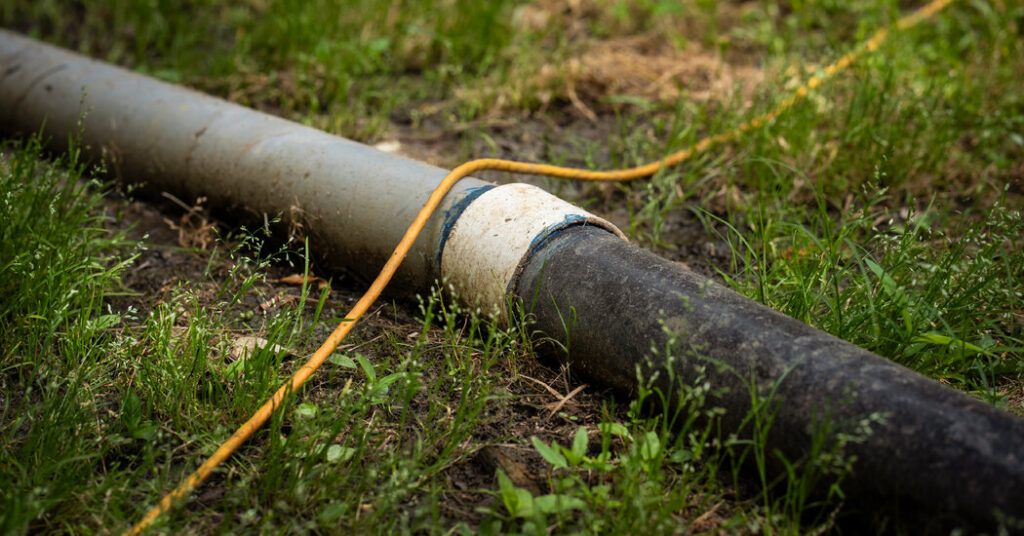
Behind Dana Anderson’s home in central Alabama, a plastic pipe carries waste from her toilet through her backyard, discarding it outdoors. Three or four times a year, a spell of heavy rain forces the excrement back up into the house.
It is a plight that has long plagued residents across Alabama’s Black Belt, a stretch of largely rural counties so named for its dark soil and history of slavery. Cotton flourished in the region for the same reasons that conventional septic tanks fail there: The soil is dense and holds onto water. Today there are more than 50,000 people in the region who pipe raw sewage into open trenches and pits.
Now, a seeming solution to the public health problem has been stymied by an unlikely force: the Trump administration’s war on diversity, equity and inclusion programs.
Three years ago, the Biden administration concluded in its first-ever environmental justice investigation that Alabama officials had failed to adequately address the sanitation crisis disproportionately affecting the Black residents of Lowndes County. The state agreed to an interim agreement that unlocked millions of dollars in federal funding to provide homeowners with septic tanks that could handle the difficult soil.
But soon after President Trump returned to office last year, the Justice Department ended the settlement, calling it “illegal DEI.”
The administration also scuttled a separate $14 million E.P.A. grant that had been earmarked to install new systems and provide work force training across Lowndes, Hale and Wilcox Counties.
Community activists fear the region may be doomed to enduring wastewater challenges forever.
“We thought we had a solution,” said Catherine Coleman Flowers, the founder of the Alabama-based Center for Rural Enterprise and Environmental Justice, who has helped put a spotlight on the crisis. “It is almost like we are starting all over again.”
The funds have been filtering through the Alabama Department of Public Health to local nonprofit groups, which have taken on the responsibility of installing the systems.
Now, though, the money that flowed from the settlement will expire in October. So the groups are turning to whatever other funds they have and telling some homeowners that they may have to keep waiting for relief.
In interviews, many Black Belt residents said they had never heard of D.E.I. One woman even wondered whether the term originated with the president.
Some questioned what role race had actually played in their wastewater challenges. “I don’t think it’s a race issue,” said Ms. Anderson, noting that the leadership of Wilcox County was predominantly Black. She was one of the homeowners who would have gotten a new septic tank and is now out of luck.
But others tied the sanitation struggles to the legacies of slavery and segregation, linking the persistent poverty in the Black Belt to systemic racism.
The agreement that Alabama had reached with the Biden administration stopped the state from leveling fines and other penalties against Lowndes County residents who violated sanitation laws. It also ensured that the state would be an active participant in the solution — requiring it to track the number of residents without reliable sanitation, disseminate information about the health risks from raw sewage exposure, and seek funding sources to comply with the agreement.
In a statement, the Alabama Department of Health denied that it had discriminated against Black residents and said that it would continue “to expend grant funds associated with the installation of wastewater systems until funds expire.”
Some leaders fear the Supreme Court’s recent blow to the Voting Rights Act may further diminish political support for the majority-Black region.
“We cannot return to a time when the basic needs of these communities were ignored,” said Representative Terri Sewell, who represents the region in Congress and had championed the 2023 federal agreement.
Across the Black Belt, circumstances vary. Some homeowners have straight pipes snaking behind their homes, where the untreated waste creeps over their property line onto their neighbor’s land. Others purchased conventional septic tanks decades ago, which have since failed and deteriorated into cesspools and lagoons.
The flies and odor can prevent homeowners from spending time in their backyards. One day in March, a property owner had a swarm of gnats perched on the walls of his bathtub that appeared to be waiting for waste to rise through the drain.
State researchers estimate that up to four million gallons of raw sewage enter the region’s water system per year.
The burden of installing septic systems falls on property owners if they live outside the limits of a municipal sewer system, as many in the Black Belt do. But many residents cannot afford the costly, engineered systems that are needed to withstand the impermeable clay soil. And local counties do not generate enough tax revenue to help.
In Lowndes County, for example, the poverty rate hovers around 30 percent, almost three times the national average.
Several nonprofit groups have taken on the work of installing septic tanks in the county. But two of them do not regularly share information, and one has implied that the other has committed fraud.
Still, the groups admit that the system would benefit from more collaboration. Some activists have faulted state officials for making local nonprofits play such a vital role.
“There needs to be an overseeing body,” said Carmelita Arnold, president of the Lowndes County Unincorporated Wastewater Program.
And the groups agree that without federal aid, the issue will persist.
“If the current administration doesn’t change their mind about funding, it won’t be solved,” said Sherry Bradley, the executive director of the Black Belt Unicorporated Wastewater Program. We have a solution, she added, “but it takes funding.”
Ms. Bradley worked at the state health department for four decades and oversaw the wastewater issue as the agency’s bureau of environmental services director.
She said she knew back then that there had been raw sewage on the ground, and had even issued violations in Lowndes County. But she said that she was not aware of the full extent of the crisis until 2017, when a United Nations report compared the conditions in the county to those in the developing world.
For many Black Belt residents, land has been passed down through generations.
Andrew Rives, 83, still raises horses and goats on the 40 acres that his grandfather purchased many years ago near Tyler, Ala., in Lowndes County.
He was proud of owning the land. After the Civil War, the government reneged on its promise to give emancipated people 40 acres and a mule, but Mr. Rives said his grandfather was determined to buy the 40 acres.
Waste flows from his mobile home through a 50-foot pipe into a trench near a creek. When it rains, he said, the waste ends up in the watershed.
Mr. Rives signed up for a new septic tank two years ago, but it is unclear if he will get one before the funding expires. The Lowndes County Unincorporated Wastewater Program has installed around 35 septic tanks since 2024. The group still has around 140 homeowners on its list and Ms. Arnold, the president, hopes to install 30 more systems by October. But slow permit approval could get in the way, as could bad weather.
The organization has also been hampered by a lack of cash reserves to be able to pay for the work upfront. Last May, it took out a $1 million loan from a local bank in order to make progress.
Murline Wilson, 67, has been promised a new septic tank at her home in Wilcox County. She’s eager for her grandchildren to be able to play in the backyard, but she feels terrible for the dozens of homeowners who won’t get one now.
Community outreach officials in the county have whittled a list of 100 homeowners hoping for septic tanks down to 20 by drawing 13 names from a hat, and then giving seven others priority because they signed up first.
“It is really sad. This is one of the poorest counties in Alabama, and we need them,” said Ms. Wilson, referring to the septic tanks. “I was just blessed to get funding.”
Bernard Mokam covers breaking news.
The post They Were Promised New Septic Tanks. Trump Called It ‘Illegal DEI.’ appeared first on New York Times.