Most woodworkers join or carve their wares from cut timber. Some glue and bend it. Few grow their own.
But since the early 2000s, that is exactly what Gavin Munro, an English artist and trained furniture designer, has been trying to do. One April morning, Munro and his wife, Alice, took a video call from two deck chairs in their “chair orchard,” just over an acre of green land in the Peak District. With a nurse’s care and attention, the pair, who are known professionally as the design collective Full Grown, have planted generations of common British hedgerow trees (willow, hazel, sycamore, ash, hawthorn, oak, apple) then experimented with shaping them into variations on a Shaker dining chair.
“It’s a bit of art, it’s a bit of design, it’s a bit of horticulture,” Gavin Munro said. “There is this kind of element of now accepting that it could be any of these things at any moment.”
The Aztec Chair, a piece by Full Grown 16 years in the making, is among the works included in the Sarah Myerscough Gallery presentation at TEFAF New York, running May 15 through May 19. For the fair, Sarah Myerscough, the London-based gallery’s founder and creative director, who has specialized in art, design and craft since 1998, has brought together 25 crafted pieces by 13 makers.
These artisans include Asako Sato, known as Arko, a Japanese artist who uses straw in a kind of experimental thatching, the English ceramist Luke Fuller, who makes stratified stoneware, and Adi Toch, a London-based smithy who delicately hammers metal and polishes it to a mirror sheen. What all share is uncommon patience, a collaborative bond with nature and a singular drive to push their chosen material far beyond any normal bounds — and then delight in what they discover.
As Myerscough put it in a recent interview about the artists toward whom she gravitates, “these materials have had a past, and they’re creating a new present for them.”
Last fall, Myerscough opened a renovated Victorian schoolhouse in Mayfair as an exhibition space. She said that she was also in the process of applying for charitable status for an educational foundation for crafted arts she is setting up. Speaking as she led a tour of the space in a pair of loose, black Issey Miyake trousers and pink Chloé woven platform sneakers, she displayed a sense of style as playful as her curatorial ethos.
“I always get so bored of when I see these interior design spaces which are all beige,” she said, describing how she oscillated “between a Louis XIV interior” and the rich, layered earthiness of the work she shows.
Cue gemstone paint choices for the walls (a burned red in the corridors; a strong blue in the downstairs bathroom) and big plans for a showroom in the basement. She wants a great big boardroom table, the best of the gallery’s inventory, and “lots of velvet,” she said. “Because that’s what my fair interiors look like,” she added. “Dark, theatrical, you know, cool spaces.”
Visitors to the gallery’s space at TEFAF New York will be greeted by Myerscough’s signature maximalism. Her rich paint choices and dramatic lighting set the stage for the objets d’art she hangs from the walls, the lighting fixtures suspended from the ceiling and the sculpted pieces perched on plinths. In different ways, they all speak to the abundance, the wonder and the entropy of the natural world.
Eleanor Lakelin, a wood-turner based in London, will be showing four vessels made from tree burrs, those outgrowths in a trunk where a wound has healed over. Turning them on a lathe to hollow them out, she then carefully picks off the bark with dental tools to reveal the patterning beneath.
“These are 300-400 year-old trees,” Myerscough said. “Their life story is told in that work, where they’ve been damaged, how they’ve protected themselves.”
The German wood-turner Ernst Gamperl also focuses on the possibilities of the tree, crafting haunting vessels from single branches or logs, each of which bears the age of the tree in its title.
“28/2024//180,” one of five pieces by Gamperl that will be on view at TEFAF, is the 28th piece he made in 2024, from an oak branch roughly 180 years old. It stands as tall as a man on its small plinth, yet boasts undulating walls reduced to millimeters in thickness.
It is the imperfections in the wood that Gamperl celebrates, Myerscough noted. The tiny butterfly keys (bow tie-shape wooden inlays) with which he stabilizes any cracks, to her mind, “have a sort of tension,” she said, comparing them to the slashes the artist Lucio Fontana made to his canvases.
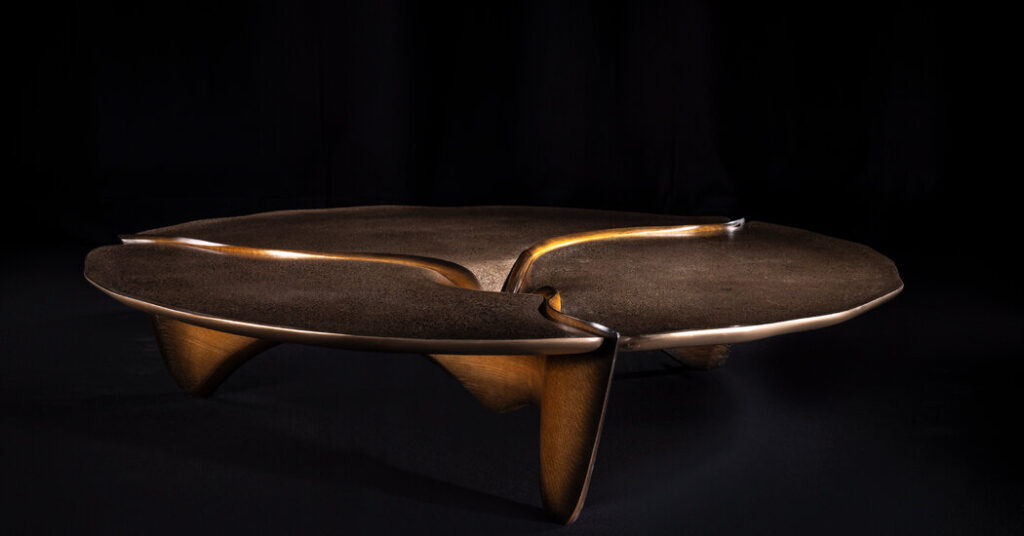
Marc Fish’s fine furniture practice is underpinned by a similarly intimate engagement with the inner workings of a tree. In a phone interview from his studio in Newhaven, East Sussex, on the southeast coast of England, Fish described how his shapes were dictated by “the flow of the wood.”
He purchases 0.6 millimeter (0.02 inch) veneers from suppliers in Germany or Italy, who boil logs of ancient European bog oak, then peel off the thin layers of wood with a knife. This avoids the wastage incurred when saws are used. He then laminates these thin panels in the sequence in which they were cut to create elegant curvilinear forms. Adhering to the way the timber grew in the first place means working not against it but with it: understanding how the wood wants to behave.
Fish’s studio is renowned for its daring multifaceted material innovation. The tables and light fittings he will show at TEFAF are from his “Mokume-Gane” series, finished with a unique bronze and black lacquer he has developed to look like the hammered steel on a Japanese samurai sword. But as modern or complex as his methods might be, in terms of material and form, he said, “it always comes back to nature.”
The materials researcher Ori Orisun, based in Brussels, pushes this idea even further. Her collaborators are the Kerria lacca bugs, found primarily in Thailand and India and long prized for lac, a natural polymer that they produce. Lac can be refined into shellac, which has of course been put to all manner of uses (from pressing 78 r.p.m. records to glazing Junior Mints) that have little to do with its entomological origin.
Orisun, by contrast, derives her very forms and methods from the tiny creatures’ ways. To safely lay their eggs, the female Kerria lacca bugs transform the sugars of the trees on which they live into the polymer, which they secrete around themselves in tiny globular shelters. These multiply around branches in what Orisun said she thought of as “a collective womb.”
During a video visit to the lab/studio she calls The Insect Club, Orisun sported honey-colored, bubble-shape hair clips and rings, made by shaping the lac the way that a glassblower shapes glass.
“With the blowing, I push the thickness of the material to less than a millimeter, so it’s very delicate and it can be fragile, but for me, fragile is also precious,” she said. By contrast, she builds up larger pieces through an accumulation of bubbles. “I call it cluster blowing,” she said, “because like in the insect cocoon, the insects work in a lot of small cells.”
At TEFAF, Myerscough will show a piece Orisun has just completed, “Morphocatalysis.” During the video visit, Orisun panned across a stainless steel work surface on which the piece, a tall urn of sorts, stood, surrounded by tools and tests. It measured about 65 centimeters (25 inches) in height and, she said, would stay that tall for now. Its texture appeared braided and pulled, reminiscent of honeycomb and spun sugar.
This is the second piece in her “Morpho” series. To make them, Orisun explained that her team had adapted a 3-D printer to print with lac instead of plastic. The studio has also developed a code language that allows the printer to imitate the growth patterns detected through scans of the cocoons.
It is a high-tech process. Yet Orisun holds onto the notion that, in a spiritual sense, her objects retain their insectile lifeblood. She calls them “companions.”
“I hope,” she said, “they hold memories of the encounter between insect and tree.”
The post These Artisans, Showing at TEFAF New York, Push the Limits of Materials appeared first on New York Times.