Florida has created a new American history course that advances a more conservative interpretation of the nation’s story.
It focuses on the Protestant faith of the founders, argues that the U.S. Constitution is an antislavery document and recommends a textbook written explicitly to build patriotism.
The class, which will roll out as a pilot program this fall, is meant to serve as an alternative to Advanced Placement U.S. History, a behemoth that reached more than half a million high school students last year.
Many historians and educators say A.P. United States History is well balanced and avoids any single ideological interpretation of the American story.
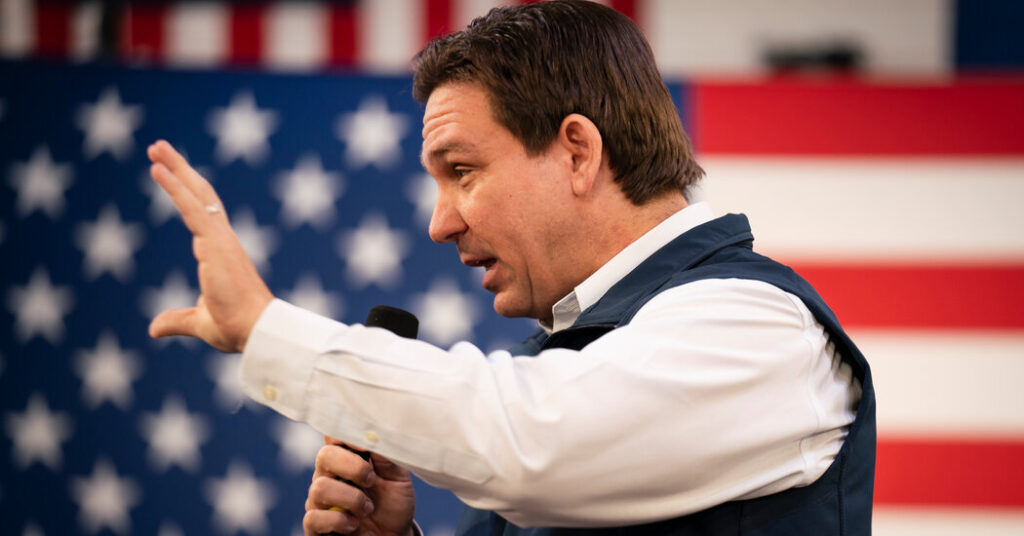
But Gov. Ron DeSantis has waged a three-year battle against the College Board, the organization that runs the A.P. program. His administration has argued A.P. courses lean too far to the left in how they discuss race and gender, in particular.
Frederick Hess, director of education policy at the center-right American Enterprise Institute, said he found the new Florida framework rigorous, especially its emphasis on primary sources. In the ongoing debate about whether American history classes should lean more toward presenting the country as a “good, special place” or as a “fundamentally imperfect place,” he added, the framework clearly comes down on one side.
“This is a very explicit attempt to frame it as the former,” he said.
Here are some of the ways the Florida course does that.
It advances American exceptionalism.
The Florida class, whose framework was released on Monday, shares many similarities with other American history survey courses. It does not omit dark periods in the nation’s history, such as slavery, Japanese internment or the Trail of Tears. It does suggest a specific textbook — “Land of Hope” by Wilfred McClay — that, according to Jonathan Zimmerman, a historian at the University of Pennsylvania, tends to cover such events as “aberrations from an otherwise admirable story,” as opposed to part of a foundational history of racism.
Professor McClay teaches at Hillsdale College, a conservative Christian institution in Michigan. He has suggested he wrote “Land of Hope,” in part, to counteract the influence of “A People’s History of the United States” by Howard Zinn, a popular book that focuses on America’s role in abuses of human and civil rights.
Professor McClay declined an interview for this article, but wrote in an email that he supported competition, and that “the College Board should not enjoy a monopoly on the certification of advanced placement in this country.” He added that his work does not downplay “racial inequality and prejudice and brutality in American history,” but sees these moments as departures from “our professed ideals.”
The McClay book is not required for the Florida class, but it is the only suggested textbook. In comparison, the A.P. program provides a list of 21 suggested U.S. history textbooks, which does not include Professor McClay’s book.
Both programs offer teachers significant autonomy in how to present individual lessons.
It focuses on Western civilization.
Florida’s course goes deep on the English constitutional roots of American democracy and contains a big dose of European history. It focuses especially on the ways in which the Protestant Reformation gave rise to certain democratic ideas.
“We must teach our young people to become informed, self-aware and dedicated citizens of the United States of America — of this particular nation,” the framework states. “That requires knowledge of the history of American civilization, as well as its deep roots in English and, more broadly, Western civilization.”
Manisha Sinha, a historian at the University of Connecticut, noted that, in emphasizing Europe, the course framework offered little on American Indigenous history before European contact. She argued that this was a dated approach to U.S. history, “especially in a place like Florida, with a long history of Native presence and major encounters and wars.”
It emphasizes the nation’s Protestant religious heritage.
Ideas about liberty and equality from the Bible, and in the writings of Martin Luther and John Calvin, were crucial precursors to the American founding, according to the new Florida framework. It suggests that students read religious texts, a practice that has fallen out of favor in most public schools.
Professor Zimmerman acknowledged that many of today’s students, including his own, were unfamiliar with basic religious thought, which could make it difficult to understand the nation’s origins.
“These people were reading the Bible,” he said of Puritan colonists, “and if you don’t understand what the Bible says, you can’t understand them.”
The framework stops short of explicitly calling the United States “a Christian nation,” which is a popular term on the right, Professor Zimmerman noted. The course does mention that the early United States was “a Protestant nation with many denominations,” in which rights were gradually extended to Catholics and Jews.
It argues the founders opposed slavery.
The Florida framework devotes an entire unit to a topic that has long fascinated Americans, but which is often skated over in history classes: the contradiction between the founders’ stated antislavery beliefs and the fact that many of them owned other human beings.
But Annette Gordon-Reed, a Harvard historian and leading scholar of Thomas Jefferson, said that, in portraying the founders as fundamentally opposed to slavery, the framework simplified their views. She noted that Jefferson believed that if enslaved people were freed, they should be expatriated, and that George Washington waited until his death to free the enslaved people he owned.
“Each of these people had political power that could have been deployed against slavery,” she wrote in an email. “This presentation seems directed at explaining away their inaction.”
The framework also argues that the Constitution is an antislavery document. Mainstream historians tend to see the Constitution as a compromise between slaveholding and free states, and one that protected the institution of slavery for many decades.
The clause prohibiting Congress from banning the importation of enslaved people until 1808 halted abolitionist momentum at the time, said Professor Sinha, and “was very disappointing to most abolitionists.”
It may be a map for other conservative states.
Florida created the class as part of a new suite of accelerated courses known as FACT — Florida Advanced Courses and Tests. Florida has often set the pace for Republican education policy during the Trump era, so the curriculum could serve as a model that other states follow.
It is also possible that states outside Florida could eventually choose to administer FACT courses and exams, establishing a sort of red-state competitor to the College Board.
The College Board declined to comment on how its course differs from the new Florida offering, but pointed out that the A.P. program remains popular in the state.
This year, over 500 Florida schools offered the A.P. American history course, according to College Board data. Students who do well on A.P. tests can earn college credit or access to more advanced classes at thousands of institutions nationwide, while the new FACT tests will carry credit only at Florida public colleges, at least for now.
It is unclear how many high schools in Florida will adopt the course. The Florida Department of Education did not respond to an interview request.
Dana Goldstein covers education and families for The Times.
The post Florida Creates a More Conservative U.S. History Course to Rival A.P. appeared first on New York Times.