For close to a year, a room on the fourth floor of an unremarkable six-story building in Manhattan’s Chinatown served as a hub of transnational repression, federal prosecutors say.
From there, they say, two men with close ties to Beijing helped covertly carry out the Chinese Communist Party’s campaign of harassing overseas dissidents.
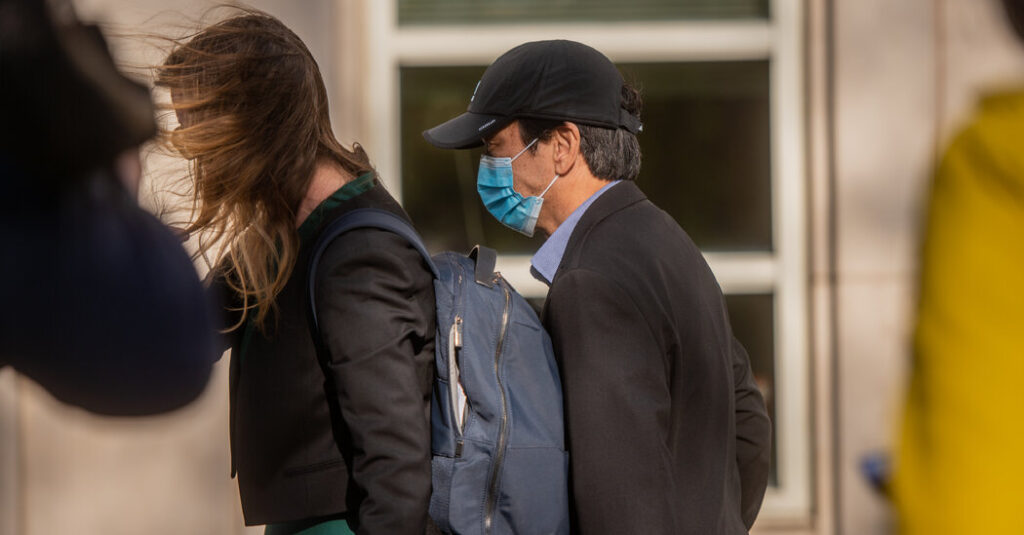
Now, one of the men, Lu Jianwang, an American citizen who lives in the Bronx, is standing trial in Brooklyn federal court. He faces accusations that he worked on behalf of China, including by using the room as an unauthorized police station at the behest of the country’s Ministry of Public Security.
Mr. Lu, 64, was charged in April 2023 with conspiracy to act as an agent of a foreign government and obstruction of justice. In March, prosecutors tacked on another charge of acting as an unauthorized agent of China.
He has pleaded not guilty to all charges. His lawyer, John Carman, said in a statement that his client “looks forward to the opportunity to clear his name.”
Mr. Lu’s co-defendant, Chen Jinping, admitted in December 2024 to working as an unauthorized agent of the Chinese government. Mr. Chen has not yet been sentenced.
Mr. Lu’s trial, which is expected to begin with opening statements on Wednesday, represents the Justice Department’s continuing crackdown on what it calls a covert initiative by Beijing to target Chinese dissidents in other countries.
Chinese officials have said the initiative, named Operation Fox Hunt, is meant to ensure that fugitives from the country face justice. U.S. officials say it is a tool of autocratic repression that must be thwarted by the American justice system.
Police stations like the one Mr. Lu is accused of running are widely seen as places from which China can monitor and control its diaspora, and governments in several countries have demanded they be shut down. Though foreign law enforcement agencies can operate in the United States, they must seek permission from American authorities. Prosecutors say Mr. Lu never declared himself as an agent of China.
Mr. Lu was the president of the American Changle Association, a Chinese community organization operating out of the Manhattan building that bills itself as a “social gathering place” for people from the province of Fuzhou, according to prosecutors and federal tax filings.
Such groups have become tools of the Chinese Consulate in New York, which has instructed leaders to harass or intimidate politicians who support Taiwanese independence or otherwise go against Beijing’s interests. And federal prosecutors say Mr. Lu similarly used his organization to advance China’s agenda.
When members of Falun Gong, a spiritual movement that is banned in China, protested during a 2015 visit to Washington by the Chinese leader Xi Jinping, Chinese officials asked Mr. Lu to recruit members of his organization to take part in a counterprotest, prosecutors say. He was later rewarded with a plaque from the Ministry of Public Security, China’s top law enforcement agency, according to court papers.
Mr. Lu’s lawyer has asked the trial judge to limit the introduction of evidence regarding his client’s involvement in the 2015 counterprotest, as well as a January 2022 visit to China, where he has a home. In a recent court filing, Mr. Carman called the accusation that his client had failed to register as a foreign agent a “paperwork offense.”
In 2018, prosecutors say, Mr. Lu began harassing two people of Chinese origin who were wanted by Beijing. One victim, prosecutors say, received numerous phone calls from Mr. Lu’s association demanding he return to China and saying that his family members there would be harmed if he did not.
Mr. Lu opened the police station with Mr. Chen at the Changle Association’s headquarters in February 2022, about a month after a branch of China’s Ministry of Public Security announced a global plan to create such outposts, prosecutors say.
People could go to the office, which featured a banner that said “Fuzhou Police Overseas Service Station,” to renew their Chinese driver’s licenses. But prosecutors say it was also used for more sinister purposes.
In one case, prosecutors say, Chinese officials directed the police station to locate a pro-democracy activist, referred to in court papers only as “Victim 3.” The victim, according to prosecutors, has been the target of repeated harassment by Chinese officials over the years, including a car break-in after the victim delivered a speech.
The pro-democracy activist served a political adviser to Yan Xiong, who took part in the 1989 Tiananmen Square protests and ran for the U.S. House of Representatives in 2022. Mr. Yan, too, was harassed by a Chinese officer, according to charges in a separate case brought by federal prosecutors.
In October 2022, the F.B.I. raided the Chinatown police station. Agents interviewed Mr. Lu, who denied having been directed by Chinese officials to locate dissidents.
Santul Nerkar is a Times reporter covering federal courts in Brooklyn.
The post Trial Begins for Man Accused of Running Secret Police Outpost for China appeared first on New York Times.