There seemed nothing to fear on a sunny, windswept day last month on the banks of the Danube River, not far from the Ukrainian border. Frequent alerts about possible Russian drone attacks had proved more annoying than alarming for residents.
Besides, “We are in NATO,” said Dumitru Cerneaga, a 74-year-old Romanian who was strolling by the river.
“All NATO countries must defend us,” he said confidently.
The very next day, during an exercise on Romania’s Black Sea coast, NATO air defense systems failed to thwart target drones in three out of nine tests. Then, hours later, metal fragments from a Russian drone downed over Ukraine crashed into a residential compound in Romania, not far from where Mr. Cerneaga had stood. Nobody was hurt.
The pervasive presence of drones since Russia invaded Ukraine in 2022 has changed the nature of warfare around the world. Now these cheap weapons are routinely intruding into NATO airspace, putting the military alliance and its border communities on edge — and testing Europe’s resolve to push back against Russia without sparking a wider conflict.
In response to the persistent incursions, NATO and the European Union are drafting plans for a coordinated “drone wall” along the continent’s eastern flank. But the relentless evolution of drone technology has left the alliance scrambling to modernize its air defenses and operating on constant alert.
“NATO has traditionally focused on conventional defense, but this is now happening in peacetime,” said Brig. Gen. Chris Gent, the British deputy chief of staff of NATO’s Allied Land Command.
Romanian defense ministry data show the pace of alerts about possible incursions in the country’s airspace is rising. The most recent alert was May 2, when Romanian F-16 fighter jets were scrambled overnight to ensure that 20 approaching Russian drones did not reach the region around Tulcea.
Although one drone briefly entered Romanian airspace, the Russian fleet appeared destined for a Ukrainian port city on the other side of the Danube River, where numerous explosions were heard.
“We are neighbors with the war,” the mayor of Tulcea, Stefan Ilie, said in an interview.
In Tulcea, a resort city with about 70,000 year-round residents, people have grown irritated with the push alerts they receive on their mobile phones, usually in the middle of the night, to warn of incoming aircraft or falling drone debris. Children often are unable to go back to sleep, and each alert prompts at least a few panicked residents to call the city’s emergency operations command, said a spokesman, Daniel Nastase.
He called the situation a wake-up call about the risk of being “a possible target, or a mistake target.”
Tourism in Tulcea decreased by 40 percent between 2023 and 2025, said Mr. Ilie, attributing the drop to the potential threat.
He has tried to reassure residents that NATO is there to protect them, telling them, he said: “We are NATO. You see, you hear the plane, the F-16, in two minutes, or one minute after the alarm? That is for us.”
In September, a NATO mission was created to defend alliance territory from Finland to Turkey after about 20 Russian drones flew into Polish airspace that month. Though the drones were shot down, the incursion was seen as a test of NATO’s defenses and political resolve to push back against Russia.
Since this NATO mission began, Russian aircraft have been intercepted at least 300 times, said Col. Martin O’Donnell, a NATO spokesman, including fighter jets that have been escorted out of NATO territory. That is in addition to individual NATO countries responding to incoming drones and planes under their own sovereign authority.
None of the 300 intercepts involved American warplanes, Colonel O’Donnell said, calling it “another example of Europe securing Europe.”
Many of the Russian drones that have pulsed NATO borders are small, evasive or fly in overwhelming numbers. Their technology is evolving so quickly that new air defense systems must be quickly tested before they become obsolete.
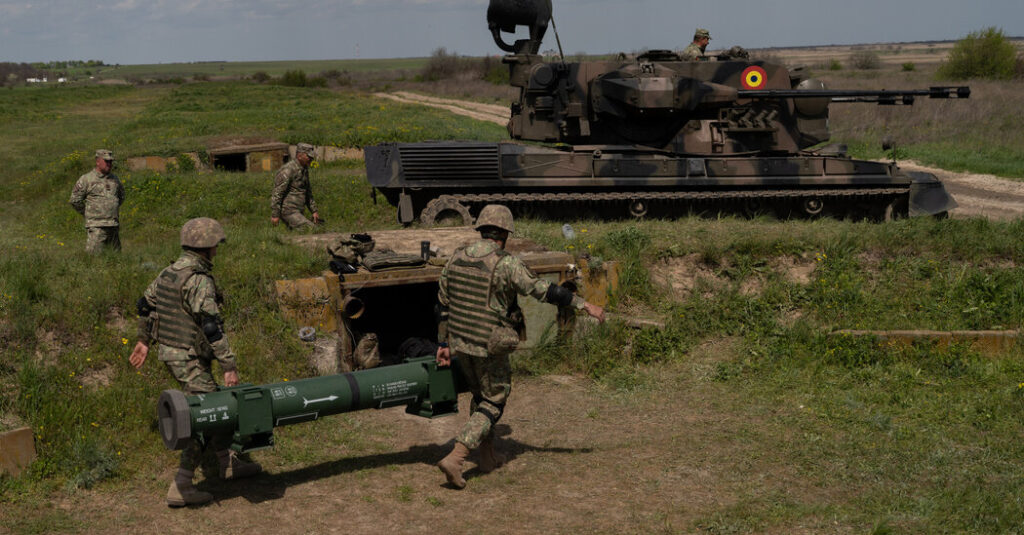
At the NATO test last month, which was at Capu Midia, a training range near Constanta, on Romania’s Black Sea coast, five of nine counter-drone systems hit their mark. A sixth, the low-cost American-made Merops interceptor drone, was deemed “neutral” because it identified its target but did not hit it.
“That’s the reason we are testing,” the Romanian defense minister, Radu Miruta, said afterward. “After these tests, we will have a better understanding of what could be improved.”
The U.S. Army began training Romanian and Polish soldiers last fall to use Merops, which has intercepted about 90 percent of Russian drones in Ukraine, U.S. defense officials said. Poland and Lithuania have bought an undisclosed number of systems, and Romania is about to formally field them in its army.
Attack helicopters, electronic jammers, artillery and shoulder-fired missiles were also tested in the exercise at Capu Midia, which Mr. Miruta said sought to “push the limits” of the weapons’ capabilities.
Still, he said, “You won’t be able to see a drone wall that will protect completely, all of the time.”
“When you are seeing drones coming over the Black Sea, in some situations, we cannot guarantee that they won’t cross the border,” he said in a brief follow-up interview later. “That’s why we take measures in advance.”
In some places close to the Ukrainian border, the Romanian government has built new air-raid bunkers to shield people from incoming strikes or falling debris from drones that have been intercepted.
Two constructed in 2023 in Plauru, a tiny village directly across the Danube from a Ukrainian port city, Izmail, appear to have barely been used.
“If I go there and the drone falls on top of it, what’s the difference?” said Maria Nedelcu, a sprightly 66-year-old wearing pink-tinted eyeglasses to match her pink knit hat.
Gesturing to one of the bunkers, sitting in a field of weeds just steps from her front door, she said the alerts usually came after midnight, “and it’s really cold. I just stay in my bed and I say, ‘whatever will happen, will happen.’”
None of the 10 public air-raid shelters in downtown Tulcea are deemed functional. Built during the Cold War in the basement of apartment buildings, the shelters lack ventilation, lights and toilets, and are all clouded by cobwebs, mold and trash left over from squatters long gone.
Mr. Ilie said the city was waiting for money from the national government to bring the shelters up to standard. Mr. Miruta, the defense minister, said that was not a matter under his budget authority.
Tanase Dascalu, 66, stores his fishing poles, tote bags, wine and jars of pickles and homemade jam in his building’s shelter. He has never used it for safety. “There was no need,” he said.
He had opened the locked shelter for Raluca Elena Doros, the city’s civil protection inspector, who has been pushing to upgrade the public bunkers. Later, Ms. Doros, 47, lamented the indifference that many residents have shown to the threat just across the Danube.
“Not everyone gets scared,” she said. “We’ve gotten used to it. This is what’s worse.”
Lara Jakes, a Times reporter based in Rome, reports on conflict and diplomacy, with a focus on weapons and the wars in Ukraine and the Middle East. She has been a journalist for more than 30 years.
The post In Romania, Living With Weapons of War Spilling Into NATO Territory appeared first on New York Times.