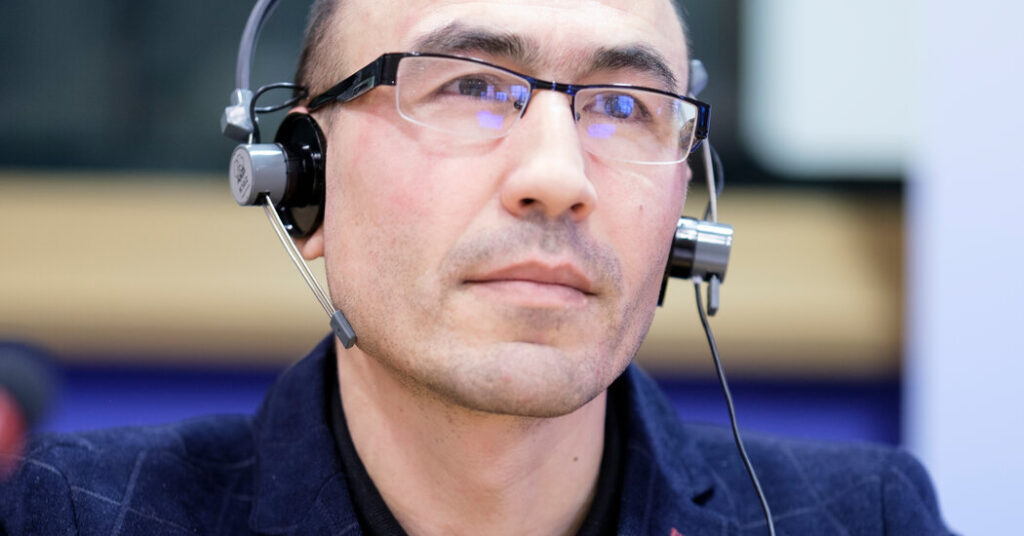
Ruslan Gabbasov knew his activism had made him a target of Russia’s security services, so when he found an Apple AirTag tracker hidden under the hood of his car last spring, he understood it meant trouble.
Just not how much trouble.
The discovery of the tracking device triggered a sprawling, yearlong investigation by the authorities in Lithuania, where Mr. Gabbasov, an advocate for minority rights, had sought asylum after fleeing Russia in 2021. That investigation culminated this week when Lithuanian officials announced the arrests of nine people accused of plotting murders and sabotage across Europe at the behest of Russia’s military intelligence service, known as the G.R.U.
The group set fire to military equipment in Bulgaria that was destined for Ukraine and carried out surveillance of Greek military installations, according to a statement released by the Lithuanian police. Among those arrested was a man in his 50s captured outside Mr. Gabbasov’s home in Lithuania, where he lives with his wife and 5-year-old son. The man, who the authorities said had Greek and Russian citizenship, was armed with a pistol, the police said.
Mr. Gabbasov said he was at a McDonald’s, drinking coffee, when the police called, frantic, to tell him, “You simply have no idea the danger you’re in.”
“I understood that I was a person of interest for the Russian secret services,” Mr. Gabbasov said in a phone interview. “But I didn’t think it would go so far as murder.”
The case is a reminder of the threat Russia poses to the West at a time when Washington has shifted focus from Europe’s eastern flank and the war in Ukraine to the Middle East. Western intelligence officials assess that dismantling institutions like NATO and the European Union, and undermining Western diplomatic ties, remains a key foreign policy goal of Russia’s president, Vladimir V. Putin.
In parallel to Moscow’s military action in Ukraine, Russia’s intelligence services have waged a campaign of sabotage in Europe that has escalated over the years from vandalism to bombings, arson and murder plots, according to intelligence agencies in multiple countries. Countries that are Ukraine’s biggest supporters, and anti-Putin Russians living in exile, have been the primary targets. Railroad tracks in Poland used to transport military hardware have been bombed and warehouses storing goods destined for Ukraine have been burned down in Britain and Spain.
The most dramatic of these plots to date involved placing incendiary devices inside packages meant to be loaded onto DHL cargo planes. Two of the devices ignited at shipping facilities in Britain and Germany and another went off inside a truck in Poland.
Lithuania, where the DHL packages originated, has led that investigation, as well, which so far has resulted in more than a dozen arrests, mostly of proxies recruited online by the Russian intelligence services with promises of cash, the authorities say.
The use of proxies is a typical strategy employed by Russia’s intelligence services, Western officials say. On Wednesday, German authorities announced the arrest of a Kazakh national accused of providing Russia’s intelligence services with information about Germany’s military support for Ukraine.
Russia has repeatedly denied that its intelligence services are involved in sabotage and homicide.
In the case involving Mr. Gabbasov, the Lithuanian authorities said, the network they broke up involved citizens of Greece, Ukraine, Russia, Georgia, Latvia, Moldova and Lithuania. The investigation, according to the Lithuanian police statement, “established direct connections between the perpetrators and the people who ordered the murders, acting in the interests of the Main Intelligence Directorate of the General Staff of the Armed Forces of the Russian Federation,” as the G.R.U. is called officially.
“We have been facing a series of hybrid-type criminal acts that are in fact directed against European Union countries, their national security interests, and individuals who in one way or another support Ukraine,” Saulius Briginas, Deputy Head of the Lithuanian Criminal Police Bureau, said at a news conference on Monday. “The nature and objectives of these criminal acts align with those of the Russian Federation.”
Lithuanian authorities released few details about the plots. They said several people who had supported Ukraine or worked against Russia had been targeted for murder. They did not offer a number, and most have not been identified.
In addition to Mr. Gabbasov, a Lithuanian citizen named Valdas Bartkevičius said that he was also targeted for murder, which the authorities confirmed. Mr. Bartkevičius has gained notoriety for anti-Russian stunts including defacing Soviet World War II monuments and bringing a bucket of feces to a memorial to victims of a terrorist attack in Moscow.
“It’s logical they’re trying to kill me,” Mr. Bartkevičius said in a phone interview from Ukraine, where he has been assisting the Ukrainian military.
After alerting the authorities about the AirTag, Mr. Gabbasov, 46, said he was used as bait in a “cat-and-mouse game” with his would-be killers. Lithuanian police set up surveillance cameras at his home and near his car. He was told to inform the police whenever he planned to leave home and when he planned to return.
But in March last year, Mr. Gabbasov forgot to tell them when he left home with his family to attend festivities marking the anniversary of Lithuania’s independence from the Soviet Union. While he was at the McDonald’s, the armed man took up position outside of his home. He said the police told him that the man, who was arrested, was dressed and equipped to wait “all night,” if necessary, for Mr. Gabbasov to return, though they provided few other details.
The arrest was first announced this week, along with those of others in the investigation that followed.
Mr. Gabbasov said the police offered to put him into a witness protection program, but he declined because he did not want to step away from his activism. He has agitated for independence for his native Bashkortostan, a mostly Muslim region of central Russia. In response, Russian authorities have put a bounty on his head and added him to Russia’s version of a terrorist watch list. In March, he was sentenced in absentia to 14 years in prison.
Despite the arrests by Lithuania, Mr. Gabbasov does not expect the threat to subside.
“The end of the story will come when the Putin regime collapses,” he said.
Michael Schwirtz is the global intelligence correspondent for The Times based in London.
The post Lithuania Says It Broke Up Russian Sabotage and Murder Plots appeared first on New York Times.