When President Trump announced, last Friday, that Jared Kushner and Steven Witkoff, his special envoys for peace missions, would be returning to Pakistan over the weekend to resume peace talks with Iran, the news was taken as a sign that the war might in fact be nearing an end. Stocks closed at record highs and relief from rising gas prices seemed in reach. That the two businessmen were merely boarding a plane seemed to calm the addled market.
Less than 24 hours later, Trump told the media that Kushner and Witkoff’s trip was off. “Nope, you’re not making an 18-hour flight to go there,” he said he told the two men as they were preparing to leave. He referred to Kushner and Witkoff — his son-in-law and his longtime business associate — as “my people,” a nod to the strange role they have taken on as civilian proxies for the president. There is a long history of moguls and financiers meddling in matters of state, but Trump has taken the intermingling of private interests and public affairs to a new extreme.
Over the past year, Kushner and Witkoff have crisscrossed the globe as White House emissaries: They have met with Hamas and with Vladimir Putin, with Volodymyr Zelensky and with Iranian negotiators. Their near-universal presence at high-stakes negotiations suggests that Kushner and Witkoff, New York real estate developers who are now executive members of Trump’s Board of Peace, have been almost single-handedly tasked with realizing Trump’s desire to be remembered as the “president of peace.”
But these are businessmen first and diplomats second. Their approach to peacemaking is abundantly evident in the settlements they have brokered thus far. The October cease-fire between Israel and Hamas opened the door to Kushner’s aspiration to build a shiny special economic zone where there are now 60 million tons of rubble — with human remains and unexploded ordnance trapped inside. In this vision, the economic zone will house data centers, skyscrapers and advanced manufacturing and run on cryptocurrency. Their draft proposal for a negotiated settlement between Russia and Ukraine included a provision that the United States would receive “50 percent of profits” from the “venture” of rebuilding Ukraine’s destroyed infrastructure. Their view seems to be that peace is an asset to be leveraged and maximized.
On the sidelines of the inaugural meeting of the Board of Peace in February, Witkoff announced an agreement between the United States and Pakistan to redevelop the Roosevelt Hotel in New York, just weeks after the Pakistani government signed a deal with a company affiliated with World Liberty Financial, the crypto firm run by Witkoff’s and Trump’s sons. In the months since, Pakistan has become one of the primary mediators between the United States and Iran.
The apparent entanglement of Kushner’s and Witkoff’s business interests and their public roles — and the many unanswered questions about their personal legal and financial status, as well as that of the Board of Peace itself — is both a cause and a symptom of the near-complete “fusion of peace and corporate governance,” as the scholar Teresa Almeida Cravo describes it, that has come to define Trump’s second term.
While both men are presidential appointees who do not draw a salary from the federal government, they are supported by an entirely new White House office that uses public funds. Witkoff has submitted a financial disclosure report that lists his extensive holdings around the world, but Kushner has not. (He told “60 Minutes” in January that “what people call conflicts of interests, Steve and I call experience and trusted relationships.”) Instead, Kushner has continued to raise funds for his investment firm, Affinity Partners, seeking $5 billion from Middle Eastern governments even as he participates in peace talks in the region. Saudi Arabia, one of his largest investment partners, urged the Trump administration to continue fighting Iran until the regime is destroyed.
The creeping privatization of both war and peace has been underway for some time. But Trump has pushed this trend to its logical conclusion: His administration has turned the delicate practice of peacemaking, previously handled largely by experienced diplomats, mediators and specialists, into a business for a select few stakeholders who are bound together by a thicket of financial affiliations and conflicts of interest.
Private Peace Entrepreneurs
In his inaugural address to the Board of Peace, Trump said that among the organization’s many functions would be “looking over the United Nations and making sure it runs properly.” His message was that the board intended to strengthen the U.N. rather than supplant it. “Someday, I won’t be here,” he said. “The United Nations will be.”
The visual and legal language of the Board of Peace tells a different story. Its logo looks as if the U.N. logo had been dipped in gold vermeil, with the globe rotated to center the United States. The U.N. Charter explicitly states that the organization exists to “reaffirm faith in fundamental human rights, in the dignity and worth of the human person.” The founding charter of the Board of Peace promises to “restore dependable and lawful governance, and secure enduring peace,” and neglects to mention the principle of sovereignty or human rights.
Diplomats and scholars alike widely believe the United Nations is in need of reform. The Security Council has long been deadlocked, and the organization’s many commissions, agencies and funds have often fallen short of their lofty goals. The appointment of Iran as chair of the 2023 U.N. Human Rights Council Social Forum was, for many observers, a grave indicator of how far the organization had strayed from its founding charter.
In one sense, the creation of the Board of Peace might be viewed as an attempt to bring long-awaited reforms to the U.N. and to the web of international treaties and arrangements it supports, to jolt a sclerotic system back to life.
After all, contemporary international law owes much to another enterprising businessman who sought to reshape the world order. At the start of the 20th century, Andrew Carnegie, motivated by the belief that humankind had advanced beyond using physical violence to settle disputes, devoted much of his time and wealth to creating a “league of peace” that sought to alleviate rising tensions in Europe and, ideally, eliminate the possibility of war. Carnegie financed the construction of the Peace Palace in The Hague, now the seat of the International Court of Justice and the Permanent Court of Arbitration. He represented the United States in diplomatic negotiations and lobbied foreign governments as a private citizen. His wife believed that he never recovered from the heartbreak of watching World War I unfold. He died in 1919, just after peace had been restored.
Carnegie stands out as the most prominent in a long line of businessmen who took it upon themselves to work to broker international agreements. These “private peace entrepreneurs,” as the scholar Lior Lehrs calls them, conducted “unofficial peace diplomacy” on behalf of their nations. The German shipping magnate Albert Ballin and the financier Ernest Cassel tried to broker peace between the U.K. and Germany before World War I; the Irish businessman Brendan Duddy was a critical back channel between Britain and the I.R.A. during the Troubles; Gavin Relly, the head of the mining company Anglo American, led a group of businessmen to meet with the African National Congress before the end of apartheid in South Africa.
Each had personal and financial interests in bringing these conflicts to an end, but these precedents now seem almost quaint. Carnegie’s vision of peace — premised upon the rule of law, the peaceful settlement of disputes and the preservation of national self-determination — doesn’t bear much resemblance to what’s on offer from the Trump administration. Rather than give away their wealth to build the international legal system, emissaries of the Board of Peace have been enriched by their relation to the White House. Their proposals for the extraction of wealth from war-torn regions have not received the consent of the governed in any real sense, and far from buttressing the institutions of international law, the administration has repeatedly tried to dismantle them.
The Normal Rules Do Not Apply
For the time being, the board’s logo stands for little more than the idea that the politics of peace can be married to capital interests and the belief that this alignment stands to benefit everyone involved. Kushner and Witkoff’s fellow executive board members include Martin Edelman, a corporate lawyer with extensive ties to the upper echelons of the United Arab Emirates, and Marc Rowan, the chief executive of Apollo Global Management. In May 2025, Apollo invested $100 million in the Witkoff Group; Edelman is the general counsel of G42, an A.I. company controlled by the U.A.E.’s national security adviser, Sheikh Tahnoon bin Zayed Al Nahyan. A New York Times investigation found that Tahnoon was involved in a deal that netted $2 billion in 2025 for World Liberty Financial, the crypto company owned by Trump’s and Witkoff’s sons.
In his January executive order establishing it as a public international organization, Trump wrote that the Board of Peace is covered by the International Organizations Immunities Act, which prohibits employees or agents of an international organization (and their immediate family members) from being sued for “official work.” But that same law defines an international organization as an entity that results either from a treaty or from an act of Congress — neither of which is true of the board.
“They didn’t send the Board of Peace charter to the Senate for advice and consent to a treaty, and there are no statutes that authorize U.S. participation,” said Michael Mattler, a former assistant legal adviser for treaty affairs at the State Department. Trump authorized U.S. participation in the board unilaterally and established himself — in his private capacity — as chairman, with no limits on his term. “This is an organization composed of states, but that by its own rules gives a private individual a controlling role,” Mattler said. That makes it a “uniquely structured organization,” he said, compared with other international groups.
Lawmakers are noticing the murky legal status. Several Democratic congressional investigations are looking into both Witkoff’s and Kushner’s financial records and international relationships. In mid-April, four Democratic senators announced a probe of the Board of Peace’s proposal to create a stablecoin for Gaza, pointing out that a number of its executives, including Witkoff and Trump himself, could stand to profit.
In a letter addressed to Kushner announcing a House Judiciary Committee probe of his dual role as an investor and a “volunteer” government representative, Representative Jamie Raskin wrote, “You cannot faithfully represent the United States with billions of dollars in Saudi and Emirati cash burning a hole in every pocket of every suit you own.” By continuing to do so, Kushner was effectively insisting “that the normal rules do not apply to you,” Raskin argued.
Under the Trump administration’s privatization of peace, the “normal rules” no longer exist at all. Yet exceptional wars require exceptional solutions. If the Board of Peace does bring stability and governance to embattled regions, it’s of course possible that in some quarters, all its flaws will be forgiven. An imperfect peace, or a fragile cease-fire, is better than nothing, even if survivors find themselves returning to territories that have been stripped of their autonomy and natural resources — if they are able to return at all.
But even this grim vision of peace still seems a long way off given the recent record of the Trump administration’s diplomacy. Some 800 people have been killed in Gaza since the October cease-fire; a settlement between Russia and Ukraine has only become less likely since the United States relaxed sanctions on Russian oil because of its war on Iran; ongoing negotiations with Hamas have repeatedly broken down; Kushner and Witkoff’s previous meetings with mediators on Iran have failed, by some accounts because they did not fully grasp the intricacies of nuclear issues, and the deal on the table would fall short of the administration’s stated goal of preventing Iran from ever producing a nuclear weapon.
Rising energy prices have begun to strain American households, but Trump and his “people” aren’t feeling the squeeze. Witkoff has said he is in the process of divesting from his real estate and crypto holdings; in 2024, Kushner said he would “try to pre-emptively avoid any conflicts of interests.” But both men have seen their wealth grow significantly since Trump returned to office. And the peace they have long promised remains out of reach.
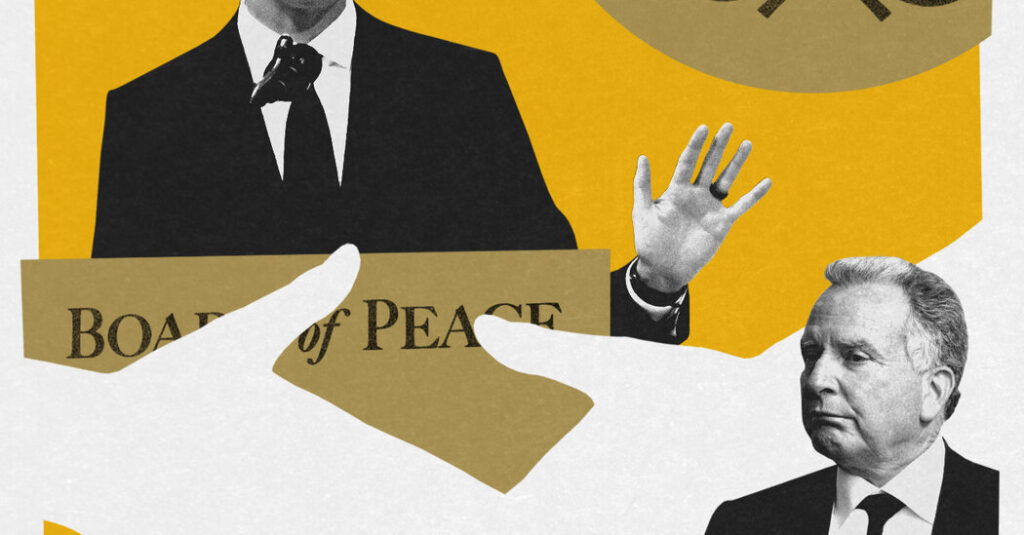
Source images for illustration above: Krisztian Bocsi/Bloomberg, via Getty Images; Andrew Harnik/Getty Images; Mohammed Eslayeh/Anadolu, via Getty Images; NiseriN/Getty Images; Probst/ullstein bild, via Getty Images; Mandel Ngan/Agence France-Presse — Getty Images; mapo/Getty Images.
The post Jared Kushner, Steve Witkoff and the Profitable Business of Peace appeared first on New York Times.